What can we help you with?
Technical flooring, delivered directly
- ESD flooring, urethane cement, terrazzo, and polished concrete
- In-house W-2 installation crews and experienced field leadership
- National service coverage with project-specific staffing plans
- Testing, documentation, and defined project closeout
- Dedicated support for corporate procurement and multi-site contracting
Phone: +1 (844) 687-1961
Safety & Prequalification
Craftsman Concrete Floors has had zero OSHA-recordable work-related injuries or illnesses since current ownership began in 2018. During that period, no incident has met OSHA’s direct-reporting threshold and no workplace injury has required medical treatment beyond first aid. That record spans years of grinding and preparing concrete, operating powered machinery, handling industrial coatings and chemicals, and coordinating inside active construction sites and operating commercial facilities.
The record belongs to the crews who do the work. Craftsman self-performs flooring installation with direct W-2 employees who are cross-trained across the company’s installation classes and kept on payroll through slower seasons, so the equipment knowledge and hazard judgment that prevent injuries stay with the company from one project to the next.
Safety Performance, Stated Precisely
What the Record Covers
The record covers 2018 through the present, the full period of current ownership, and excludes operations before the acquisition. Zero OSHA-recordable means the company’s OSHA 300 logs are empty for that period: no case involving days away from work, restricted work or job transfer, medical treatment beyond first aid, loss of consciousness, or a significant diagnosed injury or illness under OSHA’s recording criteria. Two supporting figures follow from it. No incident has met OSHA’s narrower direct-reporting threshold for fatalities and specified severe injuries, and no workplace injury has required medical treatment beyond first aid.
The record describes what has happened. It is not presented as a promise that an incident can never occur.
The EMR Has Stayed Below the Industry Benchmark
Craftsman’s workers’-compensation experience modification rate (EMR) has remained below 1.0, the industry-average benchmark, under current ownership. The EMR is calculated by the rating bureau from the company’s actual loss experience, which makes it an independent, insurer-side confirmation of below-average losses, separate from the OSHA injury logs. The exact figure is year- and state-specific, and the current experience-rating documentation is supplied through the controlled prequalification request.
Reporting Keeps the Record Honest
Craftsman’s written process requires employees to report every accident, incident, near miss, and unsafe condition, including matters that end at the first-aid kit. Reports route to field and safety leadership, and the written incident process calls for immediate corrective action and a root-cause assessment intended to prevent recurrence.
Current Documents Through Controlled Review
Current safety and prequalification records are supplied through a controlled request, so a reviewer receives current values instead of copies that have aged online. Depending on the project and the requesting platform, the package may include current insurance documentation, the current experience-rating record, written safety-program materials, job-hazard and inspection forms, and training evidence. Values and effective dates are checked against the current source document before release.
The project supervisor also keeps compliance documents onsite, including the current safety manual, the SDS binder, toolbox-talk records, and safety reports, available for general-contractor inspection.
The Workforce Behind the Record
Training compounds when the people trained stay.
Direct W-2 Crews Perform the Installation
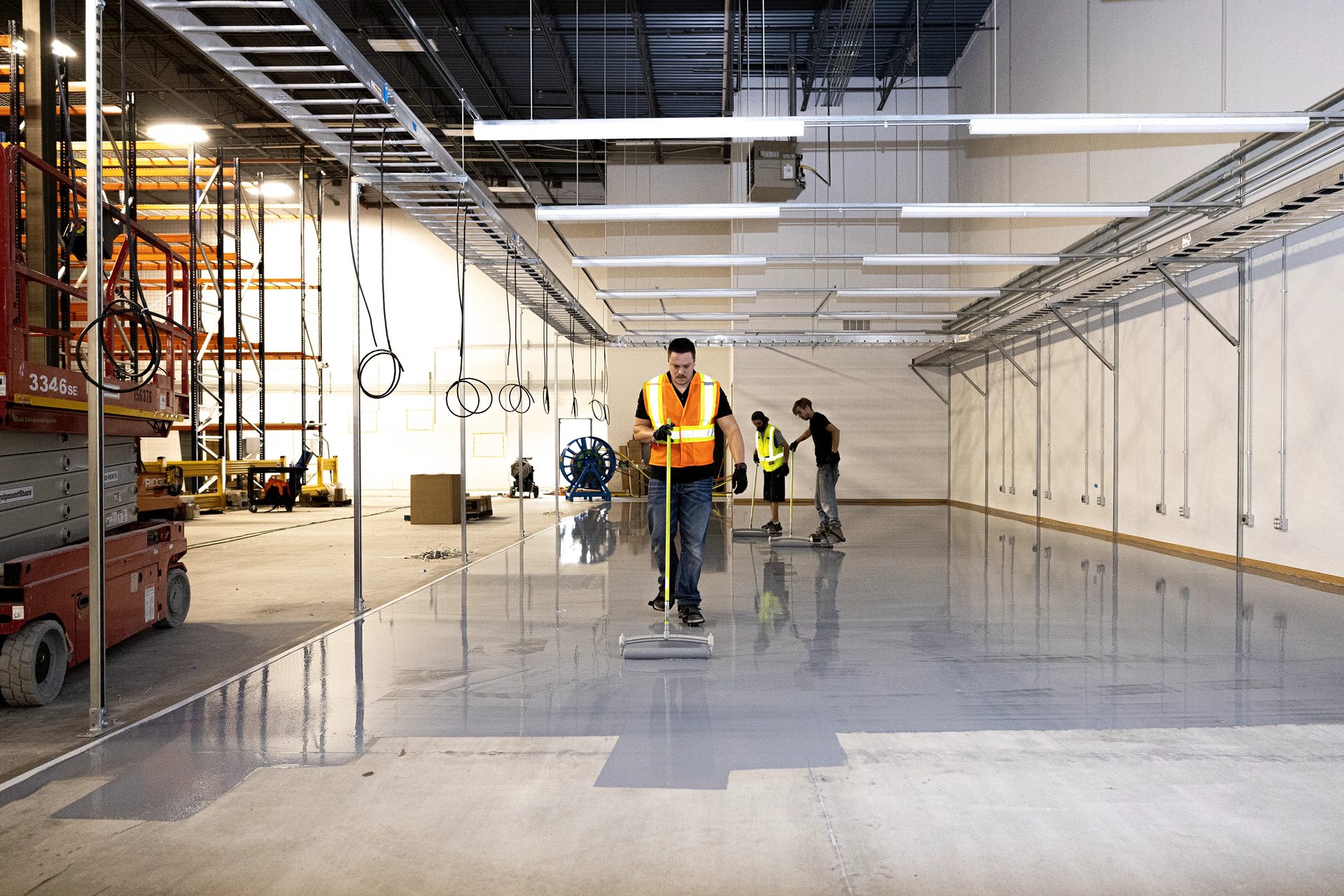
Craftsman’s regular practice is to self-perform flooring installation with direct W-2 crews rather than subcontracted labor or 1099 day labor. The people operating the grinders, mixing the materials, and carrying out the safety plan are employees of the company that contracted the work, trained under its program and accountable through its reporting structure.
In the rare circumstance that a scope calls for a subcontractor, it happens with the client’s understanding. Subcontractors are selected for their domain expertise and are governed by the same safety rules that apply to Craftsman’s own crews, including the jobsite planning, hazard-communication, and reporting requirements.
Skilled Installers Stay Through Slower Seasons
A deliberately oversized core of skilled W-2 installers stays on payroll through seasonal slow periods instead of being released and rebuilt for each busy stretch. Keeping trained people underutilized costs money, and Craftsman treats that cost as an operating investment. The return is a workforce that arrives at the next project already knowing the equipment, the products, and the company’s procedures, with experienced field supervision available for routine work and rapid program ramps alike.
Every Installer Is Cross-Trained Across Installation Classes
Installation employees are cross-trained across the company’s installation classes, including polished concrete, urethane cement, ESD, and resinous flooring. Working across systems builds familiarity with different machines, materials, hazards, sequencing requirements, and operating environments, which sharpens hazard recognition on any single project. Cross-training broadens judgment; it does not by itself qualify an installer on a machine. Assignment to specific equipment or operations still requires equipment-specific instruction and a demonstrated qualification.
The Same Crews and Standards Across Multi-Site Programs
A multi-location customer works with one accountable installation organization. Craftsman contracts and self-performs nationwide with direct W-2 crews, and the core workforce, training system, and installation leadership carry across phased and multi-site programs. Repeat and national accounts can operate under a Master Service Agreement, which keeps the labor model, training expectations, documentation path, and escalation structure consistent from site to site.
Repeat execution also builds familiarity with the customer’s facility rules, access constraints, shutdown procedures, recurring hazards, and sequencing priorities, although each location still receives its own site assessment. When a program requires compressed shutdown windows or concurrent mobilizations, Craftsman can approximately double field capacity by adding mid-skilled W-2 installers beneath experienced W-2 leads, so added hands work inside the existing supervision structure.
Training Is Assigned to the Work
General construction experience is never accepted as proof of qualification; training attaches to the specific machine, product, and task.
Equipment Qualification Requires Demonstrated Ability
An installer assigned to a machine or powered equipment receives instruction on that equipment, completes an understanding check, and must demonstrate the operation before the qualification is certified in writing. The qualification is specific to the equipment and the assignment.
Retraining is required whenever understanding or skill comes into question, and additional instruction follows incidents, near misses, inspection findings, new equipment or materials, and changed site conditions. Training continues through execution instead of ending at orientation.
Product Familiarity Makes Exceptions Visible
Craftsman’s standard installations repeatedly use the same approved products, so crews handle materials they know rather than encountering a new chemical system on each project. That repetition gives installers working knowledge of each product’s packaging, labeling, mixing and application sequence, required protection, cleanup, storage, and disposal. Review before use covers the product label, the technical data sheet, and the SDS, and the company maintains a product-by-product PPE reference for its approved set.
Familiarity also makes the abnormal stand out. A substituted product, a damaged or inconsistent package, an unfamiliar label, or a customer-specified material outside the standard set is recognized and reviewed before the crew proceeds. Employees who handle hazardous materials must demonstrate that they can find and use SDS information, and printed SDS binders travel in every foreman’s truck alongside electronic access.
PPE Is Provided, Fitted, and Matched to the Task
Every installer receives a company-purchased PPE kit, including a half-mask respirator that is individually fitted and seal-checked before use under the company’s respiratory-protection procedures. Foremen stock disposable N95 masks, nitrile gloves, and earplugs in their trucks, a quarterly survey checks the condition of issued equipment, and an annual review reassesses what the kit should contain.
Beyond the baseline kit, protection is selected for the task. Grinding dust, wet work around powered equipment, chemical application, material handling, and noise call for different protection, and the crew confirms the selection using its knowledge of the system and exposure together with the material SDS, site rules, and the job-hazard assessment. PPE training covers donning and doffing, fit, care, cleaning, useful life, and replacement.
Installers Sign the Program and Renew It in the Field
Every employee reads the field-safety portion of the company manual, initials each page, and signs a safety agreement; drivers additionally sign the driving policy as a condition of employment. Documented toolbox talks keep that commitment current, giving field leadership a direct channel to review hazards, materials, SDS information, and lessons with the crews performing the work, with attendance and acknowledgments recorded.
The rules carry consequences. Safety violations draw escalating discipline, from verbal reprimand through written reprimand, suspension, and termination.
Jobsite Planning, Controls, and Inspection
One Written Program Governs Field Work, Equipment, Chemicals, and Driving
Craftsman maintains a written safety and health program covering employee, jobsite, equipment, hazardous-material, and driving practices, and applies each program to the OSHA standard that governs the setting, whether general industry under 29 CFR 1910 or construction under 29 CFR 1926. The written programs draw on the controlling OSHA standards, including 29 CFR 1910 Subpart I for PPE, Subparts O and P for machines and powered tools, and 1910.1200 for hazard communication. Responsibility is assigned by role across executive management, project supervision, foremen, and employees, so planning, field monitoring, reporting, and correction each have a designated owner. The program is led by Paul Studebaker, Craftsman’s Director of Safety & Operations and designated corporate safety officer, whose 30-plus years of continuous on-site field experience keep the written procedures matched to actual jobsite conditions, installation methods, equipment requirements, and the practical demands placed on flooring crews.
The Site Is Assessed Before Work Begins
Craftsman assesses site conditions before work begins so access, staging, equipment and material routes, power and water, concurrent operations, emergency resources, waste paths, and scope-specific hazards are identified while they can still change the plan. The jobsite hazard assessment covers fall, impact, penetration, compression, chemical, harmful-dust, temperature, optical-radiation, and electrical hazards, along with hazards created by other contractors in the area, and it is documented as a written certification naming the workplace, the assessor, and the date.
The findings become instructions. A project safety communication plan translates the assessment into direction the foreman and crew use, covering the scope, equipment, materials, PPE, routes, electrical access and GFCIs, water near powered equipment, waste paths, emergency resources, and customer or general-contractor requirements, which are incorporated alongside the hazards of Craftsman’s own scope. Foremen and installers then keep the plan current, raising sequence conflicts and changed conditions that are visible only from inside the work.
Engineering Controls Come Before PPE
Hazards are abated first through machine guards and engineering controls, with PPE protecting against what cannot reasonably be eliminated. Guards must prevent contact with moving parts, stay secured, and remain in place during operation, and equipment with a defective guard comes out of service. Electrical controls cover connections, GFCIs, extension-cable condition and ratings, and removal of damaged cords and defective equipment.
Craftsman’s job-hazard process specifically evaluates harmful dust from cutting and grinding concrete, with controls selected for the task and site. Housekeeping requirements keep access paths clear, remove waste regularly, use covered containers for specified wastes, and coordinate cords, water, and equipment around other trades.
Emergency Planning Includes a Headcount
Project planning identifies the nearest medical facility, onsite fire extinguishers, evacuation requirements, and the designated muster location before production begins. If an alarm sounds, the crew evacuates, and the foreman completes a headcount and reports the all-clear to the general contractor’s site supervisor. Site-specific alarms and general-contractor procedures govern whenever they are more restrictive.
Inspection Tests Whether the Plan Reached the Crew
A jobsite inspection checklist covers emergency resources, housekeeping, fire prevention, tools, operator training, electrical safety, GFCIs, and PPE, and each finding can be assigned a corrective action and a correction date, so a field issue becomes a documented correction with an owner and a deadline.
Field leadership backs the paperwork in person. Craftsman’s Manager of Installation, who has 30 years of onsite-management experience, maintains a regular presence on active projects, seeing the conditions crews are working in and resolving changing conditions with the people performing the work.
Safety Travels with the Crew
Loading, Transport, and Unloading Follow Written Procedure
Moving heavy grinding equipment is treated as part of the work, with its own written procedure. Trailers are loaded for weight distribution, with roughly 60 percent of the load forward of the center axle, and equipment is cleaned and strapped before travel. Before arrival, the foreman communicates what is on the trailer and the order of unloading, and the unloading plan addresses pinch-point, caught-between, slip and trip, and struck-by hazards around an active site.
Drivers Are Screened, Trained, and Reviewed
Driving a company vehicle starts with screening. Licenses are verified and motor-vehicle records are reviewed at hire and periodically afterward, and a road test is required before a vehicle is issued. Drivers complete periodic safety training, report collisions and near misses, and operate vehicles that are serviced every six months or 10,000 miles and carry incident kits and insurance documentation.
The written program calls for monthly review of dash-cam indicators, tracking speeding, following distance, fast starts, hard stops, lane changes, signal use, and distracted driving, so coaching and corrective action tie to observed conduct.
Frequently Asked Questions
Craftsman’s regular practice is to staff surges with mid-skilled W-2 installers working beneath experienced W-2 leads, inside the same training and reporting structure, rather than temp or day labor. In the rare circumstance that a subcontractor is used, it is with the client’s understanding, and the subcontractor is selected for domain expertise and works under the same safety rules as Craftsman’s own crews.
No. Cross-training across installation classes builds hazard recognition and material familiarity, but operating a specific machine still requires equipment-specific instruction, an understanding check, and a demonstrated, certified qualification for that assignment.
The stricter requirement governs. Customer and general-contractor safety requirements are incorporated into the project safety plan, and site-specific alarm and evacuation procedures control whenever they are more restrictive than company procedure.
A customer-specified or substituted product outside the standard approved set is reviewed before the crew proceeds, using the product label, technical data sheet, and SDS, and the PPE and handling plan are adjusted to match the product’s hazards.
No. The record of zero OSHA-recordable work-related injuries or illnesses covers current ownership, from 2018 to the present, and earlier operations are outside the claim.
Yes. Current insurance documentation, the current experience-rating record, program materials, and training evidence are supplied through a controlled request, with values and effective dates checked against source documents before release, and compliance documents are also available for inspection at the project.