What can we help you with?
Technical flooring, delivered directly
- ESD flooring, urethane cement, terrazzo, and polished concrete
- In-house W-2 installation crews and experienced field leadership
- National service coverage with project-specific staffing plans
- Testing, documentation, and defined project closeout
- Dedicated support for corporate procurement and multi-site contracting
Phone: +1 (844) 687-1961
Conductive vs Dissipative at a Glance
Under ANSI/ESD STM7.1-2020, conductive flooring has resistance to a groundable point below 1 megohm. Dissipative flooring measures at least 1 megohm but less than 1 gigohm. These classes describe resistance; selecting a suitable floor also requires evaluating the complete assembly, footwear, and application.
| Flooring class | Resistance to groundable point |
|---|---|
| Conductive | Less than 1.0 × 10⁶ ohms |
| Dissipative | Greater than or equal to 1.0 × 10⁶ ohms and less than 1.0 × 10⁹ ohms |
Exactly 1.0 × 10⁶ ohms, or 1 megohm, is dissipative under these definitions. Exactly 1.0 × 10⁹ ohms is outside the dissipative band. For project pricing and planning, discuss your ESD flooring requirements.
What the Resistance Classes Tell You
A Class Boundary Is Not a Sudden Performance Change
Informative Annex C of ANSI/ESD STM7.1-2020 describes the difference in actual static-control properties between 9.5 × 10⁵ and 1.5 × 10⁶ ohms as negligible. A small variation around 1 megohm can change the class name without a corresponding sharp change in performance.
Flooring Definitions and Measurement Scope
These are flooring definitions. Other static-control materials, including packaging, use different resistance ranges for the same class names.
The measurement scope of ANSI/ESD STM7.1-2020 is greater than 1.0 × 10⁴ ohms and less than 1.0 × 10⁹ ohms. That scope does not create a lower boundary in the conductive definition, which states only an upper limit.
Antistatic Describes a Different Property
Antistatic usually describes a material’s ability to inhibit triboelectric, or friction, charging. MSFC-RQMT-2918 Revision E, effective 17 December 2015, uses this definition and notes that the property is not necessarily correlated with resistance or resistivity.
An antistatic label therefore does not identify a third fixed resistance band. It also does not establish whether the complete flooring assembly provides a path to ground. Ask for the measured resistance and assembly details instead of inferring them from the label.
How to Choose the Class for Your Application
Specify the electrical performance the application requires, then evaluate the complete flooring and footwear combination against it. A conductive or dissipative label alone does not establish personnel-grounding performance.
Informative Annex B of ANSI/ESD STM7.1-2020 identifies chemical resistance, durability, humidity dependency, maintenance, and footwear as factors that can affect electrostatic performance. Their importance depends on the installation and application.
Lower Resistance and Body Voltage
With appropriate static-control footwear, lower flooring-system resistance generally accompanies lower body-voltage generation, according to informative Annex C of ANSI/ESD STM7.1-2020. Body voltage also depends on:
- The footwear used and its contact area
- Relative humidity
- Personnel weight
- Movement speed
- The flooring material
Lower resistance is a tendency toward lower body voltage, not a guarantee. Compare measured performance for the combination and conditions you will use.
Electrical Safety Is a Separate Question
ANSI/ESD STM7.1-2020 prohibits using its resistance measurements to determine the relative safety of personnel exposed to high AC or DC voltages. The foreword to ANSI/ESD STM97.2-2016 warns that a footwear/flooring system conductive enough to discharge a person may also pose a shock hazard. Testing under that method does not guarantee personnel safety.
Ordnance, Flammables, and Explosives Need Their Own Requirements
The electronics ESD criteria discussed here do not supply an ignition-hazard flooring specification. ANSI/ESD STM7.1-2020 excludes facilities where ordnance, flammables, or explosives are stored or handled and refers those concerns to ASTM F150 (current edition ASTM F150-25). ANSI/ESD S20.20-2021 excludes electrically initiated explosive devices, flammable liquids, and powders.
Use the hazardous-area flooring and static-control guides to find the source-specific requirements for the operation. Do not select an ignition-control floor from the electronics class table alone.
Specify the Measured Performance and Complete Assembly
A useful electrical specification identifies the flooring assembly, resistance quantity and range, test method and voltage, and the personnel-grounding performance required by the application.
State the Test Voltage With the Resistance Range
Informative Annex C of ANSI/ESD STM7.1-2020 recommends specifying the required resistance range at a defined test voltage rather than relying on the words conductive or dissipative.
Some materials near 1 megohm can measure at or above 1.0 × 10⁶ ohms at 10 volts, but below that boundary at 100 volts. The label is ambiguous without its measurement conditions. The focused guide to voltage-dependent floor classification explains this distinction.
Compare the Assembly That Will Actually Be Installed
ANSI/ESD STM7.1-2020 defines a flooring system as the full combination of components that carries static charge to ground. These can include the surface material, adhesive, grounding mechanism, substrate, and other required materials.
Qualification specimens must represent the installation and include its system components. ANSI/ESD STM7.1-2020 and ANSI/ESD STM97.1-2025 both require this; changing components can change the test results.
Informative Annex B of STM7.1-2020 illustrates the problem with a conductive tile installed using a higher-resistance adhesive. The tile can measure below 1.0 × 10⁶ ohms while the resulting assembly measures at or above that value; the annex characterizes its example as a dissipative system. A tile rating cannot substitute for the complete assembly’s result.
For the material-format decision, compare ESD epoxy, tile, and vinyl options. Keep the required electrical performance attached to whichever assembly is proposed.
Floor Resistance and Personnel-Grounding Performance
The following measurements answer different questions. A floor’s resistance classification cannot substitute for the other results.
Resistance does not fully characterize a flooring system. ANSI/ESD STM7.1-2020 also identifies triboelectric charge generation with personnel and mobile equipment as a property to consider. The guide to floor-resistance measurement quantities explains the difference between groundable-point, ground, and point-to-point readings.
Flooring-System Resistance
Resistance from the top surface to a groundable point or ground reference, and between top-surface locations.
Footwear/Flooring System Resistance
Resistance through a person wearing footwear or foot grounders while standing on the flooring system.
Body-Voltage Generation
Voltage generation in combination with a person.
Both S20.20-2021 Personnel Qualification Limits Apply
Table 2 of ANSI/ESD S20.20-2021 requires a footwear/flooring system used for personnel grounding to meet both product-qualification limits:
- System resistance below 1.0 × 10⁹ ohms, measured by ANSI/ESD STM97.1
- Peak body voltage below 100 volts, measured by ANSI/ESD STM97.2
The organization must qualify every footwear and flooring type combination it uses. These are personnel-system qualification requirements; meeting them alone is not a determination of full ESD-program compliance.
Qualification and Recurring Verification
Product qualification and recurring compliance verification serve different purposes. ANSI/ESD S20.20-2021 does not allow compliance-verification records to replace footwear/flooring product qualification.
Qualification follows the test methods’ environmental conditioning, with a permitted facility-specific route using annual minimum humidity when it exceeds the methods’ conditioning levels. Footnote 7 recommends using the qualification resistances that met the below-100-volt limit for recurring verification; the maximum allowed verification resistance remains below 1 gigohm. The guide to system-resistance and body-voltage qualification limits covers these conditions in detail.
Evidence to Request Before Accepting the Floor
Request qualification data for the proposed assembly and footwear, then installed acceptance results for the completed floor. ANSI/ESD STM7.1-2020 notes that resistance to groundable point on qualification samples can differ from resistance to ground on an installed area, particularly for materials such as floor finishes.
Installed Acceptance Includes Two Resistance Measurements
For product acceptance of installed or applied flooring systems, ANSI/ESD STM7.1-2020 requires both resistance to ground and resistance point-to-point. Newly installed systems must receive the proper cure time, where applicable, following the manufacturer’s instructions. Measurements taken before coatings, finishes, or adhesives fully cure may differ from later results.
Make the Reports Comparable
Keep the measured quantity clear: qualification resistance to a groundable point and installed resistance to ground are distinct, and point-to-point resistance measures a different path again.
For a useful comparison, request:
- Resistance values in ohms and the measurement quantity
- Test method, voltage, and date
- Temperature and relative humidity at testing
- Test equipment and the flooring-system components tested
For the detailed reporting requirements and testing services, see ESD floor testing.
Discuss Your ESD Flooring Project
Craftsman Concrete Floors provides nationwide ESD flooring installation for commercial and industrial projects, using our own W-2 installation crews.
For a proposal discussion, provide the project location and size, proposed system, existing-floor condition, and schedule. Include the electrical specification, intended footwear, and required qualification and acceptance evidence.
Request a bid, call +1 (844) 687-1961, or email projects@craftsmanconcretefloors.com.
For further project information, explore ESD flooring capabilities, the conductive flooring service page, or the Dallas ESD flooring project.
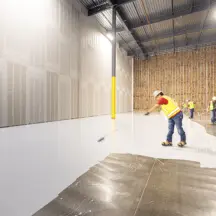
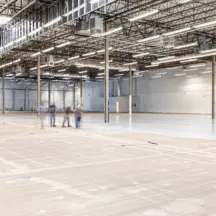
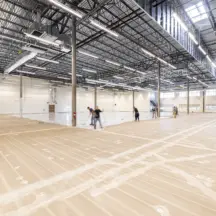
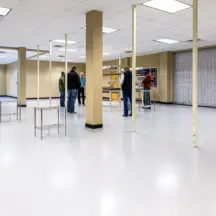
ESD Flooring Gallery





Frequently Asked Questions
Under ANSI/ESD STM7.1-2020, conductive flooring has resistance to groundable point below 1.0 × 10⁶ ohms. Dissipative flooring has resistance to groundable point at or above 1.0 × 10⁶ ohms and below 1.0 × 10⁹ ohms. The class describes resistance; it does not establish the body voltage generated by a person using the floor and footwear together.
No. Lower flooring resistance generally accompanies lower body voltage with appropriate static-control footwear, but footwear, humidity, movement, and other factors affect the result. Select against the application’s required performance. ESD resistance measurements do not determine personnel safety around high AC or DC voltages.
No. MSFC-RQMT-2918 Revision E describes antistatic as usually referring to inhibited friction charging and notes that this property is not necessarily correlated with resistance or resistivity. The label alone does not establish a flooring resistance class or a complete path to ground.
A mat’s resistance must be measured as part of its flooring system; being a mat does not exclude it from these classes. ANSI/ESD STM7.1-2020 includes floor mats within the systems it addresses. Personnel performance still depends on the footwear/flooring combination and the applicable qualification results.
No. For a footwear/flooring system used for personnel grounding, ANSI/ESD S20.20-2021 requires product qualification for both system resistance below 1.0 × 10⁹ ohms and peak body voltage below 100 volts. Each footwear and flooring type combination must be qualified. These results address personnel grounding; they do not establish conformity with every requirement of the ESD control program.
With basic project size, system, condition, and schedule inputs, Craftsman can usually provide a preliminary installed-cost range during the initial call or within a few hours. The preliminary range is subject to project review. Provide the required electrical performance and proposed assembly so the pricing discussion addresses the intended system.
Request a project schedule that identifies preparation, installation phases, the selected system’s cure requirements, and acceptance testing. ANSI/ESD STM7.1-2020 directs users to allow proper cure time following the manufacturer’s instructions before installed acceptance testing.
Conductive vs Dissipative ESD Flooring Knowledge Center
Systems & Selection
Compliance Requirements & Testing
Project Planning & Delivery
Where ESD Flooring Is Used
Maintenance & Troubleshooting
Manufacturer ESD Flooring Systems
Case Studies
Craftsman Publishes 2026–2027 ESD Flooring Technical Guide
ESD Epoxy Flooring Case Study: 34,000 SF Dallas, TX