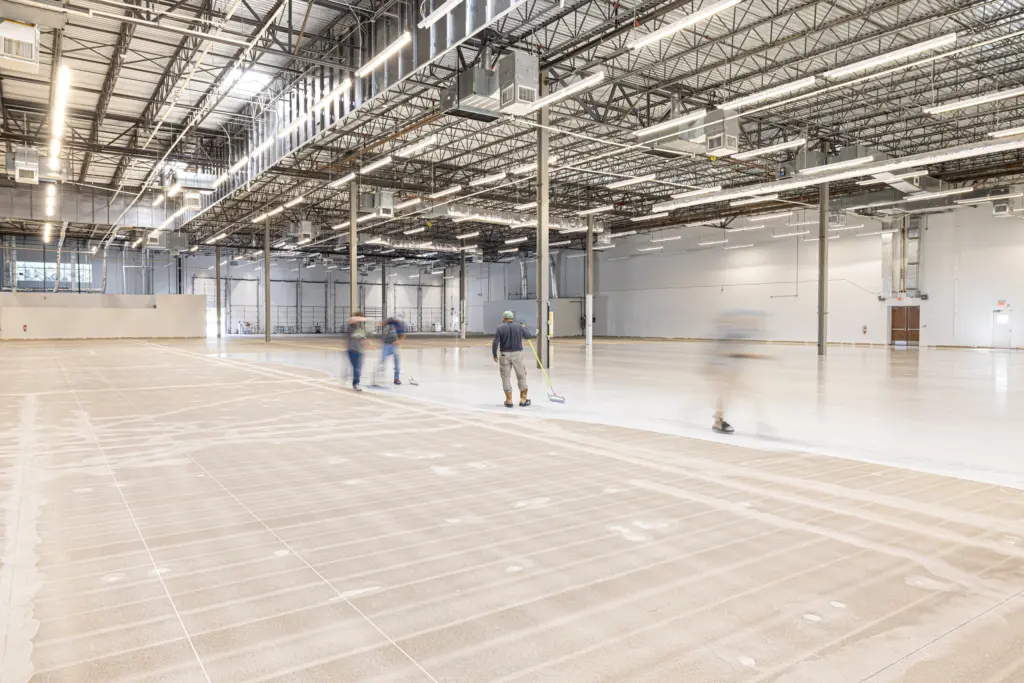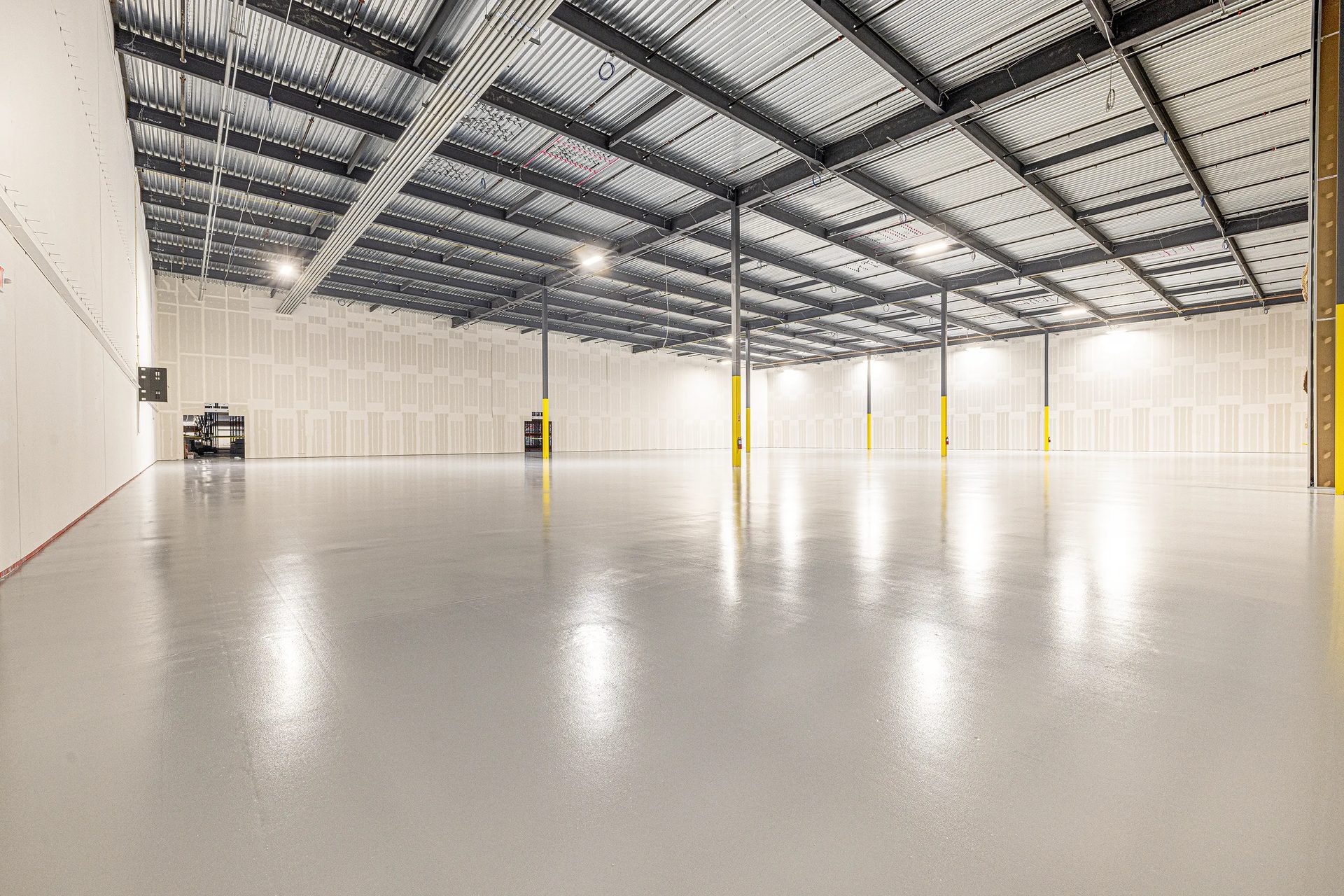
- Systems: Conductive ESD epoxy and static dissipative ESD epoxy, monolithic poured installation, 30 to 60 mils standard thickness.
- Resistance Ranges:
- – Conductive: below 1.0 × 10⁶ ohms (Rg) per ANSI/ESD S20.20
- – Static Dissipative: 106 to 109 ohms (Rg) per ANSI/ESD S20.20
- – Body Voltage: less than 100V per ANSI/ESD STM 97.1 and STM 97.2
- Compliance:
- – ANSI/ESD S20.20-2021 program standard
- – ANSI/ESD STM 7.1 resistance testing (Rg and Rtt)
- – ANSI/ESD STM 97.1 and STM 97.2 body voltage verification
- – IEC 61340-5-1 international ESD program
- – MIL-STD-1686 for defense and munitions conductive work
- – ASTM F150 resistance test method (poured-system reference)
- Pricing: $3.34 to $13.55 per square foot installed. Range driven by system type (conductive vs dissipative), thickness, substrate condition, grounding network complexity, and resistance-tolerance band. Based on real bid data from 54+ commercial ESD projects.
- Lead Time: 1 to 3 weeks from contract execution, driven by material availability.
- Installation: 3 to 5 days typical per zone; phased installation around live operations available with weekend and night shutdown windows.
- Cure and Test Window: 24 to 72 hours from final coat to STM 7.1 resistance verification.
- Service Life: 25+ years on properly installed systems with substrate-appropriate prep.
- Documentation:
- – STM 7.1 Rg and Rtt resistance logs
- – STM 97.1 and STM 97.2 body voltage test data
- – Grounding strap installation records
- – Full S20.20 closeout package, audit-ready for EHS program review
- Authorized Installer: Sherwin-Williams High Performance Flooring + PIP (Protective Industrial Polymers). Sika ESD credential pending.
- Crew Structure: In-house W-2 crews mobilize nationwide. W-2 installers, not 1099 day-labor.
- Pre-Bid Walkthroughs: Available within regional drive radius; remote spec review standard for multi-region rollouts.
- Case Study Anchors: Dallas 34,000 sq ft Fortune 500 ESD epoxy + Houston 67,000 sq ft hyperscale-grade.
- Founded: 1999.
Phone: +1 (844) 687-1961
The conductive vs dissipative flooring decision is the first specification call on any ANSI/ESD S20.20 program — and the one most often confused. Conductive flooring carries a resistance to ground below 1.0 x 10^6 ohms per S20.20, moving electrostatic charge to ground rapidly. Static dissipative flooring carries resistance in the 10^6 to 10^9 ohm range, removing charge at a controlled rate that protects sensitive devices from both rapid discharge and sustained voltage. Both are ESD flooring; the difference is how fast the charge gets to ground and what failure mode the facility is engineering against. Spec engineers and EHS program managers select the band against the operational risk profile, not against cost.
Both system types fall under the broader anti-static flooring umbrella, but anti-static as a term covers any floor that controls static — resilient ESD tile, conductive paint, ESD mats, and thin-film conductive coatings all sit under the same label. On a poured monolithic epoxy program, the practical choice narrows to conductive or static dissipative. The buyer vocabulary varies — static control flooring, ESD epoxy, electrostatic discharge flooring, anti-static epoxy — but the underlying engineering question stays the same: what resistance to ground does the facility’s S20.20 program require, and what does ANSI/ESD STM 7.1 resistance testing have to read at closeout to pass the audit.
Our Clients




















What Is Conductive Flooring?
Conductive flooring carries very low electrical resistance — below 1.0 x 10^6 ohms resistance to ground per ANSI/ESD S20.20. Electrostatic charge moves to ground rapidly through a continuous conductive pathway built into the resin system. Conductive specifications are selected where rapid charge elimination is the safety criterion: combustible atmospheres, energetic materials, and zones where a discharge spark would have immediate consequences.
Resistance Range — Below 1.0 x 10^6 Ohms per S20.20
Conductive ESD epoxy reads in the 2.5 x 10^4 to 1.0 x 10^6 ohm band at closeout, verified per ANSI/ESD STM 7.1 measuring resistance to ground (Rg) and resistance point-to-point (Rtt). The narrow band is intentional: above 1.0 x 10^6 ohms the system crosses into static dissipative territory and no longer meets the conductive program threshold. Below 2.5 x 10^4 ohms the readings start to indicate over-conductive performance, which can create personnel shock-hazard issues on its own. The 24 to 72 hour cure-and-test window between final coat and STM 7.1 verification is the same as on dissipative work; the failure margin on the conductive side is just narrower.
How It Works — Conductive Filler Network Built Into the Resin
Conductive ESD epoxy is built around a conductive filler package — typically carbon-loaded — distributed through the resin matrix to create a continuous electrical pathway from the floor surface down to the grounding network. Copper grounding straps are installed at the perimeter and across the slab at specified intervals, terminated to the facility ground system. The conductive primer, conductive midcoat, conductive topcoat, and the grounding strap network each have to read inside the target band on their own and together as a system. Substrate prep and grounding strap layout drive whether the system holds the target reading across the full installed area.
When to Specify Conductive — Munitions, Petrochemical, Battery, Semiconductor
Conductive is the right specification where uncontrolled charge would cause immediate harm: munitions and explosives manufacturing and storage, propellant handling, petrochemical facilities with combustible atmospheres, battery cell production zones with flammable solvent exposure, and semiconductor fabrication areas with ESD-class 0 components. MIL-STD-1686 references conductive performance for legacy defense work; NFPA 70 Class I Division 2 references it for spark-control environments. The common thread across these verticals is that the consequence of a discharge event is not equipment damage — it’s an ignition event in a combustible atmosphere. Specialized conductive materials and tighter resistance tolerances carry a higher installed cost, but the hazard analysis dictates the resistance target.
What Is Static Dissipative Flooring?
Static dissipative flooring carries moderate electrical resistance — 10^6 to 10^9 ohms resistance to ground per ANSI/ESD S20.20. Charge is removed at a controlled rate rather than rapidly conducted to ground. The controlled decay protects sensitive electronics from both static buildup and the rapid discharge that conductive systems use. Static dissipative is the standard specification across the bulk of commercial ESD program environments.
Resistance Range — 10^6 to 10^9 Ohms per S20.20
Static dissipative ESD epoxy reads in the 1.0 x 10^6 to 1.0 x 10^9 ohm band at closeout, verified per ANSI/ESD STM 7.1. The three-decade band is wider than the conductive target by design — controlled charge decay does not require the same tight tolerance that rapid conduction does. Walking body voltage less than 100V per ANSI/ESD STM 97.1 and combined floor/footwear voltage less than 100V per ANSI/ESD STM 97.2 are the body voltage thresholds that pair with the dissipative resistance target. Together, the resistance reading and the body voltage readings are what the S20.20 audit looks at.
How It Works — Controlled Charge Decay, Not Rapid Conduction
Static dissipative ESD epoxy moves charge to ground through a resistive pathway built into the resin matrix, but at a measured rate rather than the rapid conduction of a conductive system. The conductive filler loading is lower; the resin chemistry is tuned to limit current flow. Charge is dissipated steadily rather than dumped to ground, which prevents both static buildup at the surface and the rapid discharge spike that would itself stress sensitive electronics. Grounding strap installation is required but the network density is typically lighter than on conductive work.
When to Specify Dissipative — Electronics, Data Center, Pharmaceutical, Aerospace
Static dissipative is the right specification across electronics manufacturing (SMT lines, PCB assembly, board testing), semiconductor backend, data center white space and hyperscale colocation, pharmaceutical cleanrooms and sterile compounding zones under USP 797 and USP 800, medical device manufacturing, aerospace assembly and avionics testing under AS9100, and automotive electronics. IEC 61340-5-1 covers the international ESD program framework for the same verticals. The common thread is sensitive electronics: the consequence of a discharge event is device-level damage — anything from immediate component failure to latent reliability defects that surface months later in the field, plus assembly yield loss at the manufacturing tier. Controlled decay is what the program calls for.
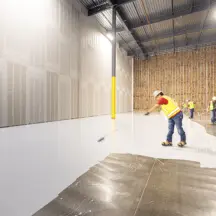
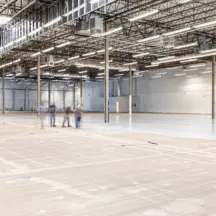
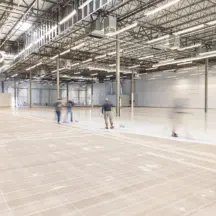
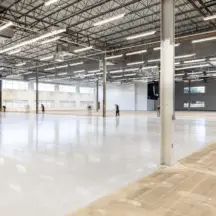
ESD Flooring Gallery

Request a Proposal
Submit project parameters for preliminary analysis. Commercial estimates typically returned within 24 hours.
Cost Considerations
Both conductive and static dissipative ESD epoxy systems fall within the same installed price range — $3.34 to $13.55 per square foot, based on real bid data from 54+ commercial ESD projects. Where a specific project lands inside that range depends on system thickness, substrate condition, grounding network complexity, and how tight the resistance tolerance has to be at testing. Conductive specs sit at the upper end of the range; dissipative specs sit at the middle and lower end.
Static Dissipative Flooring Cost — $3.34 to $13.55 per Square Foot Installed
Static dissipative ESD epoxy lands across the full $3.34 to $13.55 per square foot range. Cost drivers are substrate prep depth (shotblasting vs grinding vs patching a degraded slab), system thickness (30 to 60 mils standard), grounding strap layout, and topcoat selection. Larger projects with clean substrates and standard 10^6 to 10^9 ohm dissipative resistance targets typically land in the middle of the range. Resistance verification is done per ANSI/ESD STM 7.1 inside a 24 to 72 hour cure-and-test window after the final coat.
Conductive Flooring Cost — Same Range, Typically Higher End
Conductive ESD epoxy carries the same $3.34 to $13.55 per square foot installed range, but most conductive specifications land toward the upper end. Three reasons: the conductive resin filler package is a more specialized material, the resistance tolerance is tighter (below 1.0 x 10^6 ohms Rg per ANSI/ESD S20.20 — narrower target than the dissipative band), and the grounding network has to be more aggressive to hold readings inside that target across the full installed area. STM 7.1 verification is the same protocol; the failure margin on the conductive side is smaller.
When Cost Differential Matters
For most facilities the system selection is driven by safety and compliance — not budget. Munitions handling, propellant manufacturing, and petrochemical zones with combustible atmospheres require conductive; the resistance target is not negotiable. Pharmaceutical cleanrooms, data centers, semiconductor backend, and general electronics assembly run dissipative because rapid charge-to-ground is not the requirement — controlled decay is. Where either spec could technically pass the facility’s S20.20 program — some electronics manufacturing scenarios sit on that boundary — dissipative is typically the lower-cost option and is the path most spec engineers default to unless a specific hazard analysis pushes conductive.
Why Craftsman for Both System Types
Most ESD flooring contractors specialize in one resistance band — either conductive work tied to defense and energetics, or dissipative work tied to electronics and data centers. Craftsman installs both. In-house W-2 crews are trained on the conductive grounding network requirements that defense and propellant work demand, and on the STM 7.1 resistance verification protocols that semiconductor backend, hyperscale data center, pharmaceutical, and aerospace EHS programs require at closeout. The crew structure is the same on either system type: W-2 installers, not 1099 day-labor.
Authorized SW + PIP + Sika Installer Across Both Resistance Bands
Craftsman is an authorized installer for Sherwin-Williams High Performance Flooring, PIP (Protective Industrial Polymers), and Sika. All three manufacturers carry conductive and static dissipative product families inside their ESD lines, so the same installer credentials cover either resistance target. PIP is an ESD-specialized manufacturer; the full PIP catalog is ESD-relevant. SW HPF carries the ESD product family inherited through the July 2024 Dur-A-Flex acquisition. The Sika authorization covers the post-MBCC product family including the Sikafloor PurCem and Sikafloor ESD lines — spec engineers carrying forward legacy MBCC-era specs into current Sika-branded products work with the same authorization architecture across the transition.
Case Study Anchors — Dallas 34,000 sq ft and Houston 67,000 sq ft
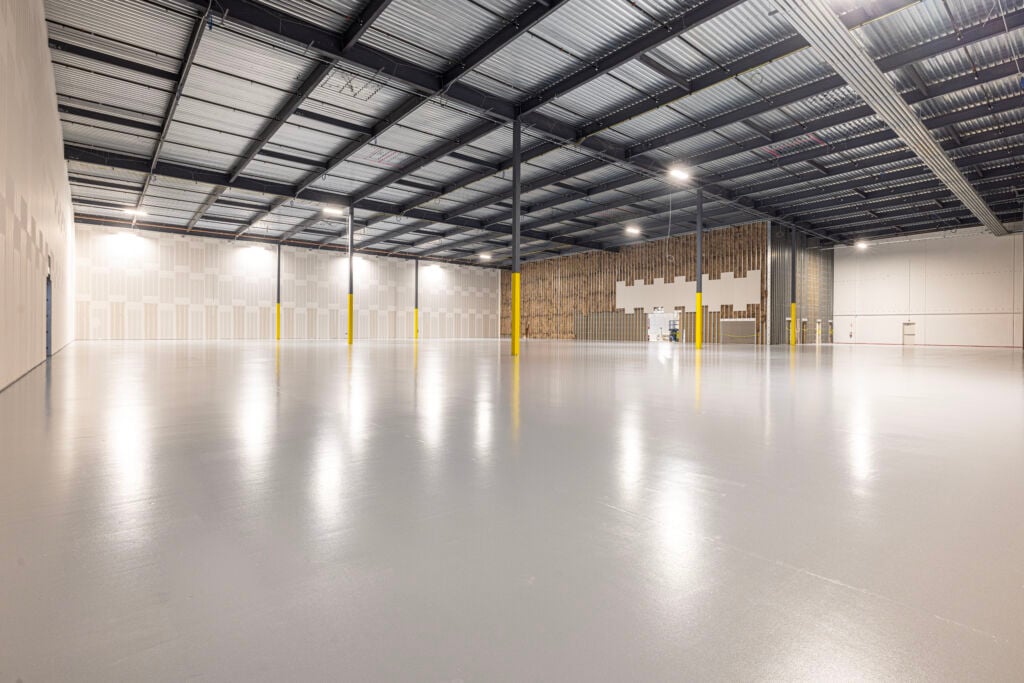
Craftsman’s most-referenced ESD project history sits on the dissipative side. The Dallas 34,000 sq ft Fortune 500 installation was a Tier-1 electronics QA environment, phased around live operations, with STM 7.1 resistance verification at closeout. The Houston 67,000 sq ft hyperscale-grade installation followed the same dissipative spec for a data center buildout. Conductive work is less frequently published as a named case study because clients in defense, energetics, petrochemical, and munitions verticals usually restrict project references — but the same crews installing dissipative on those two anchor projects install conductive on aerospace and defense work.
Fortune 500 Client Roster Across Both Resistance Bands
Client roster spans both system types. Dissipative work for electronics manufacturing, hyperscale data center, pharmaceutical, and medical device buyers includes Apple, NVIDIA, AWS, Foxconn, Lilly, AbbVie, and Equinix. Conductive specifications on certain MIL-STD-1686 program work for aerospace and defense buyers include Boeing and General Dynamics. Retail and logistics anchor the operational scale: Walmart, Best Buy, AutoZone, O’Reilly Auto Parts, Tractor Supply, PetSmart. Founded 1999. The client list is the practical evidence that the same in-house crew structure installs against both ANSI/ESD S20.20 dissipative targets and MIL-STD-1686 conductive targets without subcontracting either category.
Frequently Asked Questions
Both conductive and static dissipative ESD epoxy fall within the same installed range of $3.34 to $13.55 per square foot, based on real bid data from 250+ commercial ESD projects. Dissipative sits at the middle and lower end of the range; conductive sits at the upper end because the resin filler package is more specialized and the resistance tolerance is tighter (below 1.0 x 10^6 ohms vs. the 10^6 to 10^9 ohm dissipative band). For most facilities the system selection is driven by the S20.20 hazard analysis, not the cost differential.
Neither is universally better — the right specification depends on the facility’s S20.20 program and the consequence of a discharge event. Conductive (below 1.0 x 10^6 ohms) is the right call where rapid charge elimination is a safety requirement: munitions, propellant handling, petrochemical, battery cell production. Static dissipative (10^6 to 10^9 ohms) is the standard call where the concern is protecting sensitive electronics from controlled charge decay: electronics manufacturing, data centers, pharmaceutical cleanrooms, aerospace.
S20.20 compliance is verified through resistance testing per ANSI/ESD STM 7.1 — measuring resistance to ground (Rg) and resistance point-to-point (Rtt) at the floor surface — and body voltage testing per ANSI/ESD STM 97.1 (walking body voltage) and STM 97.2 (combined floor/footwear voltage). Conductive readings must fall below 1.0 x 10^6 ohms; dissipative readings must fall between 10^6 and 10^9 ohms. Both system types must hold body voltage less than 100V. Closeout documentation includes the STM 7.1 resistance logs, STM 97.1 and STM 97.2 body voltage data, and grounding strap installation records — the full S20.20 audit package.
Lead time is 1 to 3 weeks from contract execution, driven by material availability. Installation runs 3 to 5 days per zone on a typical project. STM 7.1 resistance testing is run inside a 24 to 72 hour cure-and-test window after the final coat — the resin has to fully cure for reliable Rg readings, so testing earlier than 24 hours produces unreliable data. Phased installation around live operations is available with weekend and night shutdown windows; on phased jobs, each zone gets its own cure-and-test cycle before crews move to the next zone.
Yes, it’s possible to combine both types in one facility if specific zones have different ESD protection needs. However, careful planning is required to ensure compatibility and grounding system integrity. Transition zones between conductive and dissipative areas need particular attention — the grounding network has to be continuous across both system types, and resistance testing per STM 7.1 has to verify each zone independently against its own target band.
The selection is driven by the facility’s ANSI/ESD S20.20 program document — specifically the resistance target the program calls for and the consequence of a discharge event in the operational zone. Conductive is specified where a discharge event would ignite a combustible atmosphere (energetic materials, propellant handling, ESD-class 0 components in spark-control environments). Dissipative is specified where a discharge event would damage sensitive electronics — anything from immediate component failure to latent reliability defects appearing in the field. Pre-bid walkthroughs review the program document, the operational risk profile, ambient humidity, grounding network, and footwear protocol to confirm the right resistance target.
Nationwide installation. Estimating and scheduling are coordinated through the Dallas headquarters; in-house W-2 crews mobilize to project sites. Pre-bid walkthroughs are available within regional drive radius, with remote spec review standard for multi-region rollouts. Craftsman has been installing industrial flooring since 1999.
Blog
ESD Epoxy Flooring Case Study: 34,000 SF Dallas, TX
Residential Terrazzo Floors in Fort Worth, Texas