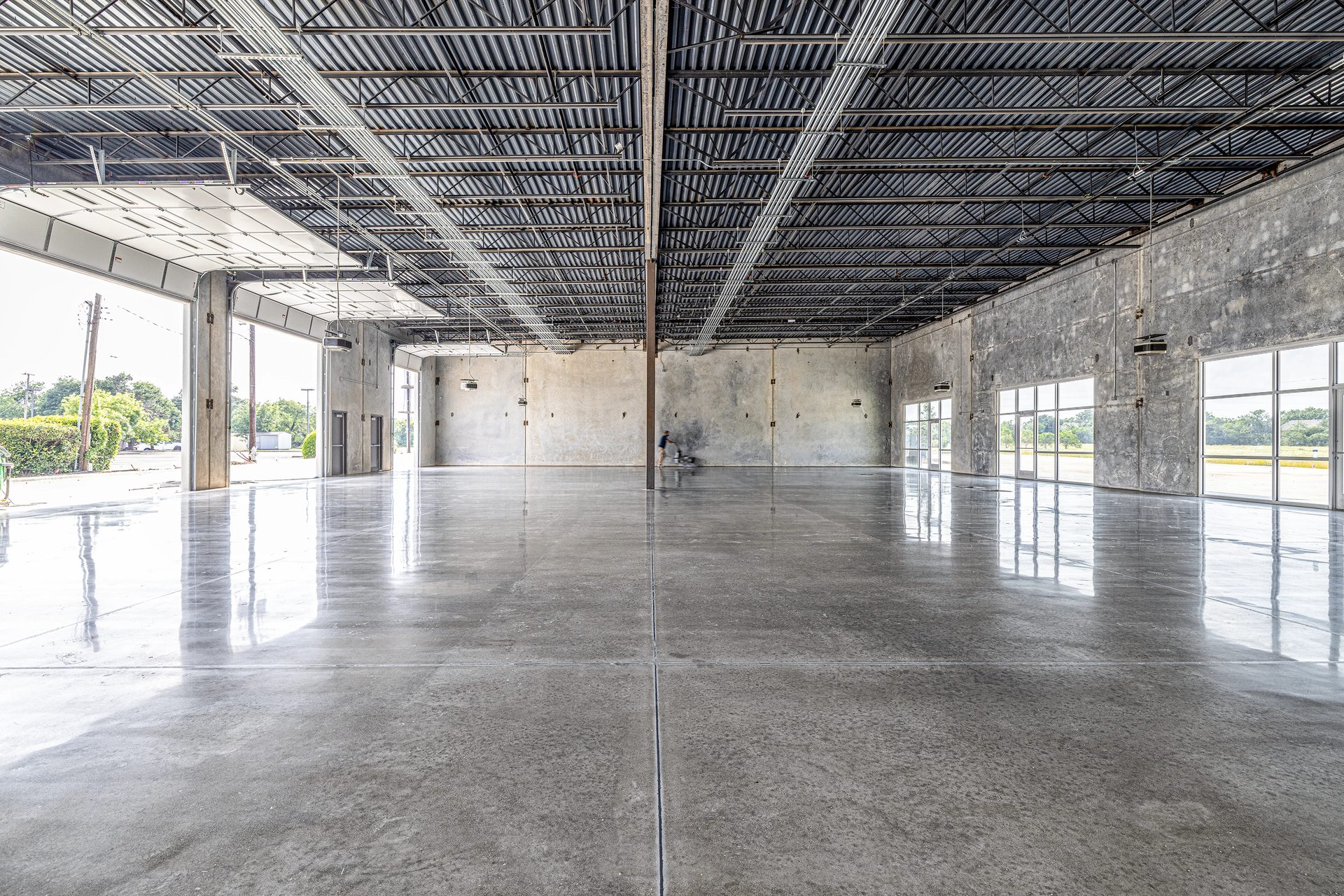
A light gray polished concrete floor is an appearance objective the project team establishes, not a catalog color a contractor orders. The finished appearance comes from the slab itself, from what its concrete was made of and how it was placed, finished, cured, protected, and repaired. Refinement brings that surface to a specified aggregate exposure and appearance level, and integral color or dye enters only where the project specifies it. A commercial project establishes the objective by recording those decisions in the specification, and evaluates the result against an approved physical sample or a representative onsite mockup rather than a photograph, a rendering, or another project’s floor. Because the slab controls what refinement can reveal, an exact, perfectly uniform color is not a realistic acceptance standard; some variation is part of the material.
Where the Color of a Polished Concrete Floor Comes From
The Slab Itself Becomes the Finished Surface
Mechanically polished concrete uses densification and bonded-abrasive refinement while the concrete remains the wear surface; Craftsman finishes the system with a penetrating stain guard. There is no applied covering that brings a color of its own. The surface a project sees is the refined surface of its own slab, which is why the color conversation starts with the concrete itself. The decisions that shape that surface are made while the slab is specified, placed, finished, cured, protected, and repaired, before a polishing abrasive ever touches it.
Aggregate Exposure Decides Which Parts of the Slab Stay Visible
Commercial polished concrete specifies what shows at the finished surface with three exposure terms: cream — cement-fines exposure (CPC Class A); salt and pepper — fine-aggregate exposure (CPC Class B); and rock-cut — full/coarse aggregate exposure (CPC Class C). Each class names the slab components that remain visible after refinement, whether cement fines, fine aggregate, or the full aggregate field. Those components are the materials the appearance is made of, so the exposure decision belongs in the same specification conversation as the color objective. Tooling and process selection are matched to the slab, specified exposure, finish requirements, and project conditions. Aggregate exposure itself depends on slab mix, aggregate distribution, placement, finishing, flatness, repairs, and field conditions and should not be expected to be perfectly uniform. Choosing among the three classes for a particular space is covered in the complete guide to polished concrete aggregate exposure.
Color, Exposure, and Appearance Level Remain Three Separate Decisions
An exposure class does not settle how refined or reflective the floor will be. Appearance level is described in buyer terms as flat/ground, satin/honed, polished, and highly polished within the CPC Levels 1–4 technical framework, and the terminal abrasive grit is a means and method, not the accepted appearance definition. A light-gray objective therefore resolves into three recorded decisions: the exposure, the appearance level, and any specified color treatment. For how the finish families compare across the range of polished work, and where a light tone sits among them, see the broader overview of styles of polished concrete floors.
Color Treatments Come Only From the Specification
In Craftsman’s polished-concrete system, the standard functions are a densifier and a penetrating stain guard. Grout or pore filler and repair and joint materials are condition-specific, and integral color or dye is optional. No color treatment is assumed by default, and not every project uses identical chemistry or products. Where the design requires a tone the slab alone will not produce, the color treatment is named in the project specification and carried through the approved sample or mockup that governs acceptance, so the decision is evaluated on real concrete.
Two Starting Points: The Slab You Design and the Slab You Inherit
A Coordinated New Slab Sets Its Appearance Before Placement
When possible, a slab intended for polishing should be coordinated before placement. Concrete mixture, placement, finishing, curing, surface density, flatness, joints, penetrations, repairs, and construction protection can all affect the finished floor. For a light-gray objective, pre-placement coordination matters because the appearance-setting work belongs to parties other than the polishing contractor. The architect or engineer controls the slab specification, and the concrete contractor controls placement, finishing, curing, and initial slab delivery. The general contractor controls sequencing, access, site conditions, and protection by other trades. Craftsman uses no universal minimum cure age, compressive-strength value, surface-hardness value, or moisture threshold for beginning polished-concrete work; the project’s own documents and conditions control readiness.
Evaluation Establishes What an Existing Slab Can Produce
Before polishing begins, Craftsman evaluates accessible slab conditions and identifies visible issues that may affect appearance, exposure, performance, schedule, or cost. The evaluation is not a structural assessment and cannot identify every concealed or latent condition. On an existing slab, the decisions that set the concrete’s appearance were made when it was built, so the realistic question is what the slab, once refined, can produce. The acceptance reference on this path is an approved sample or representative onsite mockup prepared from the actual floor, and Craftsman controls the polishing means, methods, workmanship, samples, and conformance to the agreed scope that follow from it.
Repairs, Joints, and Their Colors Stay Visible
Concrete repairs remain part of the finished floor’s visual record. Standard repair materials are selected and approved by color family but are not expected to disappear into the surrounding slab, and custom color development may improve the match without guaranteeing it. A complete specification therefore states how cracks, joints, edges, and transitions will be treated, so their appearance is decided before the floor is turned over.
Establishing and Evaluating the Appearance
The Approved Sample or Onsite Mockup Governs Acceptance
Appearance is evaluated against the approved sample or representative onsite mockup. A marketing photograph, a digital rendering, or another project’s floor shows different concrete — a different mixture, placed and finished under different conditions — so none of them can serve as the acceptance standard for this slab. Photographs remain useful for setting a visual direction. The reference that governs approval is physical and project-specific. Specification, sample or mockup, testing, and acceptance requirements are executed against the controlling project documents and approved references.
Instrument Readings Enter Only Through the Specification
DOI, gloss, or haze testing is used only when a controlling specification requires it and defines a complete sampling and decision protocol, and an isolated post-completion meter reading does not determine acceptance. Where no instrumented protocol is specified, the approved sample or mockup remains the acceptance reference. A numeric brightness, gloss, or reflectance requirement has meaning only when the specification that imposes it also defines how it will be sampled and judged.
A Concise Specification Checklist for a Light-Gray Objective
A commercial specification pursuing a light-gray polished concrete appearance should record each decision separately:
- the appearance objective in specification terms (the aggregate exposure and the appearance level) rather than a photograph reference alone;
- any specified color treatment, such as integral color or dye, named as a project component;
- for a new slab, the pre-placement coordination items: concrete mixture, placement, finishing, curing, surface density, flatness, joints, penetrations, repairs, and construction protection;
- for an existing slab, the accessible-condition evaluation and what it can and cannot establish;
- the approved physical sample or representative onsite mockup that will govern acceptance, with its location and scope;
- the treatment of cracks, joints, edges, and transitions, with repair colors approved by color family;
- any instrumented appearance requirement, only together with its complete sampling and decision protocol; and
- who has the authority to approve the result.
The purpose of recording these separately is to keep one selection from standing in for the others. A tone selected from an image does not, by itself, settle the exposure, the appearance level, or the way repairs will read in the finished floor.
- Founded in 1999 • National commercial & industrial technical flooring contractor
- High-spec systems: ESD/static-control flooring, urethane cement, terrazzo, polished concrete, resinous flooring & coatings, and concrete overlays
- National service coverage • Installation performed by Craftsman-employed W-2 crews
- W-2 installers, not 1099 day-labor • Trained, insured, and accountable to you
- The same core workforce model, installation leadership, training system, documentation path & safety accountability can carry across phased and multi-site programs
- Since current ownership began in 2018, zero OSHA-reportable incidents and no workplace injury requiring medical treatment beyond first aid
- Current prequalification documents available through controlled review, including COI, W-9, safety information & other current qualification records
- Commercial estimates are typically returned within 24 hours; complex bids may take longer
Company: Craftsman Concrete Floors
Phone: +1 (844) 687-1961
Our Clients




















Request a Proposal
Submit project parameters for preliminary analysis. Commercial estimates typically returned within 24 hours.
Frequently Asked Questions
A polished concrete floor reads light gray when the refined surface of the slab itself presents that tone. Mechanically polished concrete uses densification and bonded-abrasive refinement while the concrete remains the wear surface, so there is no applied covering that brings a color of its own. The concrete mixture, placement, finishing, curing, and repairs establish what the surface can look like. The specified aggregate exposure and appearance level determine how it is revealed and refined, and integral color or dye participates only where the project specifies it.
No — an exact, perfectly uniform color is not a realistic acceptance standard for polished concrete. Aggregate exposure depends on slab mix, aggregate distribution, placement, finishing, flatness, repairs, and field conditions and should not be expected to be perfectly uniform. Commercial projects manage this by establishing the target with an approved physical sample or representative onsite mockup and evaluating the finished floor against that reference, and some variation from that reference is treated as part of the material.
A marketing photograph, a digital rendering, or another project’s floor cannot serve as the acceptance standard, because each shows different concrete produced under different conditions. Photographs are useful for setting a visual direction. Appearance is evaluated against the approved sample or representative onsite mockup, and specification, sample or mockup, testing, and acceptance requirements are executed against the controlling project documents and approved references.
Aggregate exposure decides which components of the slab remain visible in the finished surface: cream — cement-fines exposure (CPC Class A); salt and pepper — fine-aggregate exposure (CPC Class B); or rock-cut — full/coarse aggregate exposure (CPC Class C). Those components are the materials the appearance is made of, so the exposure class belongs in the same specification conversation as the color objective, and it should not be expected to be perfectly uniform across the floor.
No. The exposure class and any specified color treatment establish what the surface shows, while the appearance level describes how refined and reflective it is. In buyer terms the appearance level runs from flat/ground and satin/honed to polished and highly polished within the CPC Levels 1–4 framework. The terminal abrasive grit is a means and method, not the accepted appearance definition, so a complete specification records the color objective, the exposure, and the appearance level as separate decisions.
Not by default. In Craftsman’s polished-concrete system, a densifier and a penetrating stain guard are the standard functions, grout or pore filler and repair and joint materials are condition-specific, and integral color or dye is optional. Where the design requires a tone the slab alone will not produce, the color treatment is named in the project specification and carried through the approved sample or mockup, and not every project uses identical chemistry or products.
An existing slab is a candidate for a light-gray objective, but what it can produce is established by evaluating the slab as it exists. Before polishing begins, Craftsman evaluates accessible slab conditions and identifies visible issues that may affect appearance, exposure, performance, schedule, or cost; the evaluation is not a structural assessment and cannot identify every concealed or latent condition. Because the concrete’s mixture, placement, and finishing were fixed when the slab was built, the realistic acceptance reference is an approved sample or representative onsite mockup prepared from the actual floor.
When possible, a slab intended for polishing should be coordinated before placement. Concrete mixture, placement, finishing, curing, surface density, flatness, joints, penetrations, repairs, and construction protection can all affect the finished floor, and on a new pour those decisions are made before refinement begins. The architect or engineer controls the slab specification, and the concrete contractor controls placement, finishing, curing, and initial slab delivery. The general contractor controls sequencing, access, site conditions, and protection by other trades.
Repairs should not be expected to match exactly. Concrete repairs remain part of the finished floor’s visual record. Standard repair materials are selected and approved by color family but are not expected to disappear into the surrounding slab, and custom color development may improve the match without guaranteeing it. A complete specification states how cracks, joints, edges, and transitions will be treated so their appearance is decided deliberately.
Only when the controlling specification requires instrumented testing and defines a complete sampling and decision protocol. DOI, gloss, or haze testing is used under those conditions, and an isolated post-completion meter reading does not determine acceptance. Where no instrumented protocol is specified, the approved physical sample or representative onsite mockup remains the acceptance reference.
There is no universal cure time before polishing can begin. Craftsman uses no universal minimum cure age, compressive-strength value, surface-hardness value, or moisture threshold for beginning polished-concrete work; readiness is established from the project’s controlling documents and the slab’s own conditions. That is one reason pre-placement coordination on a new slab and the accessible-condition evaluation on an existing slab both exist.
It should identify each decision separately. The core entries are the appearance objective in specification terms (the aggregate exposure and the appearance level), any specified color treatment such as integral color or dye, and either the new-slab coordination items or the existing-slab evaluation path. It should also name the approved physical sample or representative onsite mockup that will govern acceptance, the treatment of cracks, joints, edges, and transitions with repair colors approved by color family, any instrumented appearance requirement together with its complete sampling and decision protocol, and who has the authority to approve the result.
Blog

ESD Epoxy Flooring Case Study: 34,000 SF Dallas, TX

Residential Terrazzo Floors in Fort Worth, Texas