What can we help you with?
Technical flooring, delivered directly
- ESD flooring, urethane cement, terrazzo, and polished concrete
- In-house W-2 installation crews and experienced field leadership
- National service coverage with project-specific staffing plans
- Testing, documentation, and defined project closeout
- Dedicated support for corporate procurement and multi-site contracting
Phone: +1 (844) 687-1961
ESD Flooring Options
ESD flooring options divide into five formats: poured conductive or static dissipative epoxy, ESD tile and VCT, ESD vinyl sheet, ESD carpet tile, and conductive paint or thin-film coatings. An uncontrolled walk across an insulating floor can put several thousand volts on a person; every format below exists to keep that charge from reaching a component that cannot survive it. Every format is specified by measured resistance class, not product name. Conductive floors read below 1.0×10⁶ Ω; static dissipative floors read 1.0×10⁶ to 1.0×10⁹ Ω, both verified per ANSI/ESD STM7.1. What separates the types of ESD flooring is how each format maintains its ground path under years of traffic, and who actually installs it. This page compares all five, including the formats Craftsman Concrete Floors does not install.
Craftsman Concrete Floors installs one of the five, seamless poured ESD epoxy, as an authorized SW + PIP + Sika installer with in-house W-2 crews. ESD tile, VCT, vinyl sheet, and carpet tile are resilient-flooring products installed by resilient-flooring contractors, a different trade. Each format fails in a different place. Tile fails at its seams and paint wears through in traffic lanes, while a poured floor rarely fails at the surface at all, only at a grounding detail someone skipped. The comparison below covers what each format is and who installs it, including the honest cases where Craftsman’s product is not the right answer.
The Five ESD Flooring Formats
Every type of ESD flooring on the market claims the same outcome. The structural differences are what matter, chiefly whether the conductive plane is monolithic or seamed and how the format holds its resistance class under traffic. Each format below is covered on its own terms, including who installs it, with no pretense that Craftsman installs them all. Installed pricing appears where Craftsman is the installing trade.
Poured ESD Epoxy and Urethane
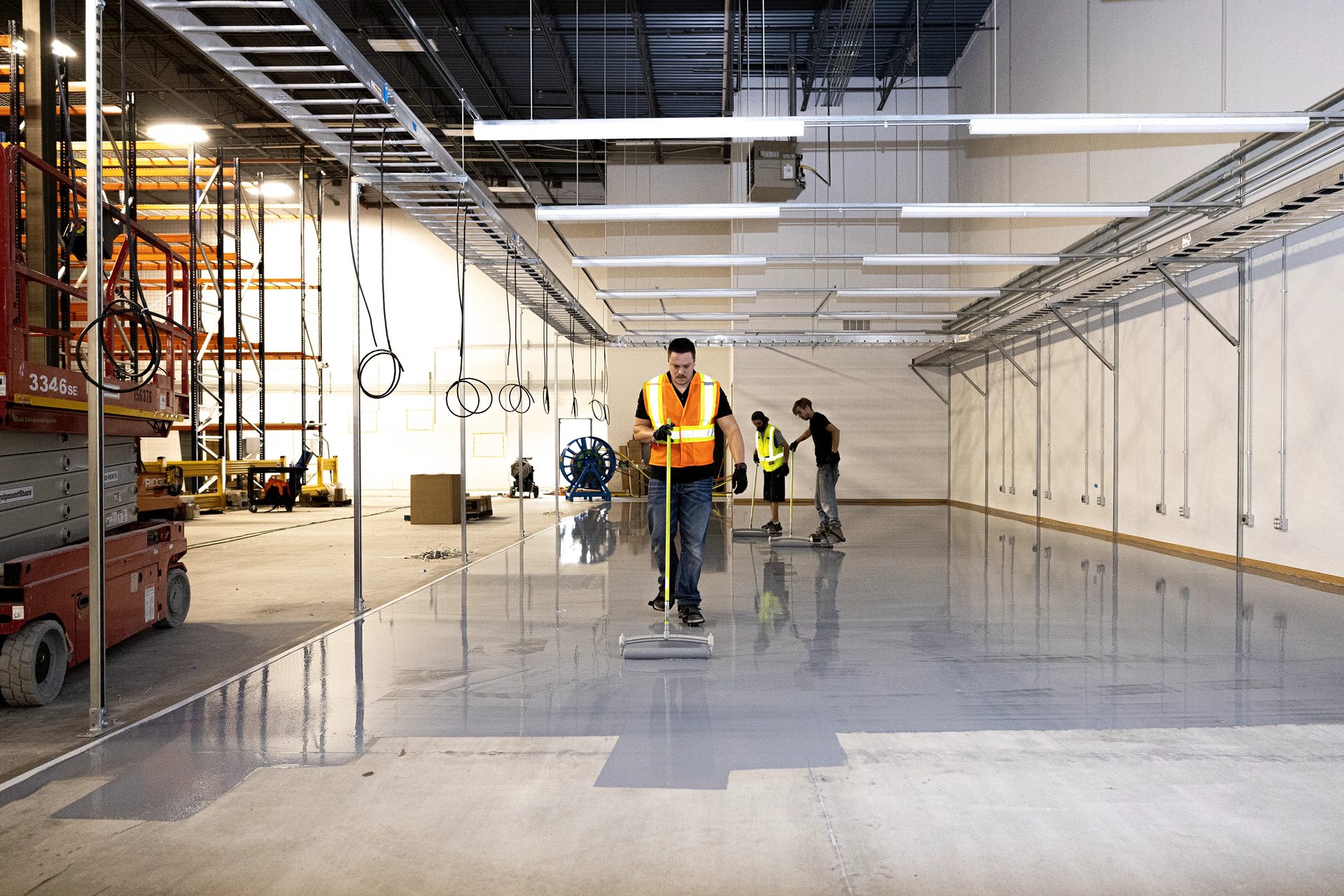
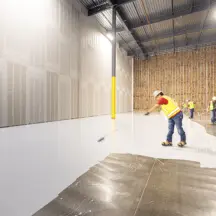
A poured ESD floor coating cures into one continuous conductive surface. Installation runs substrate prep to an ICRI 310.2 profile with ASTM F2170 moisture testing, a conductive primer or ground plane, copper ground straps tied to building steel, and a conductive or static dissipative topcoat. Because the floor is monolithic, no seam interrupts the path between a worker’s footwear and ground. Thickness varies by the specified system, roughly 12 to 30 mils across the SW + PIP + Sika lines Craftsman installs, and resistance is verified per STM7.1 after a 24-72 hour cure. This is the working format for most S20.20 compliant flooring programs, and the one behind permanent static control claims that survive an audit.
ESD Floor Tile and VCT
ESD floor tiles install over conductive adhesive with a copper grounding grid beneath, which makes tile the fastest format for renovations and modular fit-outs. The seams are the tradeoff. Every joint between ESD tiles interrupts the conductive plane, and seam lines are where ground continuity fails first. Resistance drifts as adhesive ages and soil packs the joints, and the drift is hard to spot until a periodic test catches it. ESD tile is a resilient-flooring product installed by resilient-flooring contractors; Craftsman does not install it. For facilities that reconfigure lines frequently, the swap-a-panel repair model can still outweigh the seam maintenance.
Seam-Welded ESD Vinyl Sheet
Sheet-format ESD vinyl flooring seam-welds into larger panels, cutting the joint count well below tile. Fewer seams means fewer ground-path breaks, though the welded joints still exist and still need conductive upkeep over the floor’s life. Resilient-flooring contractors install ESD vinyl, not Craftsman. It serves the same modular use cases as VCT with better plane continuity, and it remains a seamed system next to a poured floor’s unbroken conductive surface.
ESD Carpet Tile
ESD carpet tile belongs in support spaces rather than production floors, meaning control rooms, broadcast studios, air traffic control centers, and office zones adjacent to ESD-protected areas. It carries dissipative-grade conductivity through carbon-loaded fibers and a conductive backing, and grounded versions can meet program requirements for seated workstation zones. Cart and heavy foot traffic wear it out fast. Sound dampening and comfort are what ESD carpet tile buys; the production work belongs to a hard-floor conductive or dissipative surface.
Topical Coatings and Low-VOC Systems
Conductive Paint and Thin-Film Coatings
Conductive paint is the cheapest way to put an ESD number on a floor, and the least durable way to keep it there. Film builds of a few mils cannot hold resistance under abrasion, so traffic lanes wear through first, and inconsistent coverage at application means the floor may never have read uniformly to begin with. There is no embedded ground plane. The paint is the whole conductive layer. For a temporary line or a budget bridge to a permanent floor, thin-film ESD floor coatings work. As the floor under a multi-year S20.20 program, they fail in the lanes people actually walk.
ESD Floor Wax and Topical Finishes
ESD floor wax converts an existing floor into a dissipative surface. It reads in the dissipative band only, relies on surface area rather than an embedded ground strip, and must be stripped and reapplied on a cycle measured in months. Facilities use it to bridge an audit gap or cover an interim space, and vendors sell it as a stock maintenance product. No topical finish is a permanent static control system; when the wax wears, the ESD rating goes with it.
Low-VOC ESD Flooring Options
Low-VOC ESD flooring lets occupied facilities add static-control floors without the solvent emissions that trip indoor-air-quality limits or force a shutdown. The change is binder chemistry. Performance targets do not change: the low-VOC versions of Craftsman’s dissipative and conductive epoxy systems carry the same ground plane and meet the same bands, 1.0×10⁶ to 1.0×10⁹ Ω dissipative and below 1.0×10⁶ Ω conductive, verified per STM7.1. Cleanrooms, hospitals, and pharmaceutical suites specify these systems most often, usually as a phased ESD install that keeps adjacent zones running.
Choosing Between ESD Flooring Formats
Format selection comes second. Resistance class comes first, and the class is set by what the facility handles rather than by flooring preference. Once the class is fixed, what remains is matching the environment and installation window to the right format, and knowing which ESD flooring contractors handle each one. The selection logic below routes each situation to a format without pretending one format wins everywhere.
Start With Resistance Class
Conductive flooring reads below 1.0×10⁶ Ω and is specified where charge must drain fast: munitions handling, propellant work, flammable atmospheres, and explosive-classified zones. Static dissipative floors, at 1.0×10⁶ to 1.0×10⁹ Ω, slow the discharge and cover most electronics manufacturing and data center environments. The S20.20 program document dictates the class, not the flooring vendor. For the full selection logic, the conductive vs dissipative comparison page walks through it; this page assumes the class is known and helps you pick the format that holds it.
When ESD Tile Is the Right Call
Tile wins on schedule. A resilient crew can lay ESD flooring tiles over a weekend that a poured system would need most of a week to install and cure, and a damaged tile swaps out without closing the room. Frequently reconfigured production floors and short-lease spaces are legitimate tile territory. Craftsman doesn’t sell against that. We install poured epoxy; when tile genuinely fits the job, the right move is a resilient-flooring contractor, not a forced epoxy spec. What tile cannot do is hold a seamless conductive plane, so factor seam maintenance into any lifetime comparison.
The Ground Path Decides Longevity
Most ESD floor failures are grounding failures. A conductive primer thinned out of spec, ground straps spaced wrong, straps never tied to building steel, and resistance testing waived before the 24-72 hour cure window closes — the coating usually outlives the details around it. Seamed formats add a second failure surface, because every joint is a place the conductive plane can open. Whatever format you choose, the spec should name the ground-plane material and strap layout along with the STM7.1 test schedule, since those details decide whether the floor still reads in band five years in.
What Craftsman Installs
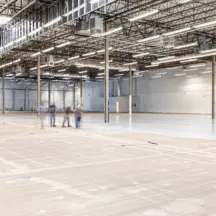
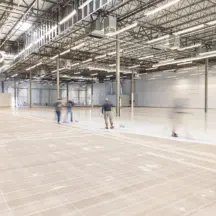
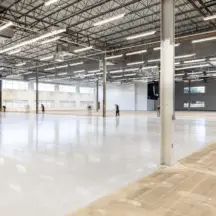
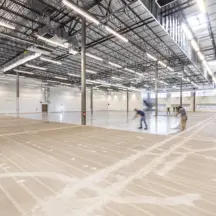
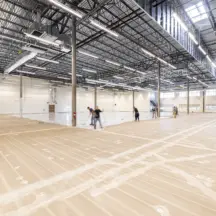
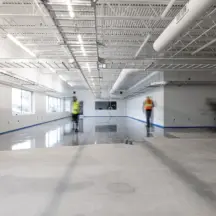
Craftsman Concrete Floors installs poured conductive and static dissipative epoxy nationwide as an authorized SW + PIP + Sika installer. W-2 installers, not 1099 day-labor. Trained, insured, and accountable to you. Anchor projects include a 34,000 sq ft Fortune 500 installation in Dallas and a 67,000 sq ft hyperscale-grade floor in Houston, both delivered with STM7.1 resistance logs, STM97.1 system resistance data, STM97.2 body voltage verification, and a full S20.20 closeout package. Pricing runs $3.34-13.55/sqft installed depending on system type, thickness, and substrate condition, informed by experience across 250+ completed projects. If the right answer for your facility is a tile or resilient system, we will tell you that in the first call.
ESD Flooring Gallery


Frequently Asked Questions
Five formats cover the ESD flooring category: poured conductive or static dissipative epoxy, ESD floor tile and VCT, seam-welded ESD vinyl sheet, ESD carpet tile, and topical treatments such as conductive paint or ESD floor wax. Poured epoxy is the format Craftsman installs; the others are named here for comparison. All are specified by measured resistance class rather than format name, either conductive below 1.0×10⁶ Ω or static dissipative at 1.0×10⁶ to 1.0×10⁹ Ω per ANSI/ESD STM7.1.
ESD-safe flooring is a performance claim, not a product type: the floor holds a measured resistance class and moves charge to ground when paired with compliant footwear. Under an ANSI/ESD S20.20 program that means resistance verified per STM7.1 and walking body voltage held under 100V per STM97.2. Any format can be marketed as ESD safe; only the test data makes the claim real.
A coating cures into one monolithic conductive surface with no seams, so the path from any point on the floor to the ground straps tied to building steel runs unbroken. ESD tile is modular, and every seam is both a potential break in the conductive plane and a maintenance point over the floor’s life. Tile swaps faster during renovations; a poured ESD floor coating holds its ground path without seam upkeep.
No. Craftsman installs poured conductive and static dissipative epoxy as an authorized SW + PIP + Sika installer; the resilient formats, meaning ESD tile, VCT, vinyl sheet, and carpet tile, are handled by a different trade. When tile is the right call, such as a fast modular fit-out or a frequently reconfigured space, we say so and point you to the right contractor type.
Yes. Low-VOC formulations are available across Craftsman’s dissipative and conductive epoxy systems for occupied buildings and cleanroom installs where solvent odor is restricted. The binder chemistry changes while the resistance targets do not, with the same 1.0×10⁶ to 1.0×10⁹ Ω dissipative and below 1.0×10⁶ Ω conductive bands verified per STM7.1 after the 24-72 hour cure window.
Poured ESD epoxy runs $3.34-13.55/sqft installed depending on system type, thickness, and substrate condition, informed by experience across 250+ completed projects. Topical treatments such as conductive wax cost less up front but carry ongoing reapplication cost; tile pricing comes from resilient-flooring contractors, not Craftsman. Larger contiguous pours land toward the lower end of the range.
Craftsman installs poured conductive and static-dissipative epoxy nationwide using directly employed W-2 crews rather than brokered or 1099 day labor. Staffing and equipment are assigned companywide for each project according to geography, schedule, system requirements, experience, availability, equipment needs, and concurrent workload. Craftsman’s offices are service and accountability points, not fixed crew or equipment origins. Recent ESD project locations include a 34,000-square-foot installation in Dallas and a 67,000-square-foot installation in Houston; those are project locations, not workforce origins.
ESD Flooring Options Knowledge Center
Systems & Selection
Compliance Requirements & Testing
Project Planning & Delivery
Where ESD Flooring Is Used
Maintenance & Troubleshooting
Manufacturer ESD Flooring Systems
Case Studies
Craftsman Publishes 2026–2027 ESD Flooring Technical Guide
ESD Epoxy Flooring Case Study: 34,000 SF Dallas, TX