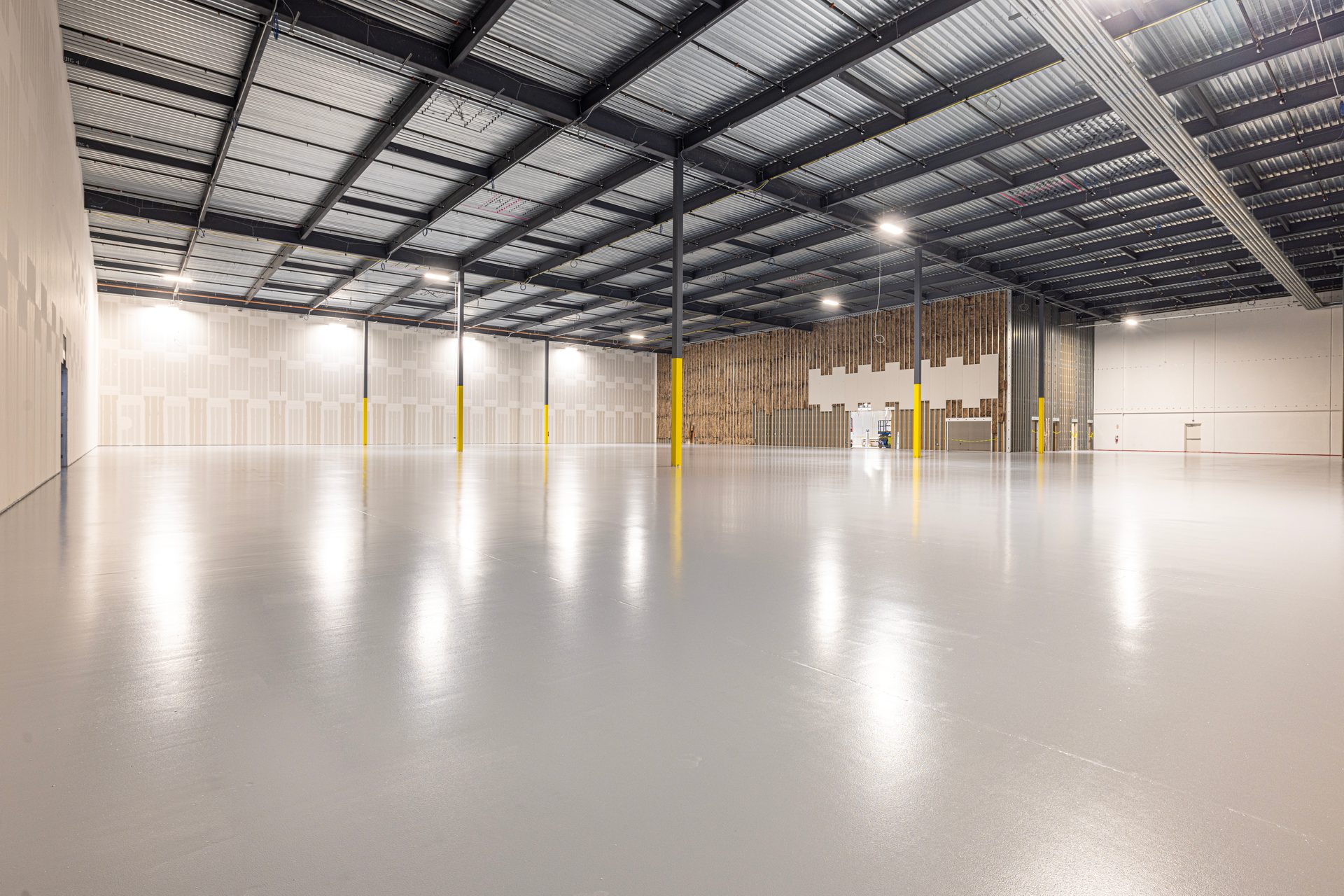
- Systems: Conductive and static dissipative epoxy from Sherwin-Williams High Performance Flooring, PIP, and Sika — Authorized SW + PIP + Sika installer
- Resistance:
- – Conductive: below 1 × 10⁶ ohms
- – Static dissipative: 1 × 10⁶ to 1 × 10⁹ ohms
- – Body voltage: under 100V per ANSI/ESD STM97.2
- Compliance:
- – ANSI/ESD S20.20 program standard
- – STM7.1 resistance testing
- – STM97.2 body voltage verification
- Pricing: $3.34-13.55/sqft installed depending on system type, thickness, and substrate condition
- Lead time: 1-3 weeks from contract execution
- Cure and testing: 24-72 hour cure-and-test window before resistance verification
- Service life: 25+ years floor system service life
- Crews: Directly employed W-2 installation crews assigned companywide through project-specific staffing and equipment plans; national service coverage; no brokered or 1099 day labor
Phone: +1 (844) 687-1961
The benefits of ESD flooring come from one mechanism: a continuous electrical path from a person’s body, through the floor, to ground. Electrostatic discharge flooring exists to move that charge before it does damage. Walking across standard epoxy can put several thousand volts on a person without them feeling it. An ESD floor bleeds that charge to building steel through a conductive ground plane, holding body voltage under 100V per ANSI/ESD STM97.2 before the charge reaches a sensitive component or an ignitable atmosphere. That is how ESD flooring works. Anti-static flooring is not the same thing — an anti-static surface resists new charge generation but gives charge already on the body nowhere to go, which is the distinction this page exists to make plain.
Who needs ESD flooring is a shorter question than it looks. If an uncontrolled discharge can damage the product you build or ignite the material you handle, you need a grounded floor, and a customer audit flow-down usually says so before an internal study does. Craftsman Concrete Floors has installed static-control flooring systems inside facility ANSI/ESD S20.20 programs since 1999, with in-house W-2 crews that provide national service coverage. The sections below cover the charge path itself, then the facilities that depend on it, then where anti-static floors stop short of a true ESD system.
How ESD Flooring Works
ESD flooring completes a circuit. The system is a stack: substrate, then a conductive ground plane, then the static-control wear surface, with copper ground straps tying the plane to building steel so a person standing anywhere on the floor is connected to ground. Remove any layer and the floor looks identical, but the circuit is open. Grounding, not the coating, is where installed ESD floors most often fail.
Several Thousand Volts from an Ordinary Walk
An ordinary walk across a standard epoxy floor generates charge through footwear-to-floor friction, a process called triboelectric charging, and can leave several thousand volts sitting on a person. The person feels none of it. Sensitive electronics do: a discharge far below human perception can latently damage a component that passes final test and fails in the field months later. Standard resinous floors give that charge no controlled path to ground, so it rides the body to the next conductive touchpoint, which in an assembly environment is usually the product.
The Ground Path Does the Work
The visible wear surface is only the top of the system. Beneath it, a conductive primer forms a continuous ground plane, and copper straps tie that plane to building steel at set intervals across the slab, so charge drains from the person continuously rather than discharging in a single event. This layer is the number-one install failure point in the category. A primer thinned out of spec, or a strap never landed on steel, produces a floor that passes visual inspection and fails resistance verification — the grounding failure a program audit exists to catch.
Verification per STM7.1 and STM97.2
None of it counts until it is measured. Resistance testing per ANSI/ESD STM7.1 confirms the floor material reads within its specified band, and a walking test per STM97.2 confirms the floor-and-footwear system holds body voltage under the 100V threshold that S20.20 sets for personnel grounding. Testing waits out the 24-72 hour cure-and-test window after the final coat, because uncured resin gives unreliable readings. The ESD compliance standards page defines each method in full; the closeout data itself goes to the facility’s program file, which is what an auditor asks to see.
Request a Proposal
Submit project parameters for preliminary analysis. Commercial estimates typically returned within 24 hours.
Facilities That Need ESD Flooring
Need here is driven by consequence, not preference. A facility falls into this category when an uncontrolled discharge damages the product being built, or when it ignites the material being handled. A third driver sits on top of both: the ANSI/ESD S20.20 program requirement or customer audit flow-down that turns a grounded floor from an engineering choice into a contractual one.
Product-Damage Environments
Semiconductor fabs, electronics assembly lines, and data center white space share one failure mode: the discharge that ruins product is one nobody in the room feels. A latent defect passes test, then fails at the customer. The floor is the only static control that covers everywhere a person walks, which is why hyperscale operators write it into build specs — Craftsman’s 67,000 square foot Houston installation went in as hyperscale-grade static control across the full data hall, not as mats around individual racks.
Ignition-Risk Environments
Munitions handling and solvent-processing areas face ignition risk, not component damage. A static discharge carries enough energy to light a flammable vapor, so a grounded floor operates in these facilities as a life-safety control rather than a yield protection. This group generally specifies the conductive class rather than static dissipative; the conductive vs dissipative page covers that selection and why the two classes are not interchangeable.
Benefits of ESD Flooring Under an S20.20 Program
For many suppliers the deciding document is a customer’s audit checklist, not an engineering study. Aerospace and medical OEMs flow ESD-control requirements down through their supply chains, and an S20.20-conformant program expects a compliant floor with test records behind it; facilities running international programs meet the same requirement under IEC 61340-5-1. In that context the benefits of ESD flooring are contractual. The floor either produces passing STM7.1 and STM97.2 data for the program file or it does not, and ESD flooring contractors are selected on their ability to deliver that closeout package.
Anti-Static Floors vs ESD Flooring
Search vocabulary blurs in this category. Anti-static, static dissipative, conductive, and ESD get used interchangeably by vendors, but they name different electrical behaviors, and specifying the wrong one produces a floor that looks right and fails its program audit. The subheads below cover the anti-static distinction this page owns. Format comparisons (poured epoxy against tile and vinyl) sit on the ESD flooring options page, and the full system catalog sits on the ESD flooring hub.
Anti-Static Is Not an S20.20 Class
An anti-static floor typically measures 10¹⁰ to 10¹² Ω — enough resistance to slow new charge generation, far too much to drain charge that already exists. A person who walks in carrying charge keeps it. The S20.20 classes behave differently: conductive flooring reads below 1.0×10⁶ Ω and static dissipative flooring reads 1.0×10⁶ to 1.0×10⁹ Ω, and both provide a verified path to ground per STM7.1. A buyer searching for anti-static ESD flooring almost always needs one of those two classes, and the selection between them belongs to the conductive vs dissipative comparison.
Partial Measures and Permanent Static Control
ESD mats protect the work zone they cover and nothing beyond it; charge re-accumulates within a few steps of leaving the mat. The rest of the facility runs unprotected. Sealed concrete drifts with humidity, so a slab that reads acceptably in a damp August can read effectively open in a dry February, with no controlled ground path in either season. Conductive paint and thin-film coatings start compliant and degrade, because abrasion strips the conductive layer out of traffic lanes first. A monolithic grounded system is the permanent static control alternative: one continuous surface, verified at installation and re-testable for the life of the floor.
Frequently Asked Questions
The core benefit is a permanent, whole-floor path to ground that holds body voltage under 100V per ANSI/ESD STM97.2 everywhere a person stands. Everything else follows from that path: product stops failing from latent discharge damage, ignition sources disappear from flammable-material areas, and the STM7.1 test records satisfy an ANSI/ESD S20.20 audit. No mat or wrist strap achieves whole-facility coverage the way the floor itself does.
It gives every person in a facility a continuous electrical path to ground while they walk, so static charge drains off the body instead of accumulating. In product environments that removes the discharge that latently damages components; in flammable-material areas it removes an ignition source. Either way the floor does one job: it moves charge to ground before the charge finds something sensitive.
The floor completes a circuit. A conductive ground plane beneath the wear surface ties to building steel through copper ground straps, so charge generated by footwear friction drains continuously rather than discharging in one event. After the 24-72 hour cure-and-test window, STM7.1 testing confirms the floor reads in its specified resistance band and the STM97.2 walking test confirms body voltage stays under the 100V threshold.
Any facility where an uncontrolled discharge damages product or ignites material. In practice that means electronics and semiconductor manufacturing, data centers, munitions handling, and solvent-processing areas, plus any supplier whose customer flows an ANSI/ESD S20.20 requirement down through an audit. If your contracts reference S20.20 or your product carries an ESD-sensitive symbol, you are in this group.
Mats and wrist straps protect the workstation they serve and nothing beyond it. Charge re-accumulates within a few steps of leaving a mat, so anyone moving product between stations works unprotected. A grounded floor is the one ESD control active everywhere a person walks, and under S20.20 the floor-and-footwear system is verified together. That is exactly what the STM97.2 walking test measures.
Resistance, and what happens to charge already on the body. Anti-static floors typically read 10¹⁰ to 10¹² Ω, which slows new charge generation but drains nothing. ESD flooring under ANSI/ESD S20.20 falls in the conductive or static dissipative class, both of which carry charge to ground through a verified path; the numeric bands and the selection between the two classes are covered on the conductive vs dissipative page.
The mechanism is identical; the driver differs. Electronics and semiconductor facilities are protecting product yield and satisfying customer audit flow-downs, while a data center is protecting uptime across live white space. Ignition-risk facilities are removing a life-safety hazard, which typically points them to the conductive class rather than static dissipative.
Yes. Craftsman provides nationwide ESD flooring installation through directly employed W-2 crews assigned companywide to each project according to geography, schedule, system requirements, crew experience, equipment needs, and concurrent workload.
Our offices in Dallas, Fort Worth, Austin, San Antonio, Houston, and Oklahoma City provide regional service and project accountability; they are not fixed crew or equipment origins. Each proposal identifies the project-specific staffing, equipment, mobilization, and travel assumptions included in the price.
Recent ESD projects include a 67,000-square-foot hyperscale-grade installation in Houston and a 34,000-square-foot Fortune 500 facility in Dallas. Those are project locations—not the origin point for Craftsman’s national workforce.