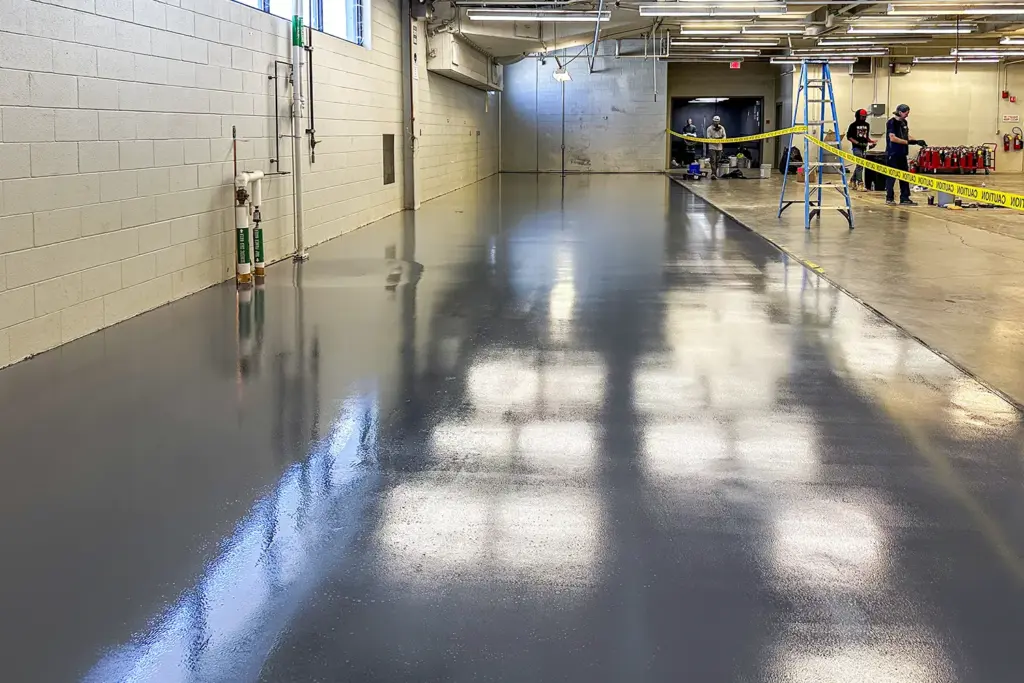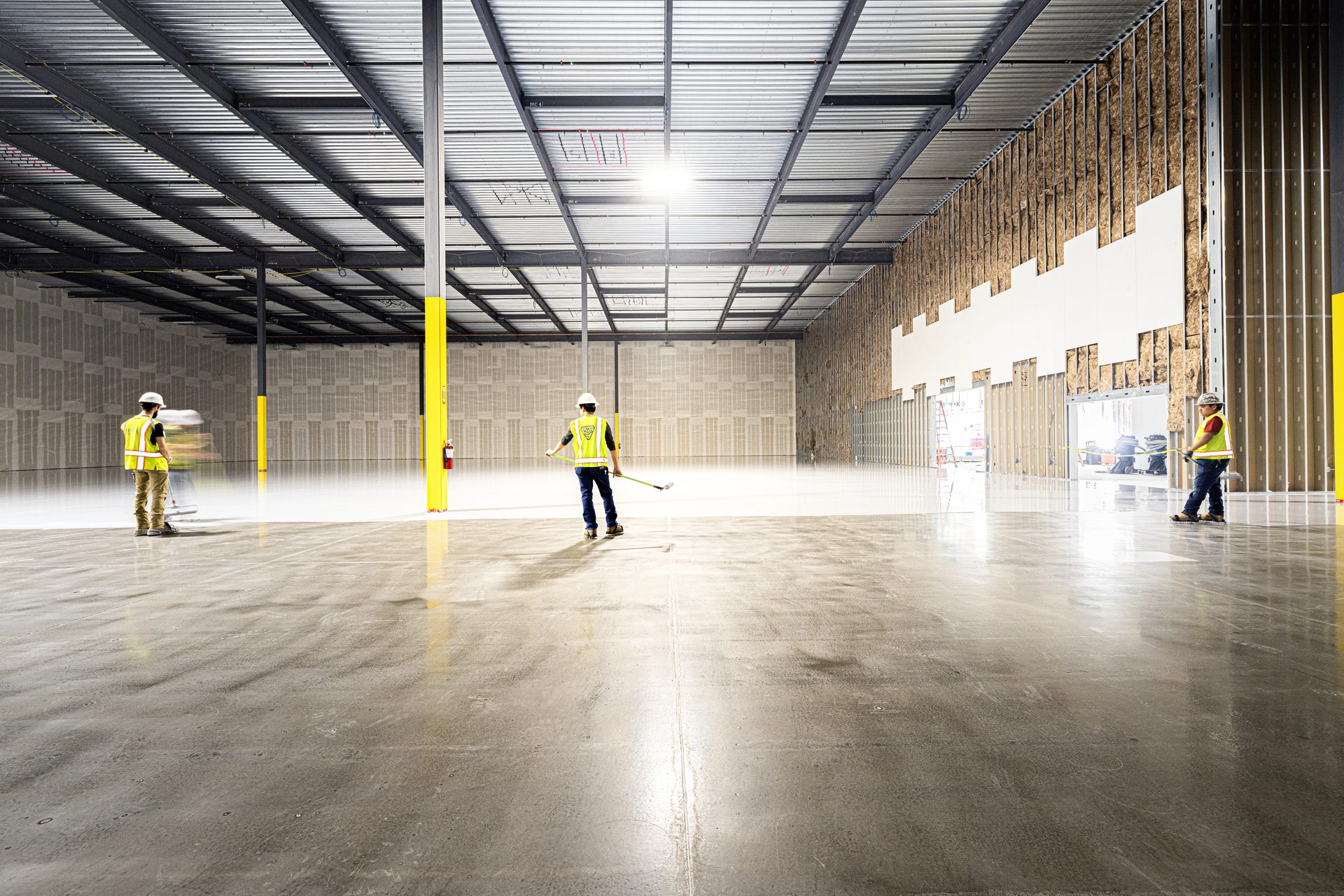
ESD SYSTEM REQUIREMENTS, TESTING + VERIFICATION
THE SPECIFICATION AND ESD CONTROL PROGRAM SET THE CRITERIA
Craftsman installs ESD and static-control flooring to the applicable specification, executed scope, and selected manufacturer’s requirements. When a project requires alignment with ANSI/ESD S20.20 or IEC 61340-5-1, the flooring classification, grounding details, test methods, responsible parties, and acceptance criteria are defined before installation.
Conductive and static-dissipative floors serve different electrical-control requirements. Conductive flooring is below 1.0 × 10⁶ ohms, while static-dissipative flooring is 1.0 × 10⁶ to 1.0 × 10⁹ ohms. The project’s ESD control plan, component sensitivity, grounding design, selected system, and governing specification determine the appropriate band; neither classification is automatically correct for every room within an industry.
When specified, Craftsman employees perform ANSI/ESD STM7.1 flooring-resistance testing. Resistance-to-ground and point-to-point readings are taken with a calibrated Desco 19290 Digital Surface Resistance Meter Kit and standard five-pound electrodes. Craftsman’s written report records the readings, mapped floor locations, applicable site conditions, photographs, and pass/fail status against the project’s approved acceptance criteria. Any STM97.1 system-resistance or STM97.2 body-voltage testing is separately assigned by the specification and executed scope.
- Project-specific ANSI/ESD S20.20 and IEC 61340-5-1 requirements review
- Conductive or static-dissipative classification against approved criteria
- Grounding and connection details for the selected flooring system
- Resistance-to-ground testing per ANSI/ESD STM7.1 when specified
- Point-to-point resistance testing per ANSI/ESD STM7.1 when specified
- Additional STM97.1 or STM97.2 testing when assigned by the project documents
- Calibrated test instrumentation with records available when specified
- Mapped readings, recorded conditions, photographs, and pass/fail reporting
- Acceptance criteria tied to the applicable project and manufacturer requirements
NATIONAL SERVICE COVERAGE
CRAFTSMAN-EMPLOYED W-2 INSTALLATION CREWS
National service coverage • Installation performed by Craftsman-employed W-2 crews. W-2 installers, not 1099 day-labor. Trained, insured, and accountable to you. The same core workforce model, installation leadership, training system, documentation path, and safety accountability can carry across phased and multi-site programs even when the employee roster changes by site, phase, scope, or schedule.
Craftsman manages estimating, contracting, scheduling, resource assignment, procurement, project management, safety, billing, documentation, warranty administration, and corrective response through one companywide management structure. Crew and equipment commitments are then made project by project through the proposal, staffing plan, equipment plan, and schedule.
Project resources are assigned according to the work, not an office address. Relevant ESD-system experience, current deployment, project location, employee home location, schedule, availability, geographic sequencing, and customer continuity can all affect assignment. The staffing plan identifies the crew and field leadership committed to the site; national coverage does not promise a fixed origin or immediate availability.
Major installation equipment is assigned through the same project-specific planning process. Craftsman employees transport major equipment directly between project sites as the sequence moves. The equipment plan identifies the equipment, origin, staging, movement, and assumptions committed to the actual site rather than treating national coverage as a universal dispatch model.
- Craftsman-employed W-2 installation crews
- On-site skilled foreman directly supervising every installation shift
- Project-specific crew and field-leadership commitments
- Project-specific equipment assignment, origin, staging, and movement plan
- Companywide management of commercial and operational functions
- Site-specific safety planning and facility-access administration
- Day, night, weekend, phased, and continuous-operation schedules when committed resources allow
- Craftsman-employee transport of major equipment between project sites
MULTI-SITE PROGRAM EXECUTION + MSA
ONE CONTRACT VEHICLE, ONE OPERATING SYSTEM
National accounts can run under a Master Service Agreement—one contract vehicle across every site in the program. The same structure is regularly available for local repeat and regional multi-location accounts. The executed agreement defines which commercial terms, operating rules, documentation requirements, and escalation procedures apply across the program; an MSA is available, not automatic.
Program consistency comes from a shared operating framework, not an assumption that every site needs the same ESD floor. Craftsman can carry one direct-workforce model, installation-leadership structure, training system, documentation path, safety-accountability model, and management structure across the program while the selected system, preparation, grounding details, testing criteria, and schedule remain specific to each facility or area.
Commercial terms and pricing formats can be standardized where the agreement defines them. Site-specific quantities, substrate conditions, access, phasing, testing, system selection, and schedule assumptions still have to be identified in the applicable work order. Defined change procedures keep those differences visible rather than forcing unlike sites into an unsupported universal price.
Multi-site delivery can be sequential, concurrent, or hybrid when the accepted schedule and committed resources allow. The proposal and program plan identify which sites overlap, the staffing and field leadership assigned to each site, the equipment allocation, work-window commitments, and the response if a site loses its scheduled window. Availability is verified against the actual rollout rather than presumed from the MSA.
- Master Service Agreement where selected by the parties
- Site-specific work orders, scopes, and ESD-system requirements
- Standardized commercial terms and pricing formats where agreed
- Consistent documentation format across sites
- Project-specific crew, field-leadership, equipment, and schedule commitments
- Centralized project management + reporting
- Defined change order and site-condition protocols
- Sequential, concurrent, or hybrid delivery as committed resources allow
- Warranty-administration and corrective-response path
ACTIVE-FACILITY + SHUTDOWN-WINDOW PHASING
INSTALLATION SEQUENCED AROUND LIVE OPERATIONS
Craftsman can phase ESD flooring installation around continuing operations when the site, selected system, access requirements, schedule, and committed resources permit it. The written phase plan identifies the areas that remain operational, the zones released for flooring work, the routes and boundaries that must remain available, the required exposure milestones, and the authority for handback and restart.
Isolation controls are selected for the preparation method, facility, adjacent operation, specified ESD system, and executed scope. Depending on the work, the plan may address capture at the tool, physical barriers, sealed penetrations, managed air movement, negative-pressure enclosures, vibration restrictions, housekeeping, and separate routes for crews, production, equipment, and waste. These controls reduce exposure; they are not a universal zero-dust, zero-odor, or uninterrupted-operations promise.
A shutdown window must cover the applicable preparation, installation, cure, inspection or specified testing, cleanup, and handback stages. Planned outages, holiday shutdowns, nights, and weekends can provide those windows. Materials and equipment may be staged in advance when the site and plan permit it, but the selected system, actual conditions, access approvals, and required exposure milestone determine what the window can contain.
Every installation shift has an on-site skilled foreman with direct supervision and stop-work accountability. Each active project also receives an assigned non-crew Safety and Operations Manager who is physically present during one shift of each working day, including weekend working days. When included in the scope, daily or shift reports, changed-condition notices, open-item logs, and phase-handback records preserve the coordination trail.
- Written phase sequencing tied to facility operating requirements
- Visible work-zone boundaries and defined access routes
- Task- and site-specific dust, odor, ventilation, and housekeeping controls
- Negative-pressure or vibration controls where the operation requires them
- Shutdown windows sized through the required exposure milestone
- Weekend and off-hours installation when the schedule and committed resources allow
- On-site skilled foreman directly supervising every installation shift
- Named facility and Craftsman communication and escalation contacts
- Changed-condition, standby, remobilization, and restart procedures
PROJECT-APPROPRIATE SUBMITTAL, TESTING + CLOSEOUT DOCUMENTATION
DEFINED BY THE SYSTEM, SPECIFICATION + EXECUTED SCOPE
Craftsman assembles and delivers the ESD flooring records selected by the relevant system, specification, and executed scope. No project automatically receives every document. Defining the required submittals, direct tests, third-party activities, turnover records, acceptance path, and file format before award allows the obligations to be scoped and priced instead of assumed.
When included in the scope, Craftsman assembles the applicable pre-installation submittals from the parties responsible for them. The package may include the approved flooring scope, selected-system product data, manufacturer requirements, installation and grounding details, project procedures, safety information, quality plan, and phasing schedule. Craftsman identifies the source where a manufacturer, customer, general contractor, design professional, or other authorized party issues the document.
Every direct Craftsman test ends in a written digital report rather than a bare reading. When specified, the report maps readings to floor locations and records the date and time, ambient temperature and relative humidity, slab temperature, photographs, acceptance criteria, and pass/fail status. For static-control floors, Craftsman issues an ANSI/ESD STM7.1 flooring-resistance report; it does not issue an ESD-floor certification.
Craftsman normally delivers closeout as a digital folder of individually named PDF files by email. Each filename identifies the project, applicable floor system or area, document type, and date or revision. Manufacturer warranty documents are included where the selected system provides them, alongside Craftsman’s one-year workmanship warranty in the executed contract and closeout documents. Other delivery systems, retention requirements, or acceptance formats apply only when the project documents require them.
- Pre-installation moisture testing (ASTM F2170 / F1869)
- Surface moisture-meter readings where the manufacturer and project procedure accept them
- Approved flooring scope and selected-system product documents
- Project procedures, quality plan, and installation phasing schedule
- Daily or shift reports and progress photographs
- Recorded test conditions and mapped floor locations
- Material batch and lot records where required
- Resistance-to-ground and point-to-point results per ANSI/ESD STM7.1
- Additional system-resistance or body-voltage results when separately specified
- Grounding and connection-verification records where assigned
- Manufacturer warranty documents where the selected system provides them
- Craftsman one-year workmanship warranty
- Open-item, corrective-work, retesting, and acceptance records where applicable
- Maintenance and care information where required
Request a Proposal
Submit project parameters for preliminary analysis. Commercial estimates typically returned within 24 hours.
ESD Flooring Knowledge Center
Resource links
Project Planning & Delivery
Compliance Requirements & Testing
Systems & Selection
Where ESD Flooring Is Used
Maintenance & Troubleshooting
Manufacturer ESD Flooring Systems
Case Studies
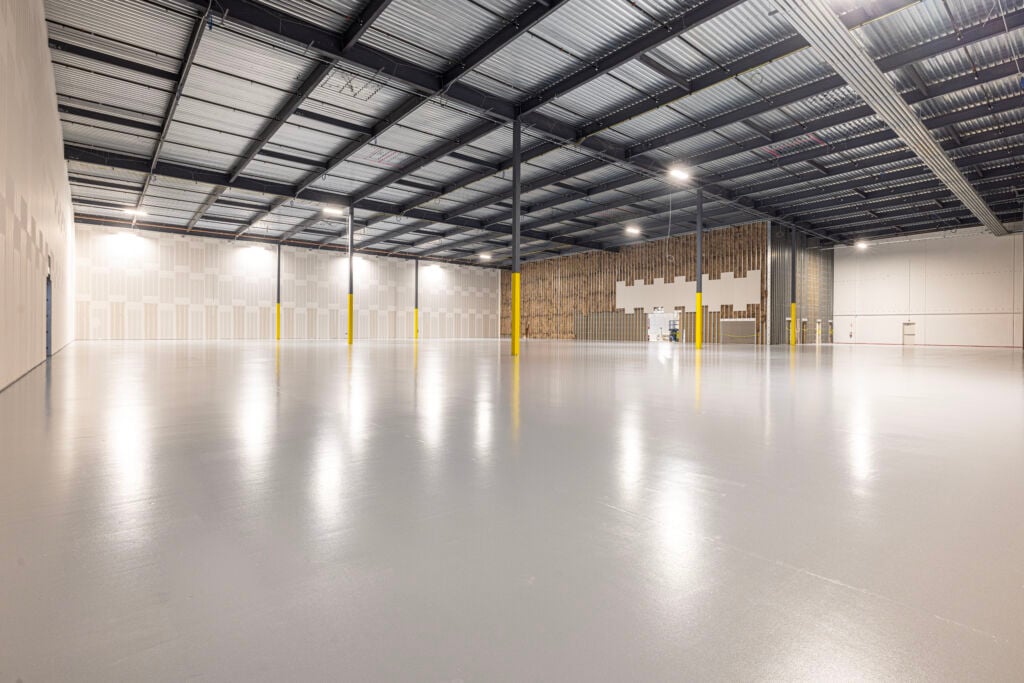
ESD Epoxy Flooring Case Study: 34,000 SF Dallas, TX
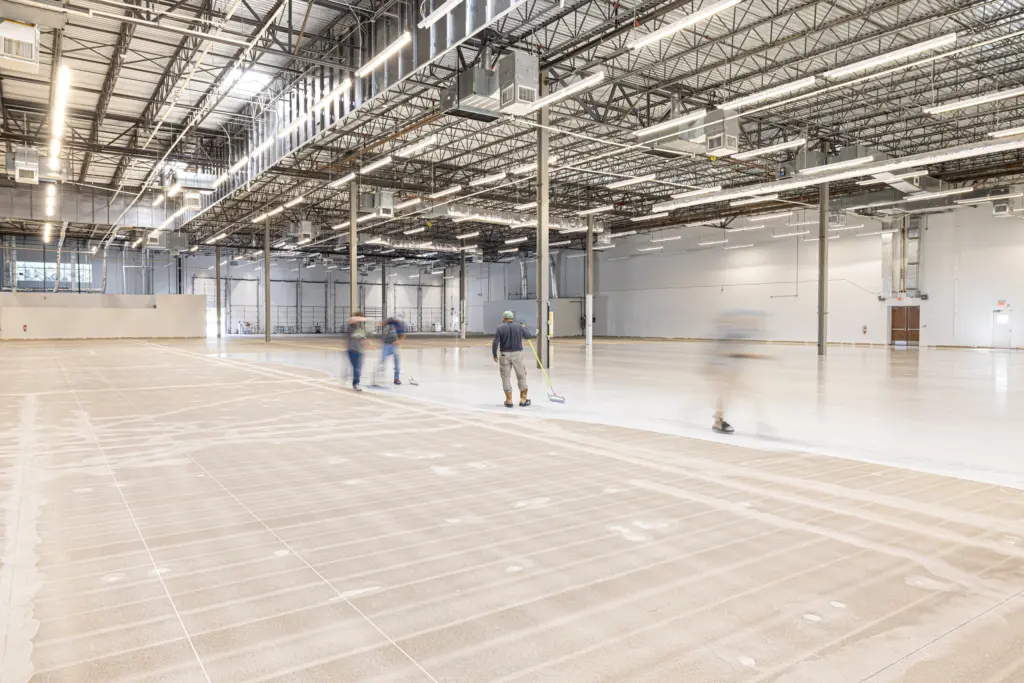
ESD Epoxy Flooring Case Study: 67,000 SF | Houston, TX