Real pricing from 54 recent commercial installs. ESD epoxy and urethane systems range from $3.34 to $13.55 per square foot installed, depending on project size, system specification, and site conditions.
| Project Size | Price Range | Typical Project Total |
| Small — under 5,000 sf | $6.70–$13.55/sf | $4,725–$67,000 |
| Mid — 5,000–20,000 sf | $3.93–$8.15/sf | $25,000–$125,000 |
| Large — 20,000+ sf | $3.34–$4.40/sf | $67,000–$449,000 |
Contact us for a project-specific quote.
Our Clients




















GET A LINE ITEM QUOTE
What Drives ESD Flooring Cost
ESD flooring pricing varies more than standard epoxy because of the materials, testing, and grounding required to meet ANSI/ESD S20.20 compliance. Six factors drive the final cost per square foot:
Project size
Larger projects generally cost less per square foot because fixed project setup, mobilization, equipment, testing, and closeout requirements are distributed across more area. A 75-square-foot repair can cost $63 per square foot, while a 114,000-square-foot installation can cost $3.91 per square foot.
Mobilization is based on the staffing and equipment plan for the specific project. Craftsman does not assume that crews or equipment originate from Dallas—or from any other fixed office. Resources are assigned companywide according to project geography, schedule, system requirements, crew experience, equipment needs, and concurrent workload.
System type
ESD epoxy costs less than ESD urethane cement. Conductive vinyl tile costs more than both. Static-dissipative coatings cost less than fully conductive systems. The right system depends on the facility’s compliance requirement, chemical exposure, and traffic load — not on what’s cheapest.
Surface preparation
Shot blasting runs $0.50–$0.97 per square foot and is required on almost every ESD install. Concrete repair, crack chasing, and grinding add more. A smooth, sound substrate is faster to prep than a damaged or contaminated one.
Joint filling
Control joints and construction joints need semi-rigid filler before ESD flooring is installed — $2.50–$4.75 per linear foot. A warehouse with joints every 20 feet adds up fast.
Moisture mitigation
Concrete slabs with high moisture vapor emission require a moisture mitigation primer or membrane. This adds $1.50–$4.00 per square foot and is non-negotiable — ESD flooring installed over wet concrete will fail.
Facility access and scheduling
Phased installation, night shifts, weekend work, clean room protocols, and equipment relocation all affect cost. A running facility that can’t shut down costs more than an empty shell.
Real ESD Project Cost Examples
These are actual installed costs from Craftsman Concrete Floors projects:
| Project | Size | Total Cost | Cost/sf |
| Floor repair | 75 sf | $4,725 | $63.00/sf |
| Aerospace component facility | 3,200 sf | $32,500 | $10.15/sf |
| Dallas electronics manufacturing | 34,000 sf | $143,140 | $4.21/sf |
| Houston data center | 67,000 sf | $240,530 | $3.59/sf |
| Battery manufacturing | 114,760 sf | $449,170 | $3.91/sf |
Small repairs have higher per-square-foot costs because fixed project requirements—including planning, equipment setup, surface preparation, grounding, testing, and documentation—are distributed across very little floor area. Large continuous installations benefit from efficiency at scale. Most commercial ESD flooring projects total between $25,000 and $250,000.
What’s Included in Our ESD Flooring Cost
- Site survey and moisture testing
- Full surface preparation — shot blasting, grinding, crack repair, joint filling
- Grounding system installation — copper ground straps tied to building ground per ANSI/ESD S20.20
- Resistance testing — ohms-to-ground and ohms point-to-point, documented per STM 97.1 and STM 97.2
- Compliance documentation — signed resistance test reports for audit and qualification
What we don’t mark up: we don’t pad material costs, we don’t bill change orders for conditions visible during the site survey, and we don’t charge for the documentation package.
ESD Flooring Gallery
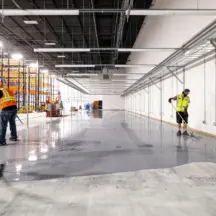
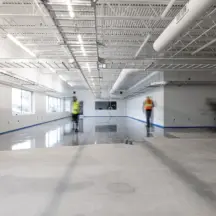
ESD Flooring Knowledge Center
Resource links
Project Planning & Delivery
- ESD Installation Timeline
- ESD Flooring Contractor Guide
- ESD Flooring Capabilities
- Static-Control Flooring Systems
- ESD Project Delivery Framework
- Planning ESD test locations — Review method-specific sampling requirements when defining the testing scope to be priced.
Systems & Selection
Compliance Requirements & Testing
- ESD Control Program Standards
- Facility-Specific ESD Requirements
- Qualification, acceptance and routine verification — Separate the testing stages before comparing proposals and their included deliverables.
Where ESD Flooring Is Used
Maintenance & Troubleshooting
Manufacturer ESD Flooring Systems
Frequently Asked Questions
ESD flooring is priced by the specification and the site rather than a flat per-foot rate. Two facilities with identical square footage can land far apart. The system class moves the number first: conductive and dissipative formulations, grounding-grid density, and topcoat selection are all spec-driven. Site conditions move it further, since slab repairs, moisture mitigation, cove base, and mechanical prep scale with the floor’s actual state. Compliance scope adds resistance testing, S20.20 turnover documentation, and any recurring re-certification program. Schedule matters as well; occupied-facility phasing and night or shutdown-window work change crew logistics. Send the spec, square footage, and facility type and Craftsman Concrete Floors returns an itemized estimate, typically within 24 hours for commercial projects.
System build and slab condition drive most of the number, with grounding scope, facility logistics, and project size making up the rest. System build is the number of coats, the conductive media loading, and the topcoat class the spec requires. Slab condition is what assessment discovers on your actual floor: moisture mitigation, crack and joint repair, and the mechanical prep profile. No brochure lists those. Grounding and testing scope spans grid density, ground-point count, STM7.1 verification, and documentation depth, while facility logistics captures occupied-space phasing, containment, security clearances, and off-hours windows. Larger continuous areas generally price lower per square foot because project setup, equipment, testing, documentation, and cure cycles are distributed across more floor area. Craftsman Concrete Floors itemizes each driver in its estimates so the number is explainable line by line.
It costs more than the same floor in standard epoxy. You are buying an engineered electrical system on top of a coating. The premium pays for conductive media in the resin, the copper grounding grid and bonded ground points, and the resistance testing and documentation that make the floor auditable. The gap narrows on larger areas where prep and mobilization dominate cost regardless of system. Skipping the ESD spec where it is genuinely required is the expensive path. Component damage, failed audits, and re-floors cost multiples of the premium. Where ESD is not actually needed, standard epoxy is the right call, and an honest contractor will say so. Craftsman Concrete Floors quotes both paths when the requirement is unclear so the decision is made on real numbers.
Testing should be a visible line item. A compliant ESD install includes ANSI/ESD STM7.1 resistance verification and turnover documentation, and a quote without it is not comparable. Turnover testing measures point-to-point and resistance-to-ground at defined locations and records the values against the specified class. S20.20 facilities may also need flooring/footwear system qualification per STM97.1 and STM97.2 in the initial scope. Recurring re-certification, commonly annual, is a separate program line and worth pricing at install time. Beware low bids that omit testing. An unverified ESD floor is indistinguishable from a failed one on audit day. Craftsman Concrete Floors includes STM7.1 turnover testing on every ESD installation and offers scheduled re-certification programs.
Case Studies
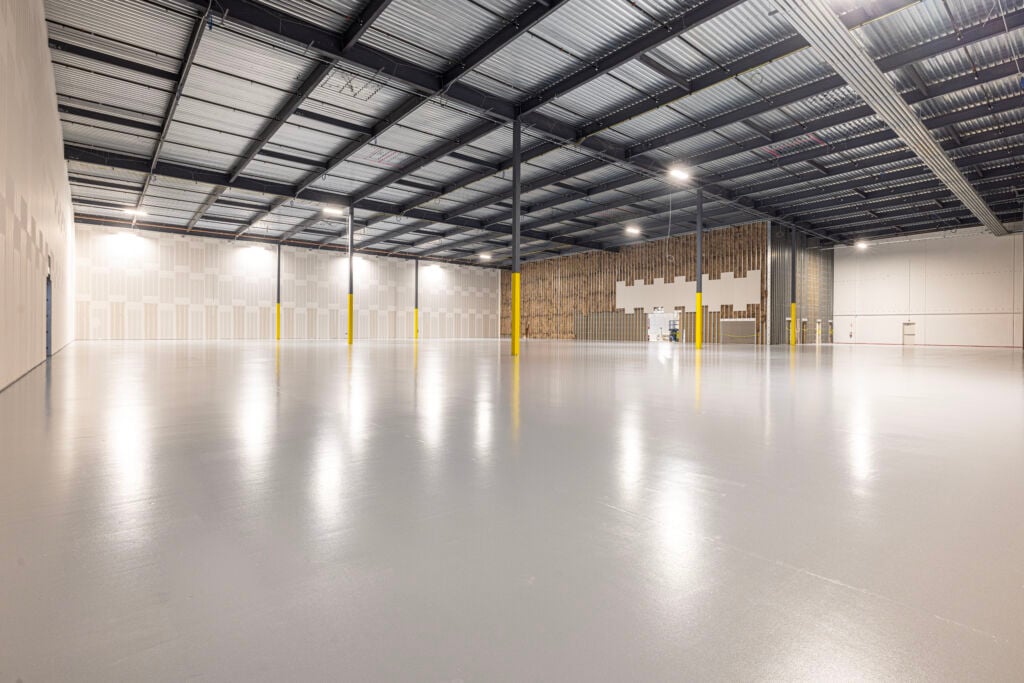
ESD Epoxy Flooring Case Study: 34,000 SF Dallas, TX
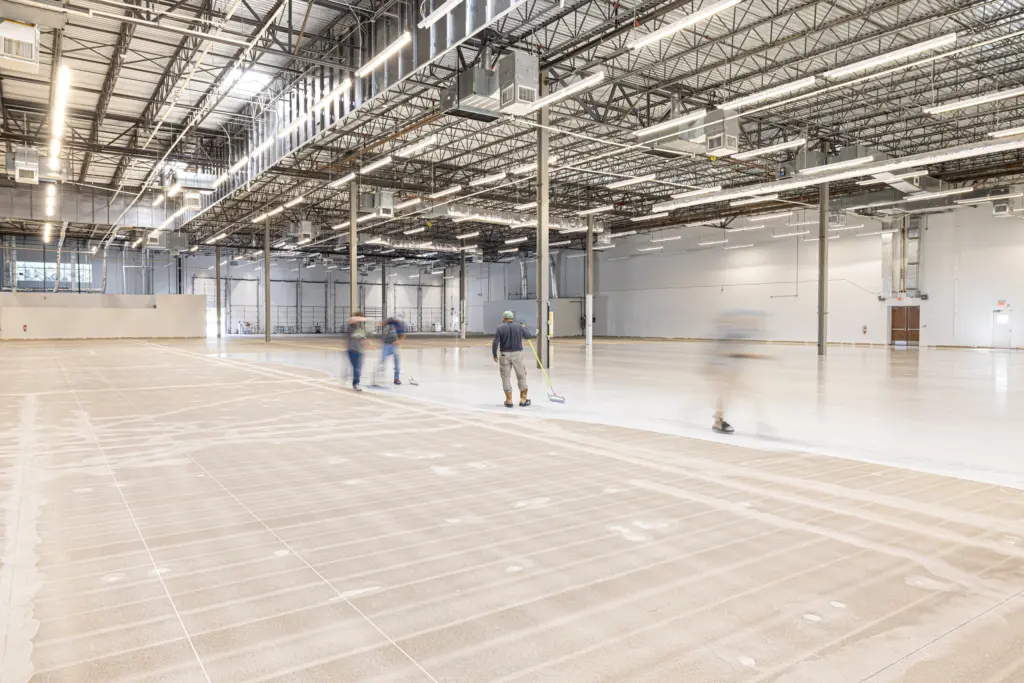
ESD Epoxy Flooring Case Study: 67,000 SF | Houston, TX