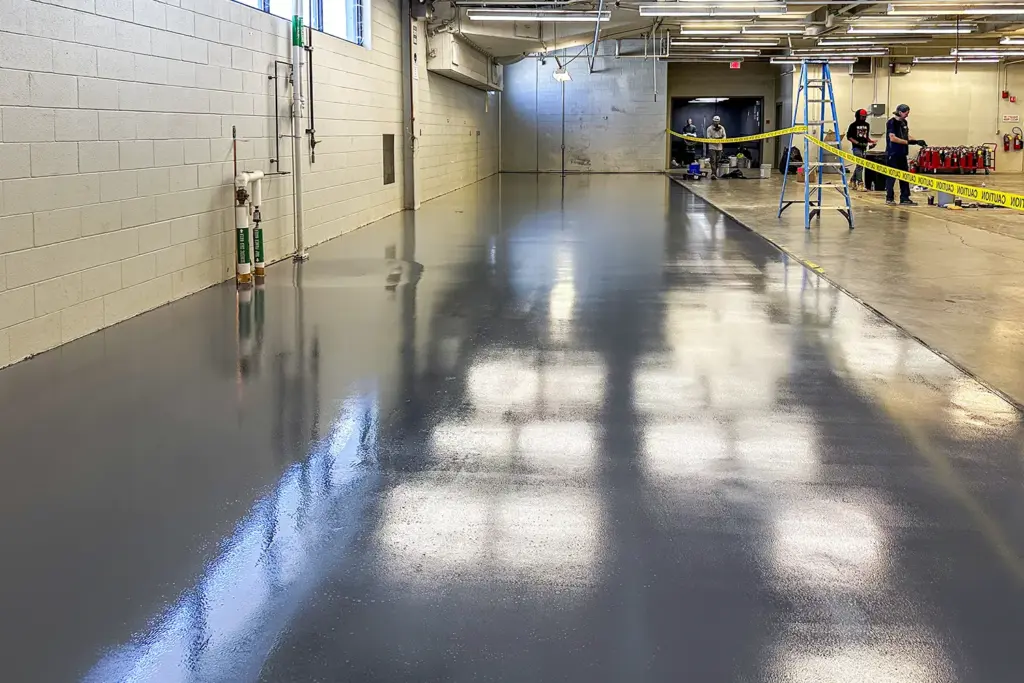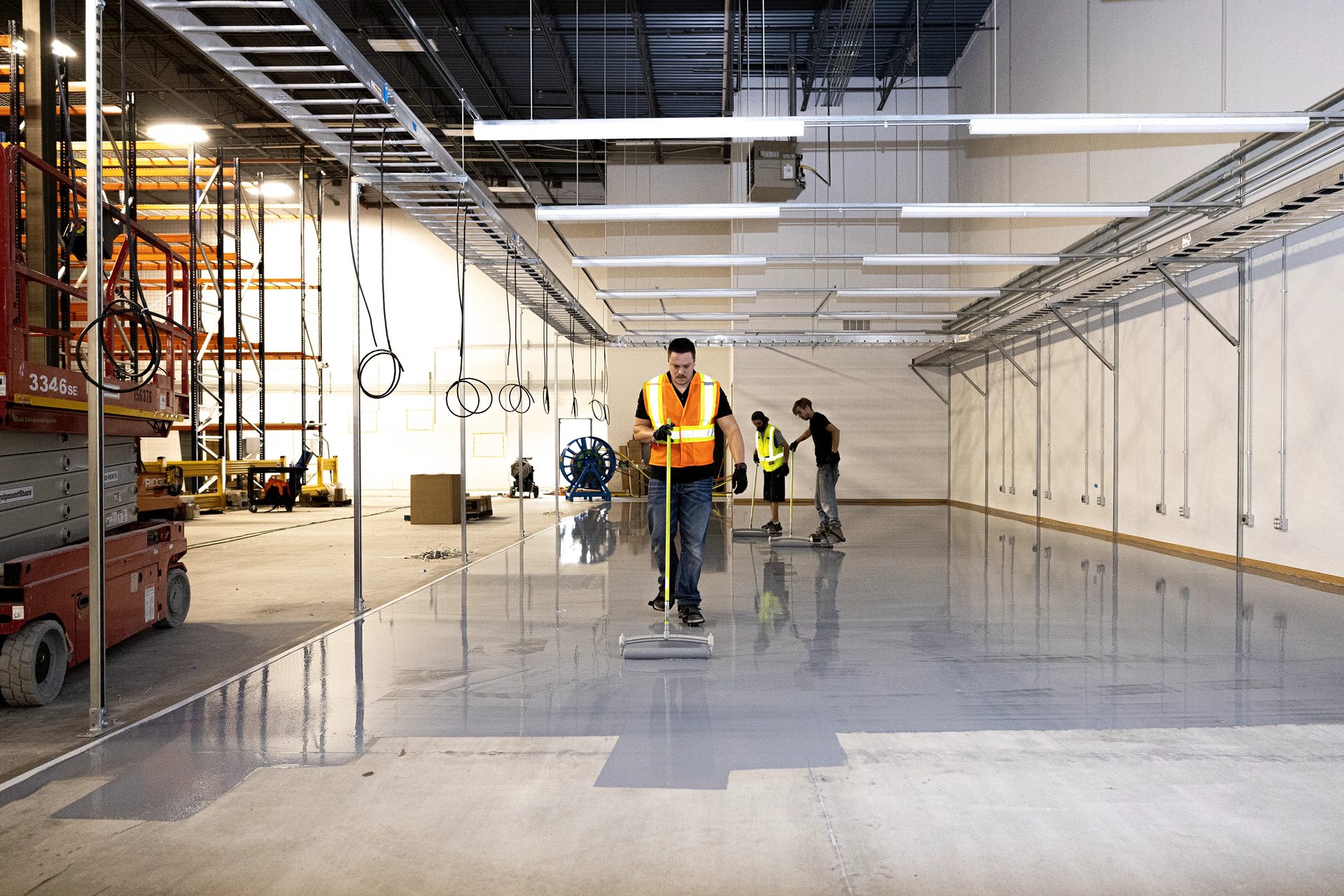
- Current Name: Resuflor SCT (Static Control Topcoat Dissipative) — Parts GP3530A01 / GP3530B01 / GP3530C01
- Manufacturer: Sherwin-Williams High Performance Flooring
- Resistance: Static dissipative, 1 × 10⁵ to 1 × 10⁹ ohms per ANSI/ESD STM7.1-2013 (point to point and point to ground)
- Compliance:
- – Meets ANSI/ESD S20.20-2014 for floor resistance readings of 1 × 10⁵ to 1 × 10⁹ ohms
- – Body voltage generation under the 100V S20.20 threshold (measured per ANSI/ESD STM97.2)
- – LEED v4 Indoor Air Quality credits available; CDPH-CA Section 01350
- System Type: Three-component high-solids epoxy topcoat with conductive powder; dissipative class
- Thickness: 15-20 mils (0.38-0.51 mm) topcoat, over the required primer and build coat
- Primer / Build: Sherwin-Williams 100% solids epoxy primer required; at least 8 mils of epoxy build coat recommended for hide
- Grounding: Copper tape on the insulator coat beneath the SCT, tied to the facility common ground
- Cure & Test: Foot traffic at 24 hours; resistance test at 24 hours; 7-day baseline reading; full properties at 14 days
- Mechanicals:
- – Abrasion 90-100 (ASTM D4060, CS-17 wheel, 1,000 g, 1,000 cycles)
- – COF 0.50-0.55 (ASTM D2047); wet static COF 0.97 (ANSI/NFSI B101.1)
- – VOC under 100 g/L mixed (ASTM D3960); volume solids 84.92%
Phone: +1 (844) 687-1961
Resuflor SCT is Sherwin-Williams’ static dissipative epoxy topcoat: a three-component, high-solids epoxy carrying a conductive powder, applied at 15-20 mils (0.38-0.51 mm) over an electrically insulating coat of Sherwin-Williams 100% solids epoxy. The current product data sheet, revised October 10, 2025, rates surface resistance at 1×10⁵ to 1×10⁹ Ω per ANSI/ESD STM7.1-2013 and states the coating meets ANSI/ESD S20.20-2014 for floor resistance readings in that range, with body voltage generation under the 100V program threshold. Craftsman Concrete Floors installs Resuflor SCT ESD flooring as an authorized Sherwin-Williams High Performance Flooring installer, with in-house W-2 crews that provide national service coverage to project sites.
The name on the pail matters less than what sits under it. Resuflor SCT is a topcoat, not a standalone system — the TDS requires a Sherwin-Williams 100% solids epoxy primer beneath it and recommends at least 8 mils of epoxy build coat for complete hide. The dissipative reading a facility gets at commissioning depends on that insulating layer, the grounding path tied into the building’s common ground, and a resistance test run per STM7.1 after the coating cures. A correctly specified product installed over a skipped primer or an unverified ground reads out of band.
Our Clients




















Resuflor SCT as an Installed System
Most Resuflor ESD flooring specs arrive from an architect or engineer working from a Sherwin-Williams system sheet. What decides whether the finished floor reads in band is rarely the topcoat itself. The requirements below, from the insulating epoxy to the cure-and-test schedule, come straight from the current data sheet, revised October 10, 2025.
The Insulating Epoxy Beneath the Topcoat
Resuflor SCT must be applied over a Sherwin-Williams 100% solids epoxy primer, with at least 8 mils of epoxy build coat recommended on top of the primer for complete hide. That insulator does two jobs. Electrically, it decouples the topcoat’s resistance readings from concrete whose resistance shifts with humidity, so charge routes through the engineered ground path instead of the slab. Visually, the topcoat needs a pigmented coat of similar color beneath it, because the finished system reads closer to the primer color and white is not offered in SCT.
Grounding, Cure, and Resistance Verification
When Resuflor SCT serves as the primary ground, the TDS requires a grounding system connected to the facility’s common ground; where copper tape is used, it installs on the insulator coat, underneath the SCT. Verification then runs on the TDS clock. Surface resistivity is tested at 24 hours to confirm the system reads within specification, the baseline reading for future audits is taken after a 7-day cure, and full coating properties develop over 14 days. Inside an ANSI/ESD S20.20 program, that floor-material reading per STM7.1 pairs with system resistance per STM97.1 and body voltage generation per STM97.2, held under the 100V program threshold.
Surface Prep and Moisture Requirements
Concrete must read below 75% internal relative humidity before application, and the TDS recommends in-situ testing per ASTM F2170 specifically. Floor and material temperatures sit between 65°F and 90°F, ambient humidity stays under 80%, and the slab holds at least five degrees above dew point. Mechanical prep scales with total system thickness: EasyPrep tooling for 10-25 mil systems, steel shot blast above 16 mils, scarification above 25 mils. Oil, silicones, and mold-release residue cause fisheyes, so a detergent scrub and rinse precedes profiling.
Where the Dissipative Band Fits
The TDS lists packaging, manufacturing, avionics, electrical assembly and production, clean room and lab, and warehouse and distribution as typical uses, all environments that run an S20.20 program on a dissipative floor. Selection between the dissipative and conductive bands is a program decision, not a product preference; conductive work below 1.0×10⁶ Ω belongs to a different product class, and the conductive vs dissipative page covers that call. The installation-process page covers sequence and phasing, and project pricing lives on the ESD flooring cost page.
ESD Flooring Gallery










Request a Proposal
Submit project parameters for preliminary analysis. Commercial estimates typically returned within 24 hours.
ESD Flooring Knowledge Center
Resource links
Systems & Selection
- Static-Control Flooring System Comparison
- Conductive vs Dissipative Flooring
- How ESD Flooring Works
- Why Facilities Use ESD Flooring
- Interpreting ESD flooring data sheets — Read resistance, body-voltage and compliance statements in the context of the tested system.
Compliance Requirements & Testing
- ESD Control Program Standards
- Recurring ESD Floor Verification
- What qualifies as system qualification evidence? — Check whether supplier information supports the actual footwear/flooring combination and required conditions.
Project Planning & Delivery
- ESD Installation Timeline
- Static-Control Flooring Systems
- ESD Program Delivery Capabilities
- When to test a newly installed ESD floor — Distinguish installation-stage checks, cure requirements and final acceptance testing.
Where ESD Flooring Is Used
Maintenance & Troubleshooting
Manufacturer ESD Flooring Systems
Frequently Asked Questions
Resuflor SCT, short for Static Control Topcoat, is Sherwin-Williams’ three-component static dissipative epoxy topcoat, applied at 15-20 mils over an insulating Sherwin-Williams 100% solids epoxy coat. The current TDS, revised October 10, 2025, rates it at 1×10⁵ to 1×10⁹ Ω per ANSI/ESD STM7.1-2013 and states conformance to ANSI/ESD S20.20-2014 for floor resistance readings in that range. Part numbers are GP3530A01, GP3530B01, and GP3530C01.
The Resuflor SCT topcoat goes down at 15-20 mils (0.38-0.51 mm). Beneath it, the TDS requires a Sherwin-Williams 100% solids epoxy primer and recommends a minimum 8-mil epoxy build coat for full hide, so total system thickness depends on the build specified. Prep method scales with that total: steel shot blast above 16 mils of system, scarification above 25.
Static dissipative. The TDS rates surface resistance at 1×10⁵ to 1×10⁹ Ω point to point and point to ground per ANSI/ESD STM7.1-2013, and its S20.20-2014 conformance statement covers floor resistance readings in that range. Programs that require a conductive floor — below 1.0×10⁶ Ω across the whole system, typical for munitions and flammable atmospheres — are specifying a different product class, covered on the conductive vs dissipative page.
The TDS mandates it: Resuflor SCT goes over a Sherwin-Williams 100% solids epoxy primer, and the topcoat’s dissipative performance is a system property, not a bucket property. When the floor is the primary ground, copper tape installs on that insulating coat, underneath the SCT, and ties to the facility’s common ground. A skipped or thinned primer, or a ground path never connected to the building’s grounding system, produces out-of-band readings from a correctly manufactured product.
Foot traffic at 24 hours cured at 75°F, with more time at lower temperatures and for heavier traffic. The first resistance reading comes at 24 hours, the audit baseline after a 7-day cure, and full properties by day 14. Hold mechanical cleaning equipment such as scrubbers off the floor until the coating has cured at least one week.
The TDS lists electrical assembly and production, avionics, clean room and lab, packaging, manufacturing, and warehouse and distribution as typical uses. In practice that means static-sensitive electronics work where an ANSI/ESD S20.20 program calls for a dissipative floor verified per STM7.1, with body voltage generation held under the 100V program threshold per STM97.2.
Craftsman Concrete Floors installs Resuflor SCT and other Sherwin-Williams ESD epoxy systems as an authorized Sherwin-Williams High Performance Flooring installer. In-house W-2 crews provide national service coverage and have installed industrial resinous flooring since 1999. Every Resuflor SCT install closes out with STM7.1 resistance documentation read against the TDS band.
Case Studies
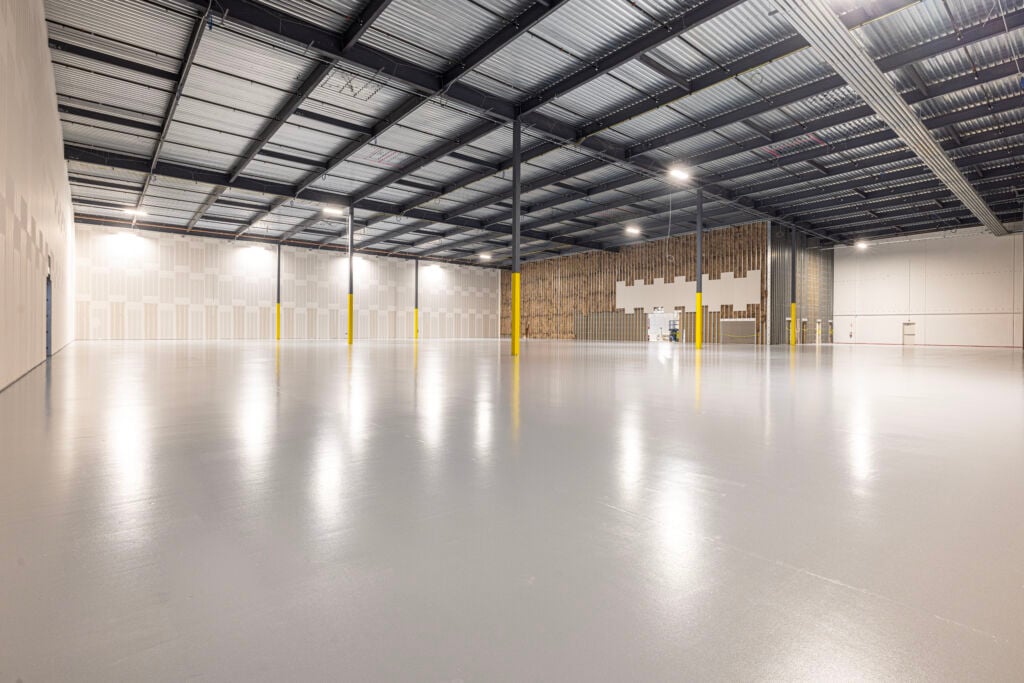
ESD Epoxy Flooring Case Study: 34,000 SF Dallas, TX
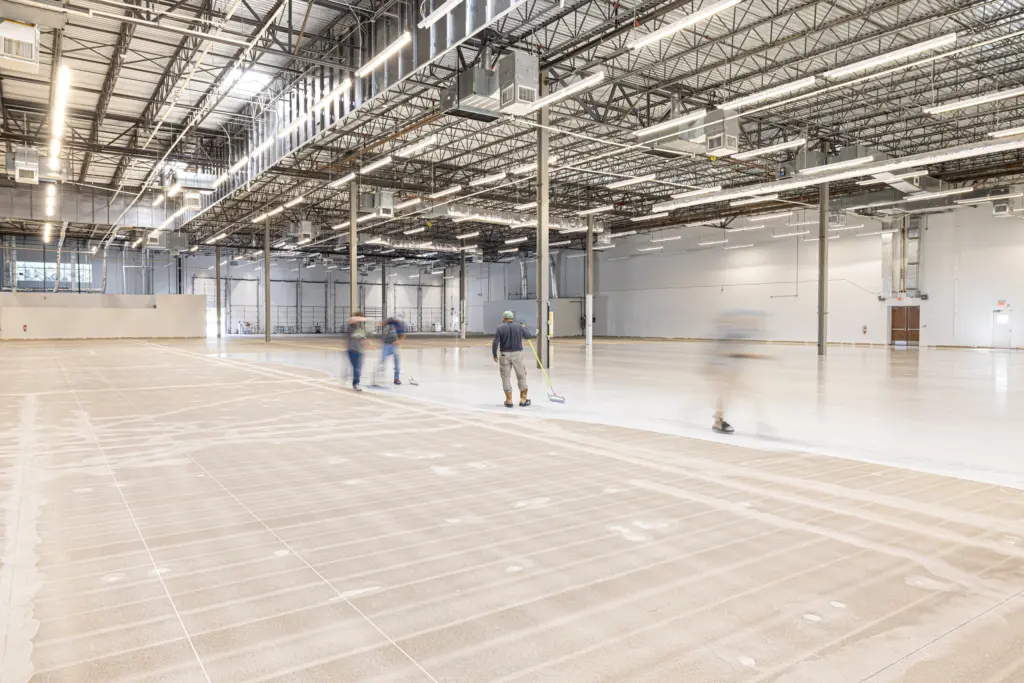
ESD Epoxy Flooring Case Study: 67,000 SF | Houston, TX