- Systems: Conductive and static dissipative ESD epoxy — Sherwin-Williams High Performance Flooring, PIP, and Sika ESD lines
- Compliance:
- – ANSI/ESD S20.20 program standard
- – STM7.1 resistance testing
- – STM97.1 system resistance + STM97.2 body voltage testing
- Resistance:
- – Conductive: below 1.0 × 10⁶ ohms
- – Static dissipative: 1.0 × 10⁶ to 1.0 × 10⁹ ohms
- – Body voltage: under 100V per STM97.2
- Credentials: Authorized SW + PIP + Sika installer
- Pricing: $3.34–$13.55/sqft installed depending on system type, thickness, and substrate condition — real bid data on 250+ commercial ESD projects
- Installation: In-house W-2 crews; phased zone-by-zone around live operations; 24–72 hour cure-and-test window
- Lead time: 1–3 weeks from contract execution
- Coverage: National service coverage; project-specific staffing and equipment plans; est. 1999
- Deliverables: Submittals; moisture verification per ASTM F2170; STM7.1 resistance logs; closeout documentation package
Phone: +1 (844) 687-1961
ESD flooring is a static-control floor system that moves electrostatic charge off people and equipment before it reaches a sensitive component or an ignitable atmosphere. Craftsman Concrete installs it as seamless ESD epoxy flooring: a conductive primer bonded to ground straps tied to building steel, finished with a static dissipative or conductive topcoat and verified against the facility’s ANSI/ESD S20.20 program. Two resistance classes cover nearly every specification. Static dissipative systems read 1.0×10⁶ to 1.0×10⁹ Ω and carry most electronics manufacturing and data center work. Conductive systems read below 1.0×10⁶ Ω for munitions and flammable-atmosphere work. Every install closes with resistance testing per ANSI/ESD STM7.1 and a documentation package an auditor can file without follow-up.
Specifications name the same system a half-dozen ways: ESD epoxy flooring, static control flooring, electrostatic discharge flooring, conductive floor coating. The engineering underneath is shared. So is the requirement behind the purchase order, which is a floor that passes a specified resistance test at turnover and keeps passing it under traffic. Craftsman has installed industrial resinous flooring since 1999 and self-performs every ESD project with in-house W-2 crews, from surface preparation and grounding through topcoat application and closeout resistance testing.
Our Clients




















ESD Epoxy Flooring System Build-Up
An ESD epoxy floor is a layered electrical system in which each layer has a measurable job — profile and moisture control in the substrate, continuity in the ground plane, a rated resistance class at the walking surface. The build-up below is what Craftsman installs on a typical project. Exact products and thicknesses follow the specified system and its manufacturer data sheet, and the installation process page covers sequencing and site logistics in day-by-day detail.
Substrate Preparation and the Conductive Ground Plane
Every ESD system starts below the coating. Concrete is profiled to the specified ICRI 310.2 surface profile and moisture-tested per ASTM F2170 before any resin goes down, because vapor drive that would blister a standard floor will also open gaps in a conductive layer. A conductive primer or ground-plane coat then establishes electrical continuity across the slab, with ground straps bonded through it and terminated at building steel. This layer, not the visible topcoat, is where most field failures originate — a primer thinned out of spec or a strap that never reaches steel leaves a floor that looks finished and cannot pass ANSI/ESD STM7.1.
Dissipative or Conductive Topcoat by Specified System
An ESD epoxy floor coating sets the floor’s resistance class at the walking surface. Static dissipative epoxies finish in the 1.0×10⁶ to 1.0×10⁹ Ω range; conductive formulations finish below 1.0×10⁶ Ω. Thickness is system-specific. Sherwin-Williams Resuflor SCT runs 15 to 20 mils over its insulating epoxy base; PIP 100 ESD HB runs 12 to 20 mils; the Sikafloor ESD system builds 24 to 30 mils. Craftsman is an Authorized SW + PIP + Sika installer and matches the product to the specification on record.
Why Standard Epoxy Fails an ESD Specification
Standard epoxy is an electrical insulator, with surface resistance above 10¹² Ω — three orders of magnitude past the 10⁹ Ω upper bound of the static dissipative band. A person walking across it can carry several thousand volts of accumulated charge with nowhere controlled to put it. ESD epoxy closes that gap by design. The conductive media in the coating connect the walking surface to the ground plane, and body voltage stays under the 100V threshold that ANSI/ESD S20.20 programs verify per STM97.2. The full mechanism, including why mats and sprays fail as substitutes, is covered on the benefits of ESD flooring page.
ANSI/ESD S20.20 Verification and Closeout Documentation
Resistance Testing per ANSI/ESD STM7.1
Every Craftsman ESD install closes with floor-material resistance testing per ANSI/ESD STM7.1. The readings only mean something after cure. The verification window runs 24 to 72 hours from final coat, and testing earlier reads uncured chemistry instead of the floor’s service condition. Technicians record point-to-point and resistance-to-ground values across a mapped test grid, and the raw readings go into the closeout package with locations noted, so a failed point two years later can be compared against its as-built baseline.
System Qualification with STM97.1 and STM97.2
S20.20 programs qualify flooring and footwear together as one system. Two test methods split that job. ANSI/ESD STM97.1 measures system resistance, the combined path of floor, footwear, and person to ground. ANSI/ESD STM97.2 measures body voltage generation while a person walks, against the program’s 100V threshold. Craftsman supports both qualifications at turnover for facilities running full S20.20 programs, with data formatted for the ESD program manager’s compliance file, and the compliance standards page defines each method in reference detail.
Documentation an Auditor Can File
The turnover package is assembled for the facility’s compliance file. A typical Craftsman closeout includes pre-installation moisture records per ASTM F2170, surface-profile documentation, product data sheets for the installed system, grounding locations, and the full STM7.1 resistance log. Facilities on periodic verification schedules can keep the floor on a recurring test program through Craftsman’s ESD floor testing service, which also covers floors installed by other contractors.
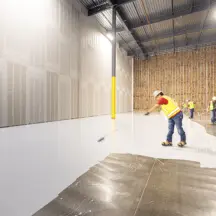
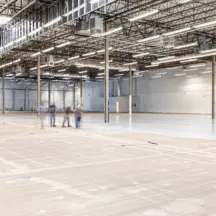
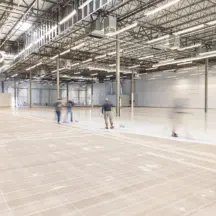
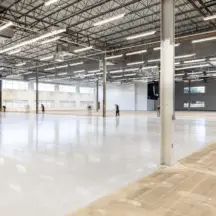
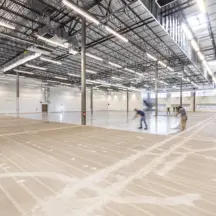
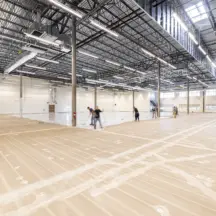
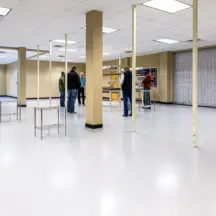
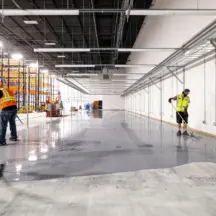
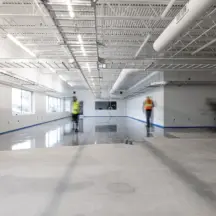
ESD Flooring Gallery

Request a Proposal
ESD Flooring Applications by Industry
Electronics Manufacturing and Data Centers
Static dissipative flooring in the 10⁶ to 10⁹ Ω band carries most electronics manufacturing and data center specifications, where the governing hazard is damage to ESD-sensitive components. Assembly, test, QA, and repair areas handle sensitive devices continuously, and a dissipative floor bleeds personnel charge through ESD footwear before it reaches the bench. Data center ESD floors add a layer relationship worth naming precisely. Poured dissipative epoxy often runs beneath raised access floor as the grounded subfloor, and the two occupy different layers of the same build. Sector detail lives on the electronics manufacturing and data center pages.
Contractual ESD Programs in Aerospace and Defense
Aerospace and defense work brings ESD control in as a contractual flow-down, typically under AS9100 quality programs referencing ANSI/ESD S20.20 or MIL-STD-1686. AS9100 itself publishes no floor resistance value; the numbers trace to the ESD program standards, and Craftsman’s STM7.1 and STM97.1/97.2 closeout data slots directly into that program file. In munitions and flammable-solvent handling the requirement inverts. The hazard is ignition of energetic material or solvent vapor, and those areas call for conductive flooring below 1.0×10⁶ Ω. The avionics page covers cleared-facility installation protocols and FOD-controlled environments.
Battery Production and Pharmaceutical Cleanrooms
Battery and EV plants pair static control with solvent handling, and dry rooms and electrode-processing areas are specified with both hazards in view, often under NFPA 70 classified-area review. Pharmaceutical and cleanroom facilities layer cleanability and particle discipline on top of the resistance spec, with cleanroom classification running through ISO 14644. Each vertical keeps a dedicated page. Battery manufacturing covers dry-room dew points and zoning, and pharmaceutical cleanroom covers the full compliance stack.
Nationwide Installation by In-House W-2 Crews
Phased Installation Around Live Operations
Most ESD retrofits happen in facilities that cannot stop running, and the schedule is engineered around that fact. Craftsman phases installations zone by zone, working shutdown windows and weekend turns where production requires it, with each zone re-tested before handback. The 24-to-72-hour cure-and-test window applies per zone, so the sequence opens verified floor behind the crew while the rest of the facility keeps running its normal production schedule. W-2 installers, not 1099 day-labor. Trained, insured, and accountable to you.
ESD Epoxy Flooring Cost and Lead Time
Pricing across ESD systems runs $3.34-13.55/sqft installed depending on system type, thickness, and substrate condition, derived from real bid data on 250+ commercial ESD projects. Larger contiguous pours land toward the low end of the band. Small phased zones with heavy grounding detail land higher. Lead time is 1-3 weeks from contract execution, driven by material availability, and the ESD flooring cost page breaks the range down by system and square footage.
National service coverage does not mean every project is staffed or equipped from Dallas. Craftsman assigns directly employed personnel and equipment companywide through a project-specific plan based on geography, schedule, technical fit, availability and customer continuity.
Recent ESD Projects at Scale
Two recent anchors show the delivery model at scale. In Dallas, Craftsman installed 34,000 sq ft of dissipative ESD epoxy through a Fortune 500 telecom-equipment manufacturer’s Tier-1 electronics QA facility, phased through occupied space with verification at each phase boundary. In Houston, a 67,000 sq ft hyperscale-grade installation took full-hall static control. Both projects closed with mapped STM7.1 resistance logs in the turnover package, and both are documented as case studies further down this page.
ESD Flooring Knowledge Center
Resource links
Where ESD Flooring Is Used
Project Planning & Delivery
Compliance Requirements & Testing
Systems & Selection
Maintenance & Troubleshooting
Manufacturer ESD Flooring Systems
Frequently Asked Questions
ESD epoxy flooring runs $3.34-13.55/sqft installed depending on system type, thickness, and substrate condition, derived from real bid data on 250+ commercial ESD projects. Grounding density and existing-coating removal are the line items that most often move a bid inside the band. The ESD flooring cost page breaks the range down by system and project size.
Standard epoxy insulates, with surface resistance above 10¹² Ω, so charge on a person has no controlled path off the floor. ESD epoxy flooring adds conductive media in the coating and a grounded primer layer beneath it, terminated at building steel, and the finished system reads in its specified band per ANSI/ESD STM7.1. Visually the two floors are near-identical at turnover, which is why the resistance log matters more than the walkthrough.
Static dissipative floors must read 1.0×10⁶ to 1.0×10⁹ Ω, and conductive floors below 1.0×10⁶ Ω, measured per ANSI/ESD STM7.1. Body voltage on the walking surface must also stay under the 100V program threshold, verified per STM97.2. S20.20 compliant flooring can sit in either class; which one your specification calls for is an application decision, and the conductive vs dissipative page carries the selection logic.
A typical single-zone project installs in 3 to 5 days, with resistance verification following the 24-to-72-hour cure window after the final coat. Phased projects in live facilities run zone by zone on the same cycle, so square footage opens progressively as zones verify. Lead time to mobilization is 1-3 weeks from contract execution, driven by material availability, and the installation process page maps the full sequence day by day.
Craftsman Concrete Floors installs conductive and static dissipative ESD epoxy throughout the United States using Craftsman-employed W-2 crews. Project staffing is assigned according to system experience, availability, geography, schedule, facility requirements, and customer continuity. The project-specific staffing and mobilization plan identifies the committed personnel, field leadership, crew and equipment origins, travel assumptions, and schedule. Craftsman performs the surface preparation, grounding, coating application, and closeout testing included in the executed scope. The ESD flooring installer page explains the qualification questions buyers should verify, including grounding methods, testing responsibilities, and turnover documentation.
The install list covers three manufacturers’ ESD epoxy lines under an Authorized SW + PIP + Sika installer credential. Sherwin-Williams High Performance Flooring supplies Resuflor SCT over the Resuprime ESD conductive primer; PIP supplies 100 ESD HB and its InhibiStat systems; Sika supplies the Sikafloor 2xx ESD series in dissipative and conductive classes. The system on your project follows the specification and its data sheet, and the ESD flooring options page compares formats and finishes.
Yes. Craftsman runs ESD floor testing as a standalone service, measuring existing floors per ANSI/ESD STM7.1 and reporting mapped resistance values suitable for an S20.20 program file. Facilities use it for periodic verification and for diagnosis when readings drift after cleaning-chemistry changes or ground-path damage. The ESD floor testing programs page covers scope and scheduling.
Case Studies
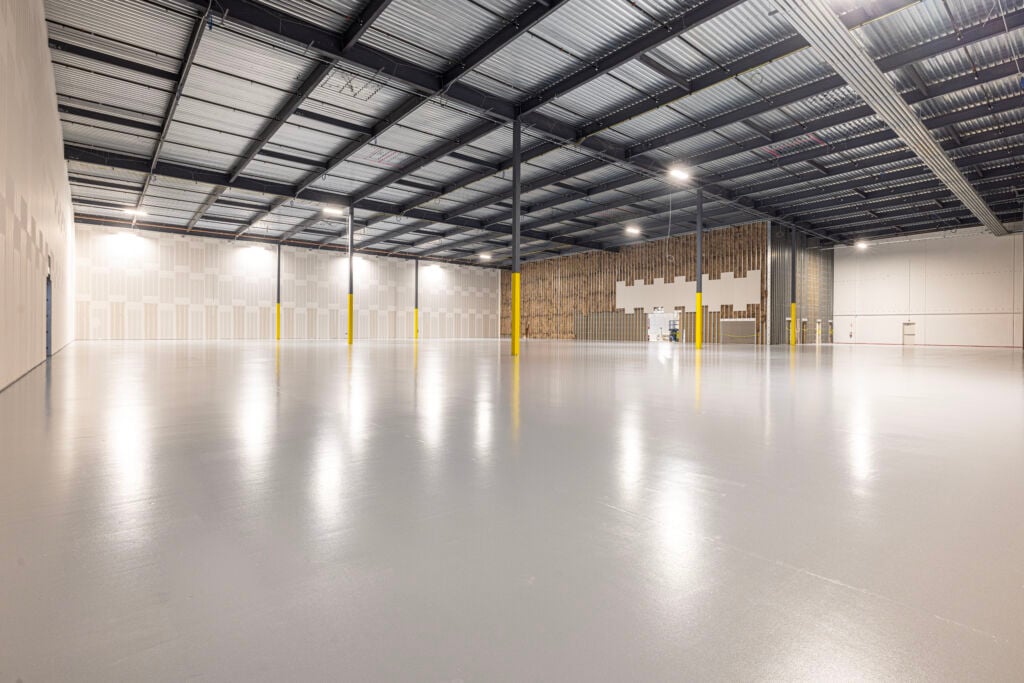
ESD Epoxy Flooring Case Study: 34,000 SF Dallas, TX
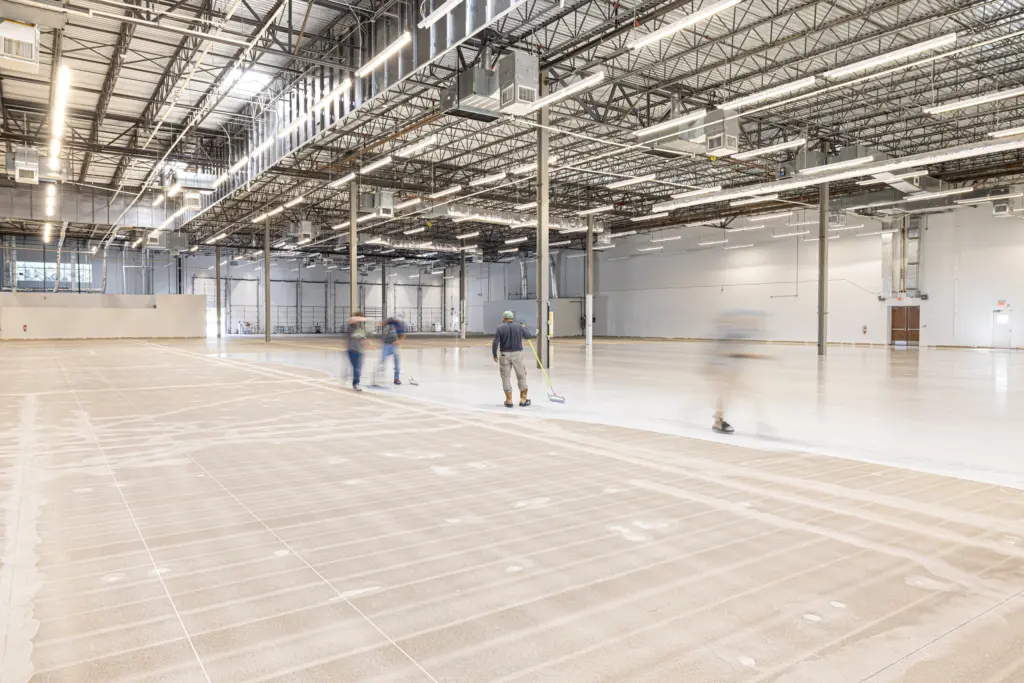
ESD Epoxy Flooring Case Study: 67,000 SF | Houston, TX