Engineered Static Control Systems
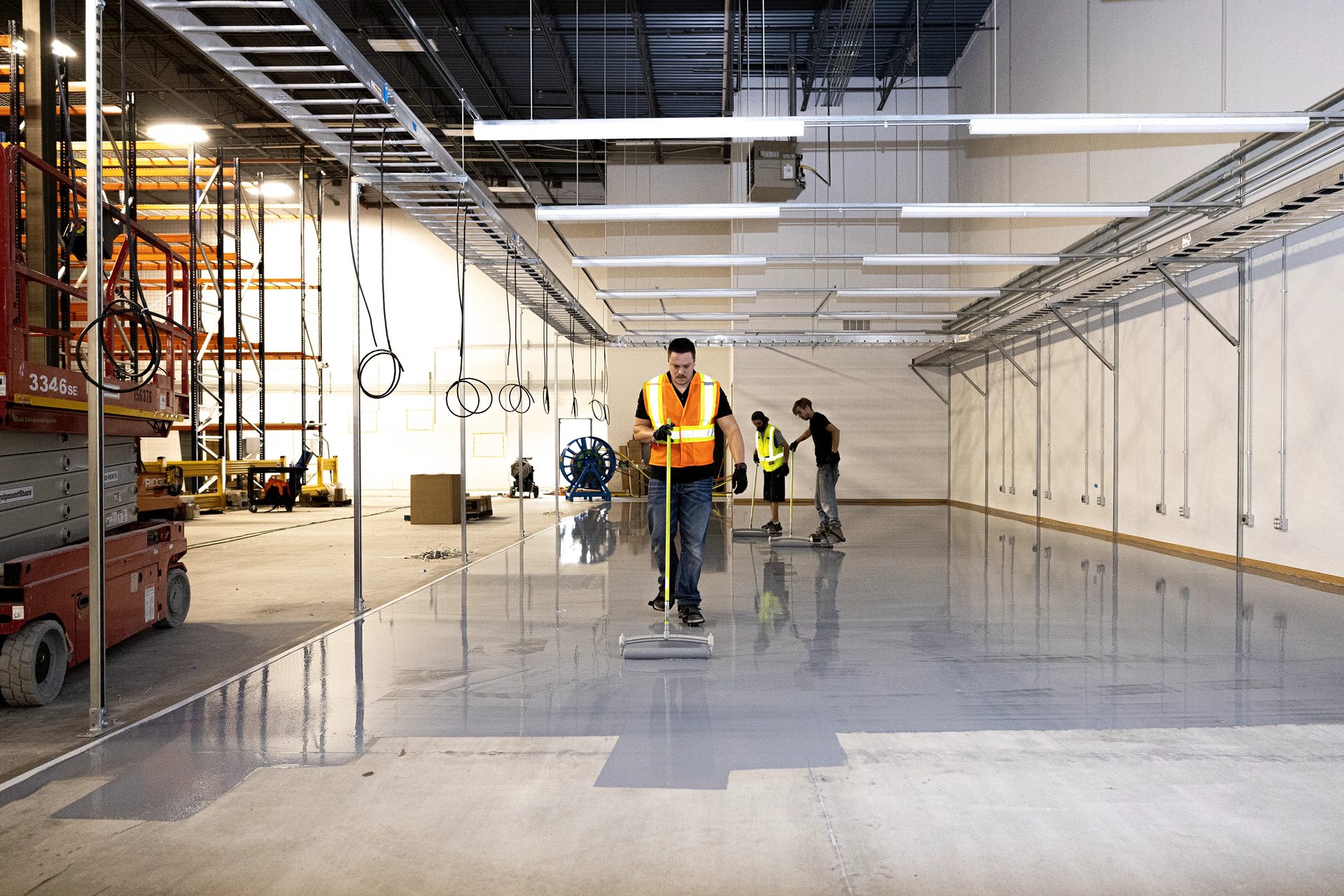
Static control flooring — the umbrella term for ESD flooring systems that dissipate or eliminate electrostatic charge — protects sensitive electronics, equipment, and processes across electronics manufacturing, data centers, aerospace, pharmaceutical, battery, and adjacent industrial environments. Craftsman installs conductive, static-dissipative, and anti-static epoxy systems engineered to ANSI/ESD S20.20 and the program standards governing your facility. Authorized installer for Sherwin Williams and Protective Industrial Polymers (PIP). Fortune 500 client base, in-house W-2 crews, submittal-ready documentation. Installed nationwide.
- Systems: conductive, static-dissipative, and anti-static ESD epoxy flooring systems; system specified by application sensitivity, ESD program standard, and facility operating conditions
- Authorized Installer: Sherwin Williams and Protective Industrial Polymers (PIP) — manufacturer-backed system warranties, factory-trained crews, validated submittals
- Applications:
- – PCB manufacturing and electronics assembly
- – semiconductor and component handling
- – data centers and server rooms
- – aerospace and avionics
- – pharmaceutical and cleanroom
- – battery and EV manufacturing
- – power equipment service centers
- – ammunition and ordnance handling
- – ESD test and qualification labs
- – telecommunications equipment manufacturing
- Compliance: ANSI/ESD S20.20 program-level compliance; ANSI/ESD STM 7.1 floor resistance testing (point-to-point and ohms-to-ground); STM 97.1 / 97.2 system testing with personnel; IEC 61340-5-1 reference where international scope applies; MIL-STD-1686 for defense program scope; NAS 412 surface integrity for aerospace
- Installation: in-house W-2 crews; experienced field leadership; national service coverage through companywide project operations; est. 1999
- Leadership: former Fortune 500 COO; operations oversight + QA/closeout discipline
- Tenant Improvement Ready: experienced with TI build-outs, landlord coordination, and short-window deliveries for facility move-ins; clean COI and safety documentation handed up front
- Deliverables: submittals, surface prep + moisture verification, resistance testing logs, grounding verification, system test reports, closeout packages
Phone: +1 (844) 687-1961
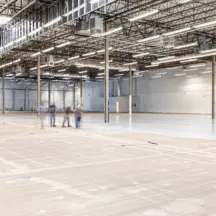
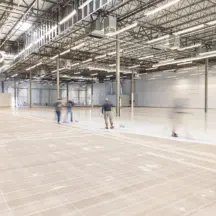
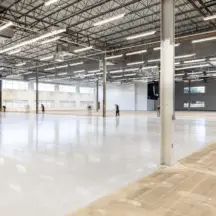
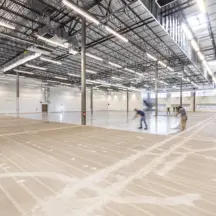
ESD Flooring Gallery

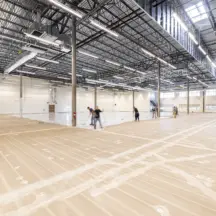
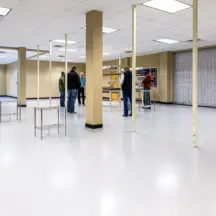
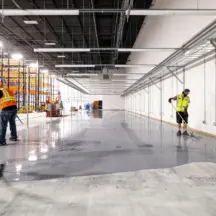
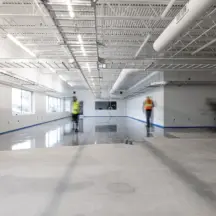
Request Pricing
Tell us about the project. Commercial estimates are typically returned within 24 hours.
What static control flooring actually is
Static control flooring is the umbrella term for any flooring system engineered to manage electrostatic charge — generated, accumulated, or discharged — in a controlled way. In industry usage, “static control flooring” and “ESD (electrostatic discharge) flooring” describe the same category of product. Procurement teams and facility specifications often use “static control.” Engineering, manufacturers, and the governing standards lean on “ESD.” Both terms point at the same thing: a floor system whose electrical resistance and charge-handling behavior are part of the spec, not a side effect.
The category contains three system types — conductive, static-dissipative, and anti-static — that each handle charge differently and each fit different applications. Picking the wrong one is one of the more common and expensive flooring mistakes in industrial projects. A floor that’s too conductive in a personnel-heavy environment can create grounding hazards. A floor that’s too resistive in an electronics assembly environment fails to discharge sensitive components and produces latent failures downstream. The right system is determined by the standard governing the facility, the sensitivity of the equipment or process being protected, and the way personnel and equipment interact with the floor under operating conditions.
Craftsman’s job on a static control flooring project is to specify the right system before the install — not to install whatever was in the original architectural drawing if the drawing is wrong for the facility’s actual operating profile.
How to choose between conductive, static-dissipative, and anti-static
System selection is driven by two questions: which standard governs your facility’s ESD program, and how fast does charge need to leave the floor when it gets there. The three system types occupy different resistance bands, defined under ANSI/ESD STM 7.1 floor testing, and the right choice rarely depends on personal preference.
Conductive systems
Conductive systems test below 1.0 × 10⁶ ohms (ohms-to-ground), measured per ANSI/ESD STM 7.1. They discharge static charge to ground quickly and are specified where any retained charge is a hazard or a process risk: ammunition and ordnance handling, fueling and explosive-atmosphere zones, certain aerospace electronics with mil-spec ESD program references, and high-sensitivity component manufacturing where ANSI/ESD S20.20 calls for the lower resistance band. Conductive systems require careful grounding design and personnel ESD program coordination — they’re the right system when the spec demands them, not the default for general electronics work.
Static-dissipative systems
Static-dissipative systems test between 1.0 × 10⁶ and 1.0 × 10⁹ ohms. They discharge in a controlled way — fast enough to protect sensitive components but slow enough that personnel-to-ground discharge isn’t violent. Static-dissipative is the most commonly specified system in commercial and industrial static control work: electronics manufacturing, PCB assembly, data centers, server rooms, ESD-controlled cleanrooms, general electronics handling. If a facility doesn’t have an explicit conductive requirement from a defense or ordnance program, static-dissipative is usually the right answer.
Anti-static systems
Anti-static systems test above 1.0 × 10⁹ ohms (and below 1.0 × 10¹² ohms in most useful applications). They prevent charge accumulation rather than discharging quickly — appropriate where the concern is preventing static buildup in personnel, garments, or equipment rather than dissipating already-present charge. Anti-static flooring is appropriate in some pharmaceutical environments, low-spec electronics, and process areas where ESD-sensitive equipment isn’t directly handled. Anti-static is not interchangeable with static-dissipative; specifying anti-static where the spec calls for dissipative will fail an audit.
The standard governing the facility tells you the band. ANSI/ESD S20.20 is the most common framework in U.S. commercial and industrial work and sets system performance by program element. IEC 61340-5-1 is the international equivalent. MIL-STD-1686 governs defense program ESD control. NAS 412 governs aerospace FOD prevention and overlays the ESD spec for aerospace applications. We help confirm the system before the install, so the floor that goes in passes its acceptance testing on the first run.
For deeper system-selection guidance, see Conductive vs Dissipative.
Industries and applications we serve
Static control flooring isn’t a single use case. The applications span any environment where uncontrolled static charge creates a measurable risk — to product, to process, or to personnel. We install across the range:
- Electronics manufacturing and PCB assembly: static-dissipative systems engineered for component-level protection; submittals tied to S20.20 program documentation.
See Electronics Manufacturing ESD Flooring
- Data centers and server rooms: raised-access-floor-compatible static-dissipative systems; performance under 24/7 traffic and equipment movement.
See Data Center ESD Flooring
- Aerospace and defense: ANSI/ESD S20.20 + NAS 412 dual-function systems; MIL-STD-1686 program references; cleared-environment installation experience.
- Pharmaceutical and cleanroom: dual-function ESD + chemical-resistant systems for sterile, aseptic, and ISO-classified environments; validation-ready documentation.
- Battery and EV manufacturing: dry room compatible, low-moisture-vapor-transmission systems; conductive and dissipative configurations.
See Battery Manufacturing ESD Flooring
- Power equipment service centers: switchgear, transformer, and high-voltage equipment service environments where personnel safety and equipment grounding both matter.
- Ammunition and ordnance handling: conductive systems specified for safety-critical environments; grounded continuity verification at closeout.
- ESD test and qualification labs: controlled-resistance flooring for environments where the floor itself is part of the test reference.
- Telecommunications equipment manufacturing: static-dissipative systems for sensitive RF and signal-processing assembly environments.
Tenant improvement and active-facility installs
A meaningful share of static control flooring projects are tenant improvement build-outs — companies signing new leases on industrial or flex space and fitting it out for ESD-sensitive operations. The static control floor is often a long-lead-time item, and the install is a fixed window inside the broader TI schedule. We run TI installs as a routine capability:
- Landlord coordination: COI, safety documentation, and access protocols handed to property management up front. Single-source W-2 crew simplifies the paperwork the landlord usually requires.
- GC sequencing: the floor goes in at the right point in the TI sequence — after MEP rough-in, before equipment set, with the surface prep window protected from other trades.
- Move-in date discipline: the install is sequenced to the move-in date, not the other way around. Cure schedules and resistance testing windows are built into the schedule, not improvised at the end.
- Active-facility retrofits: for existing operations replacing failed or wrong-spec flooring, work is phased around production campaigns, shutdowns, or after-hours windows. Containment, dust control, and clean break-in are run as standard.
Static control flooring cost
Static control flooring projects from Craftsman typically range from $3.34 to $13.55 per square foot installed, based on real bid data from recent commercial projects. Where a specific project lands in that range is driven by system type (conductive systems generally cost more than dissipative because of the grounding network and tighter resistance tolerance), substrate condition (whether the slab needs grinding, shot blasting, repair, or moisture mitigation), facility access (active facility, cleared environment, or TI build-out all carry their own scheduling premiums), project size (smaller installs distribute fixed mobilization and documentation costs across less square footage), and documentation scope (mil-spec, aerospace, and pharmaceutical projects carry real documentation overhead that shows up in the line items).
For a detailed cost breakdown by system type, project size, and scope drivers, see ESD flooring cost
For a project-specific quote, contact estimating@craftsmanconcretefloors.com.
Why Craftsman for static control flooring
- Authorized installer for Sherwin Williams and Protective Industrial Polymers (PIP) — the two manufacturers most commonly specified in U.S. commercial and industrial static control flooring. Manufacturer-backed system warranties, factory-trained crew certifications, validated submittals, direct factory support during install.
- 25+ years in industrial flooring, est. 1999, focused on high-spec environments — electronics, data centers, aerospace, defense, battery, pharmaceutical, power equipment.
- In-house W-2 crews, not subcontractors. Stable crew makes COI, safety documentation, and cleared-environment access materially simpler.
- National mobilization from Dallas-based operations and nine physical locations across Texas, Oklahoma, Missouri, and California. Long-distance projects are routine, not exceptional.
- Submittal-ready, spec-driven installation — system specifications, ANSI/ESD S20.20 documentation, STM 7.1 testing, grounding verification, manufacturer compliance attestation in every closeout.
- Fortune 500 client base. References available under NDA where the project scope requires.
ESD Flooring Knowledge Center
Resource links
Project Delivery Framework
Facility-Specific Requirements
Compliance & Testing Standards
Capabilities
ESD Systems & Selection
Installation & Maintenance
Frequently Asked Questions
Yes. Static control flooring and ESD (electrostatic discharge) flooring are the same product category — the terms are used interchangeably across the industry. “Static control” tends to be the procurement and facility-specification term; “ESD flooring” is the more common engineering term and matches the language of ANSI/ESD S20.20, the program-level standard. Both describe flooring engineered to manage static charge — preventing accumulation, dissipating to ground at a controlled rate, or eliminating it quickly — to protect static-sensitive electronics, equipment, processes, and personnel.
System selection comes from the standard governing your facility’s ESD program and the sensitivity of what’s being protected. Under ANSI/ESD STM 7.1 floor testing, conductive systems test below 1.0 × 10⁶ ohms ohms-to-ground for the fastest discharge — required by ammunition, ordnance, certain mil-spec aerospace, and high-sensitivity component programs. Static-dissipative systems sit between 1.0 × 10⁶ and 1.0 × 10⁹ ohms, balancing controlled discharge with personnel safety; this is the most common system for electronics manufacturing, data centers, and general ESD-controlled assembly. Anti-static systems sit above 1.0 × 10⁹ ohms and prevent charge accumulation rather than discharging quickly. The standard governing your facility (ANSI/ESD S20.20, IEC 61340-5-1, MIL-STD-1686, or NAS 412 for aerospace) tells you the band. We help confirm the system against your ESD program documentation before the install.
Yes. Craftsman is an authorized installer for Sherwin Williams and Protective Industrial Polymers (PIP) — the two manufacturers most commonly specified in U.S. commercial and industrial static control flooring. Authorized installer status means manufacturer-backed system warranties, factory-trained and certified crews, validated submittal packages, and direct factory technical support during install if a question comes up. We don’t represent ourselves as installers for systems we aren’t authorized on; if a project specifies a system outside our authorized lines, we say so up front.
Every install ships with a complete closeout package: surface preparation documentation, moisture testing per ASTM F2170 and F1869, resistance testing per ANSI/ESD STM 7.1 (point-to-point and ohms-to-ground), system testing per STM 97.1 and 97.2 where personnel-system testing is in scope, grounding verification with continuity readings, manufacturer certificates of compliance, and ANSI/ESD S20.20 program-level attestation. For defense or aerospace projects, MIL-STD-1686 program references and NAS 412 surface integrity documentation are tied to the project scope. For pharmaceutical and cleanroom work, IQ/OQ-ready documentation is formatted to drop into the facility’s validation package. Documentation is part of the install — we don’t bill it as an extra.
Yes. TI build-outs are a routine context for static control flooring installs. We coordinate with the landlord, the GC, and the tenant’s facility or operations team on schedule, access, and break-in protocols. For new tenants moving into leased industrial or flex space, the install is sequenced with the rest of the TI work to hit the move-in date — surface prep window protected, cure schedule respected, resistance testing built into the closeout rather than improvised at the end. For active-facility retrofits replacing failed or wrong-spec flooring, work is phased around production campaigns, shutdowns, or after-hours windows. The crews running the work are W-2 Craftsman employees, which keeps the COI, safety documentation, and access paperwork that landlords and property managers require simple and consistent.
We install Static Control Flooring nationwide.