What can we help you with?
Technical flooring, delivered directly
- ESD flooring, urethane cement, terrazzo, and polished concrete
- In-house W-2 installation crews and experienced field leadership
- National service coverage with project-specific staffing plans
- Testing, documentation, and defined project closeout
- Dedicated support for corporate procurement and multi-site contracting
Phone: +1 (844) 687-1961
Our Clients




















Qualification Humidity and Conditioning
ANSI/ESD S20.20-2021 requires a footwear/flooring system selected for personnel grounding to be qualified using the environmental conditioning specified in the Table 2 test methods or the permitted facility-minimum-humidity route. That allowance applies when the facility’s annual minimum relative humidity is above the method’s conditioning level and the items remain within that facility.
Conditioning in the Table 2 test methods
Table 2 identifies ANSI/ESD STM97.1 (current edition STM97.1-2025) for system resistance and ANSI/ESD STM97.2 (current edition STM97.2-2016) for body voltage. The cited editions specify the following conditions for footwear and flooring samples, referred to as specimens in the methods.
| Method and provision | Conditioning environment, minimum time after cleaning, and how long samples remain |
|---|---|
| ANSI/ESD STM97.1-2025, sections 5.6 and 6.1.3.6 | 12% ± 3% RH and 23 °C ± 3 °C, for at least 72 hours after cleaning; samples remain in that environment until all testing is completed |
| ANSI/ESD STM97.2-2016, section 5.2.2.2 | 12% ± 3% RH and 23 °C ± 3 °C, for at least 72 hours after cleaning; samples remain in that environment until all testing is completed, as stated in the section’s note |
These are qualification test conditions, not a required operating humidity for the facility.
Moisture-sensitive materials may need longer than 72 hours. Some materials absorb moisture and can exhibit widely varying resistance at different humidity levels or after cleaning. The informative Annex B of STM97.1-2025 explains that their surfaces may need longer than 72 hours to reach equilibrium.
Which editions supply these conditions?. S20.20-2021 references STM97.1 and STM97.2 without edition years and, unless otherwise specified, incorporates their latest revisions to the extent specified. This page uses STM97.1-2025 and STM97.2-2016.
When the facility’s annual minimum humidity can be used
The annual minimum must exceed the method’s conditioning level. S20.20-2021 permits an organization to use its facility’s annual minimum relative humidity when that minimum is above the conditioning level identified in the applicable product qualification method (section 7.3).
The allowance applies to items used within that facility. It does not mean qualification can use whichever ambient humidity happens to be present on the testing day.
The allowance does not transfer between sites. Items leaving the facility must be qualified using the environmental requirements of the methods identified in Tables 2, 3 and 4.
The standard’s informative Annex F explains that the facility allowance does not apply across multiple sites or to materials leaving the site. One facility’s minimum humidity therefore cannot be applied to combinations used at another facility.
The S20.20 footwear/flooring qualification guide explains the complete qualification process.
What the qualification record must show
Qualification records must identify the test methods, results and limits, and the qualification data must include the environmental conditioning used. The product qualification plan must identify where those records are kept (S20.20-2021, section 7.3).
The conditioning record should make clear whether the evidence follows the test-method conditions or the permitted facility-minimum-humidity route. The guide to qualification evidence and supplier documentation explains how those records support the actual footwear and flooring combination.
Frequently Asked Questions
The cited provisions specify 12% ± 3% relative humidity and 23 °C ± 3 °C for at least 72 hours after cleaning the footwear and flooring samples. The samples remain in that environment until testing is completed; STM97.2-2016 states this in a note. Moisture-sensitive materials may need longer to reach equilibrium.
The allowance applies when the facility’s annual minimum relative humidity is above the conditioning level in the relevant qualification method, for items used within that facility. Items leaving the facility must meet the listed methods’ environmental requirements. The standard’s informative Annex F explains that the allowance does not transfer across multiple sites.
No. The 12% ± 3% relative humidity specified in the cited STM97.1-2025 and STM97.2-2016 provisions is a sample-conditioning requirement for testing. It is not a facility operating-humidity requirement.
Case Studies
Craftsman Publishes 2026–2027 ESD Flooring Technical Guide
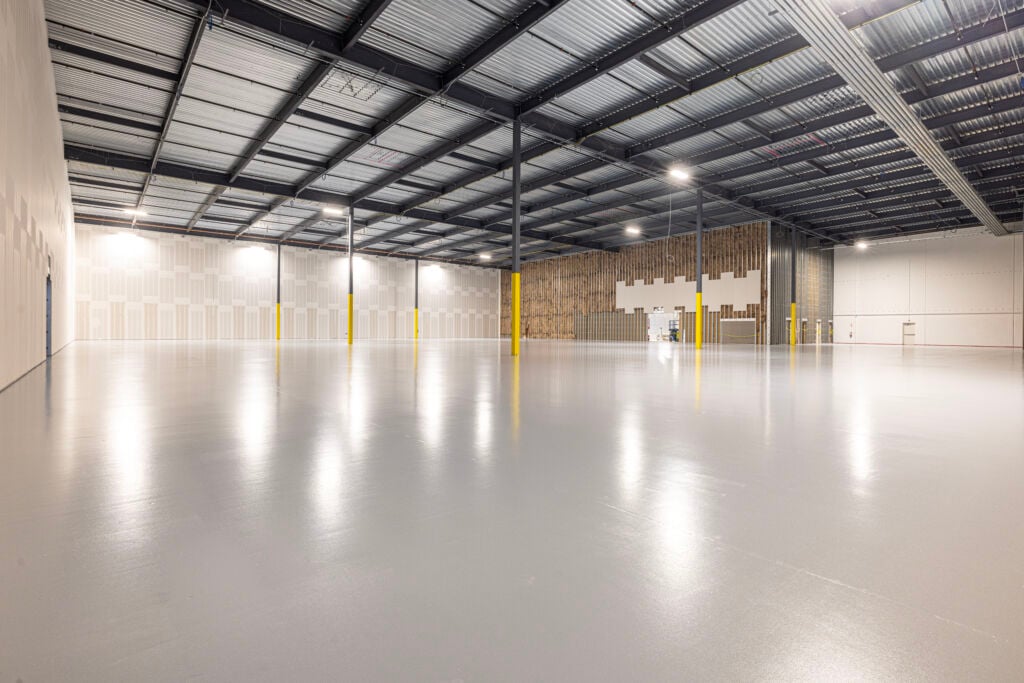
ESD Epoxy Flooring Case Study: 34,000 SF Dallas, TX