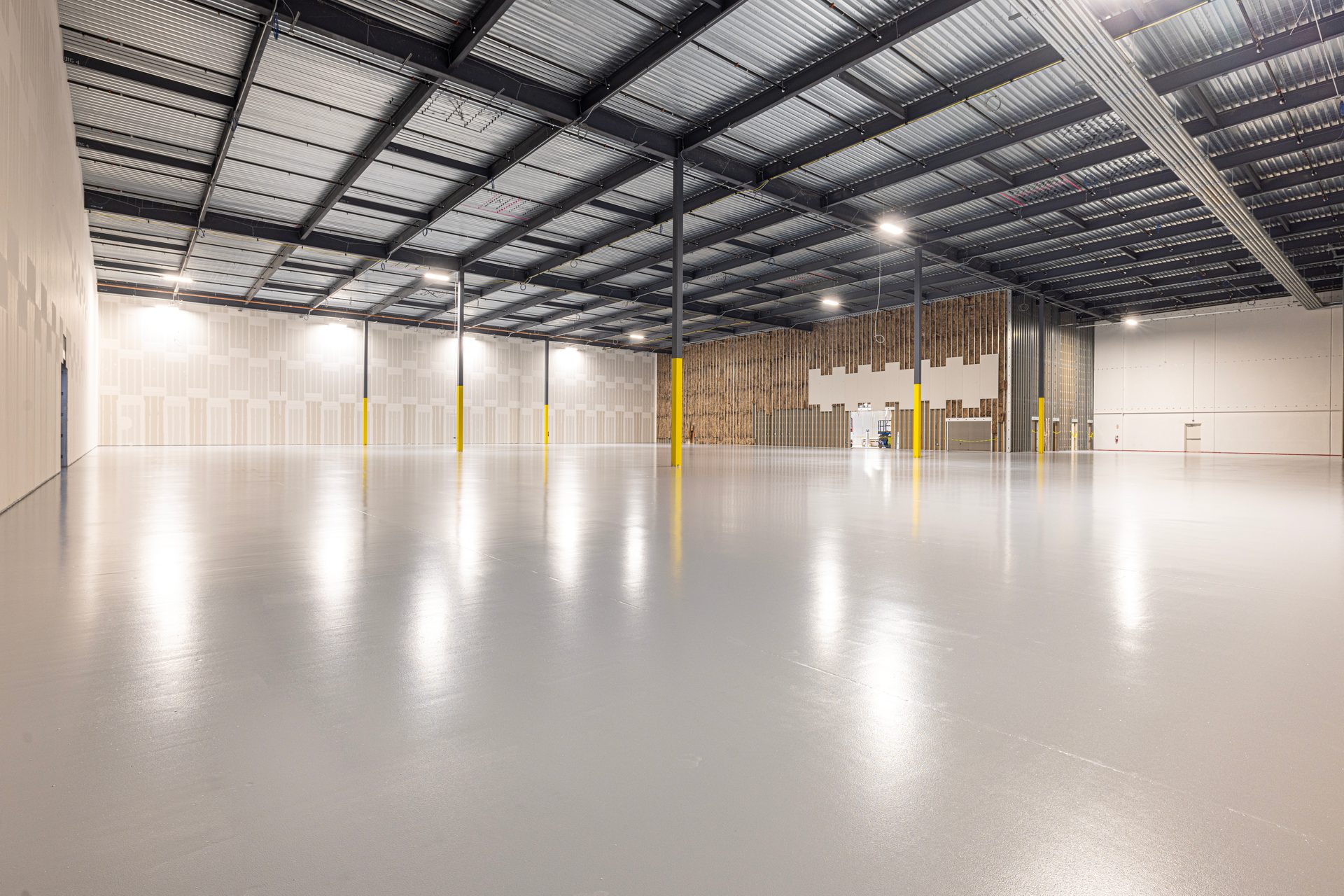
Electrostatic discharge (ESD) flooring test results do not, by themselves, establish electrical-shock safety or suitability for operations involving ordnance, flammables or explosives. Use these results to evaluate the measured ESD properties against the applicable performance requirements. Personnel-shock and ignition-safety decisions require separate assessment under the hazards, standards and authority governing the operation. The three methods below are ESD Association standard test methods (STM) approved by the American National Standards Institute (ANSI).
What ESD flooring results can establish
| Test method | What the result describes |
|---|---|
| ANSI/ESD STM7.1-2020 | Electrical resistance of the flooring system under the method’s conditions |
| ANSI/ESD STM97.1-2025 | Electrical resistance through a person, footwear and flooring together |
| ANSI/ESD STM97.2-2016 | Voltage on a person using footwear and flooring together under the tested conditions |
These measurements answer different ESD-performance questions. None of these results, by itself, establishes personnel shock safety or suitability for the hazardous operations excluded from the methods’ scopes.
Why meeting ESD requirements is not a safety approval
Personnel safety around high voltage
The informative foreword to ANSI/ESD STM97.2-2016 explains that a footwear/flooring system can discharge static electricity from a person and still present an electrical-shock hazard. Testing to this method does not guarantee personnel safety.
A result that meets an ESD resistance requirement therefore cannot serve as proof of shock protection around high alternating current (AC) or direct current (DC) voltages. Lower resistance is not, by itself, evidence of greater personnel safety.
Operations involving ordnance, flammables or explosives
ANSI/ESD STM7.1-2020 excludes facilities where ordnance, flammables or explosives are stored or handled and refers those concerns to ASTM F150, published by ASTM International. ANSI/ESD STM97.1-2025 and STM97.2-2016 also exclude uses in connection with ordnance, flammables or explosives.
Those exclusions limit the conclusions supported by the methods. They do not, by themselves, establish that a particular floor is unsuitable. Likewise, the referral to ASTM F150 does not establish that a floor or resistance result is suitable for a particular facility.
What the project team should do next
Where these hazards are present, distinguish ESD-performance acceptance from the safety assessment for the operation:
- Identify the decision. Record whether the test is intended to evaluate floor resistance, person–footwear–floor resistance or body voltage.
- Identify the safety requirements and responsibility. Establish who will assess the relevant electrical or ignition hazards and which requirements govern that assessment.
- State the limits in the acceptance record. Document the method, conditions, results and ESD acceptance criteria without presenting a conforming result as a broader safety approval.
A useful project record makes both conclusions clear: what the ESD testing demonstrated, and which safety determinations require separate evaluation.
Frequently Asked Questions
Yes. Meeting specified ESD acceptance criteria does not establish personnel safety around high AC or DC voltages. The foreword to ANSI/ESD STM97.2-2016 states that testing to the method does not guarantee personnel safety.
No. Resistance measurements alone cannot determine relative personnel safety around high AC or DC voltages. The foreword to ANSI/ESD STM97.2-2016 explains that a system capable of discharging a person may still pose a safety hazard.
No. ANSI/ESD STM97.1-2025 and ANSI/ESD STM97.2-2016 exclude those uses; their results do not establish suitability for those operations.
No. An exclusion such as ANSI/ESD STM97.2-2016’s exclusion of uses involving flammables or explosives limits what the method can establish. It is not a finding that a particular floor is safe or unsafe.
Standards basis: ANSI/ESD STM7.1-2020, ANSI/ESD STM97.1-2025, ANSI/ESD STM97.2-2016, ESD TR53-01-22 (the ESD Association’s technical report on compliance verification) and ANSI/ESD S20.20-2021. Confirm the governing editions and project requirements before applying this guidance.