What can we help you with?
Technical flooring, delivered directly
- ESD flooring, urethane cement, terrazzo, and polished concrete
- In-house W-2 installation crews and experienced field leadership
- National service coverage with project-specific staffing plans
- Testing, documentation, and defined project closeout
- Dedicated support for corporate procurement and multi-site contracting
Phone: +1 (844) 687-1961
Distinguish areas, locations, samples and readings
A field survey of dynamic coefficient of friction (DCOF) should reflect the question the testing is intended to answer. Under ANSI A326.3-2021, the objective determines which areas and locations are tested; the standard does not prescribe one universal sampling grid.
Each test location requires at least three test samples. For wet testing, each sample receives four measurements, which are recorded and averaged for that sample.
When Craftsman coordinates specified friction testing, the survey objective, floor conditions and test locations belong in the project’s quality plan. Our polished concrete slip-resistance guide explains the broader testing context.
This page covers the field procedure in ANSI A326.3-2021, released in February 2022.
| Term | Meaning in the field survey |
|---|---|
| Test area | A contiguous space with hard-surface flooring of the same or similar type |
| Test location | A position within an area selected according to the test objective |
| Test sample | A portion of the surface large enough to accommodate the test travel distance; at least three are required at each location |
| Wet measurement | One of four readings taken at each sample along two perpendicular paths |
The three-sample minimum applies to each location, not to the entire building.
Plan and run the field survey
Locations are selected to address the purpose of the testing and identified in the test record; the standard’s guidance offers considerations, not a mandatory checklist. Before testing, the tester chooses a cleaned or prevailing floor condition, which changes what the result describes. Wet readings are recorded and averaged by sample, and results stay associated with their test locations.
Choose locations that serve the test objective
The standard’s informative guidance identifies several types of locations to consider:
- High- and low-traffic locations.
- Locations with different material sizes or textures.
- Locations commonly exposed to contaminants or other risks.
These are considerations, not a mandatory checklist for every survey. Select locations that address the purpose of the testing and identify them in the test record.
The number of areas and locations depends on that objective. For sloped locations, confirm that the testing device can operate within the manufacturer’s recommended limits.
Establish the floor condition before testing
The tester determines whether the survey will evaluate a cleaned surface or prevailing conditions without pre-cleaning.
That choice changes what the result describes. A cleaned-floor survey and a survey of the floor in its prevailing condition answer different questions.
For prevailing-condition testing, ANSI A326.3-2021 still directs removal of obvious solid contaminants, such as crumbs or dirt, and requires noting what was removed. Our cleaning-before-slip-testing guide covers that distinction.
Record four wet readings for each sample
For wet field testing, take four measurements along two wetted paths set 90 degrees apart, with opposite-direction measurements on each path. Record all four readings and calculate the average for that sample.
Keep the sample results associated with their test locations.
The testfoot also requires preparation before each field sample. Our DCOF equipment-verification guide explains those apparatus checks.
Project Gallery





Frequently Asked Questions
ANSI A326.3-2021 requires at least three test samples at each field-test location. Each sample must be large enough for the instrument’s test travel distance.
Four readings, taken in opposite directions along two perpendicular wetted paths. All four are recorded and averaged for that sample.
No. Under ANSI A326.3-2021, the test objective determines the areas and locations. The standard does not prescribe a universal grid or a fixed number of areas.
Polished Concrete Knowledge Center
Resource links
Performance & Safety
Design & Aesthetics
Installation Guidance
Economics & Sustainability
Maintenance & Aftercare
Comparative & Decision-Making
Blog
Craftsman Publishes 2026–2027 ESD Flooring Technical Guide
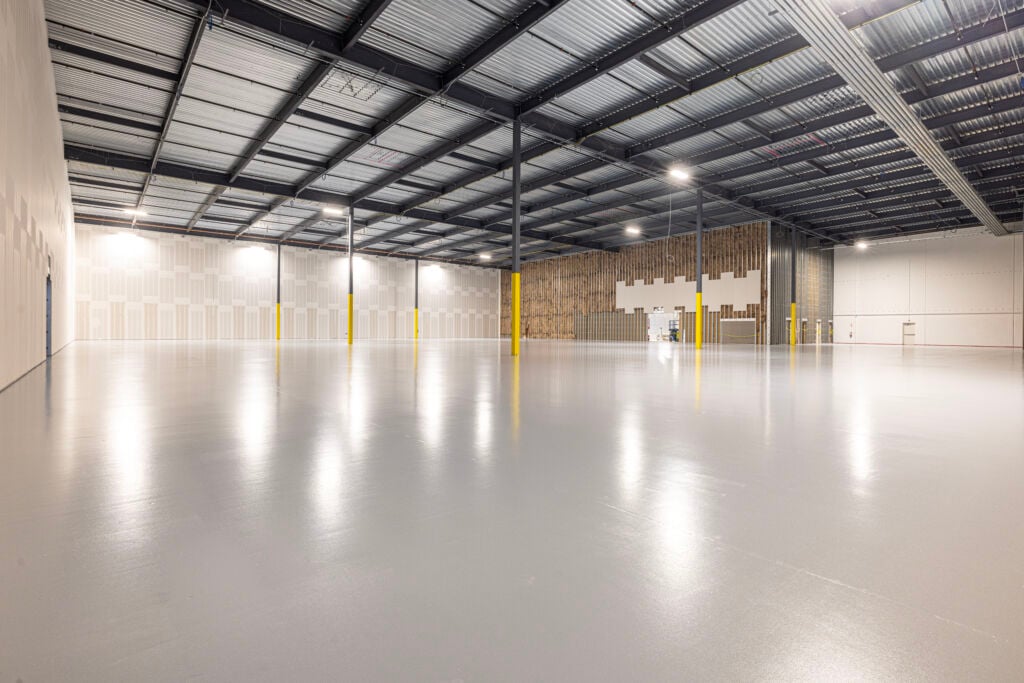
ESD Epoxy Flooring Case Study: 34,000 SF Dallas, TX