What can we help you with?
Technical flooring, delivered directly
- ESD flooring, urethane cement, terrazzo, and polished concrete
- In-house W-2 installation crews and experienced field leadership
- National service coverage with project-specific staffing plans
- Testing, documentation, and defined project closeout
- Dedicated support for corporate procurement and multi-site contracting
Phone: +1 (844) 687-1961
When the 0.42 threshold applies
A wet dynamic coefficient of friction (DCOF) of 0.42 is a numerical threshold under specified test conditions. It does not guarantee that nobody will slip or establish that a floor is suitable for every location.
ANSI A326.3-2021 applies the threshold to level interior flooring expected to be walked on when wet with water, unless otherwise declared by the manufacturer. The test method, surface condition and intended use belong alongside the number.
| Item | Scope in ANSI A326.3-2021 |
|---|---|
| Intended location | Level interior spaces expected to be walked on when wet with water |
| Numerical criterion | Wet DCOF of at least 0.42, unless otherwise declared by the manufacturer |
| Test device | BOT 3000E |
| Test materials | Specified styrene-butadiene rubber (SBR) testfoot and sodium lauryl sulfate (SLS) solution |
| What the reading measures | Dynamic friction between the testfoot and flooring under the prescribed conditions |
A report should also identify whether the surface was cleaned or tested in its prevailing condition. Our guide to cleaning before slip testing explains why that distinction matters.
Interpret a 0.42 result in context
ANSI A326.3-2021 requires the specifier to determine whether a material suits the project, provides no normative measured DCOF limits for conditions such as exterior applications and interior ramps, and applies its 0.42 threshold to the BOT 3000E. Its introduction notes that the measurement can help compare surfaces but does not predict whether a person will slip.
A passing number does not establish project suitability
ANSI A326.3-2021 requires the specifier to determine whether a material is appropriate for the project. Relevant considerations include:
- Intended use and traffic.
- Expected contaminants.
- Maintenance practices.
- Expected wear.
- Manufacturer guidance and recommendations.
The standard’s introduction explains that the measurement can help compare surfaces but does not predict whether a person will slip. The test measures a standardized testfoot against the floor; it makes no claim of correlation to actual footwear or human walking.
For the broader relationship between floor finish, contamination and maintenance, see our polished concrete slip-resistance guide.
Where 0.42 is not a universal acceptance criterion
ANSI A326.3-2021 does not provide normative measured DCOF limits for:
- Exterior applications.
- Interior ramps and inclines.
- Pool decks and shower floors.
- Floors contaminated with substances other than water.
- Floors used with minimal or no footwear.
A 0.42 result therefore cannot be used as a universal acceptance criterion for those conditions. It is also not a forklift-traction criterion.
Can readings from other devices use the same threshold?
Not directly. The 0.42 threshold in ANSI A326.3-2021 applies to the BOT 3000E. An equivalent device may use a different threshold; the standard requires independent correlation to BOT 3000E values and independently derived precision statements supplied by the device manufacturer.
Project Gallery



Frequently Asked Questions
No. ANSI A326.3-2021 measures friction under prescribed conditions. Its introduction states that the result does not predict whether a person will slip, and meeting the threshold does not establish suitability for every project.
ANSI A326.3-2021 sets a wet DCOF threshold of at least 0.42 for hard-surface flooring in level interior spaces expected to be walked on when wet with water, unless otherwise declared by the manufacturer. That value applies to testing with the BOT 3000E and the specified SBR testfoot and SLS solution. It is not a separate polished-concrete-specific criterion.
Not directly. In ANSI A326.3-2021, 0.42 is the BOT 3000E threshold. Equivalent devices require independently established correlation and precision information; their applicable thresholds may differ.
ANSI A326.3-2021 does not provide normative measured DCOF limits for exterior applications or interior ramps and inclines. Its 0.42 criterion should not be extended to those locations as a universal acceptance value.
Polished Concrete Knowledge Center
Resource links
Performance & Safety
Design & Aesthetics
Installation Guidance
Economics & Sustainability
Maintenance & Aftercare
Comparative & Decision-Making
Blog
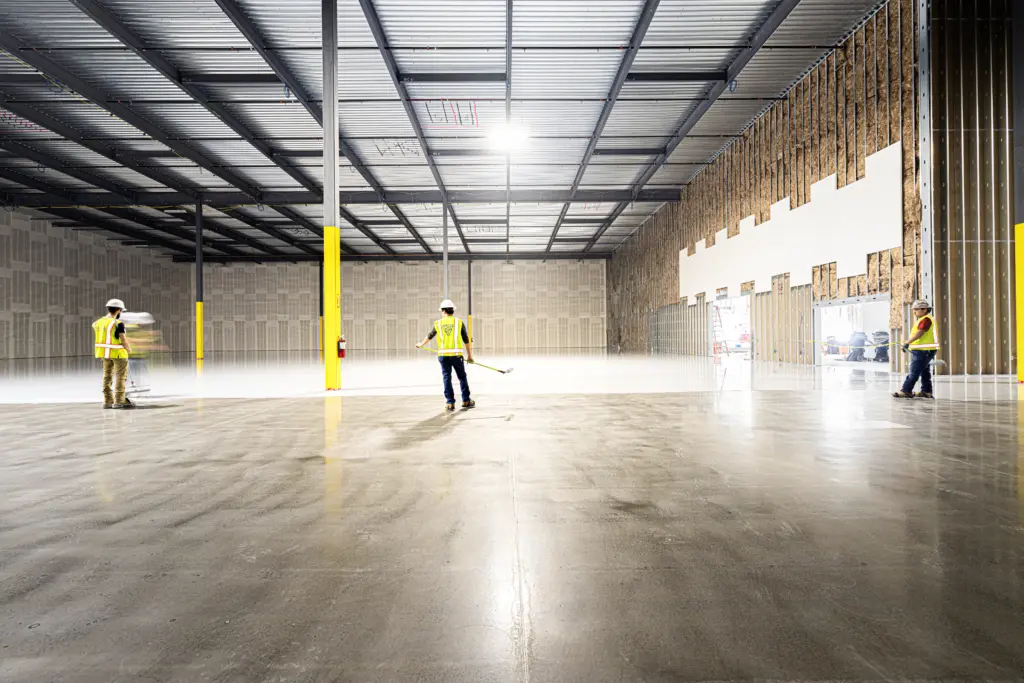
Craftsman Publishes 2026–2027 ESD Flooring Technical Guide
ESD Epoxy Flooring Case Study: 34,000 SF Dallas, TX