- Service: Periodic ESD floor verification, S20.20 recertification, audit support, and drift diagnosis on floors from any installer
- Test methods:
- – ANSI/ESD STM7.1 floor resistance to ground
- – ANSI/ESD STM97.1 system resistance
- – ANSI/ESD STM97.2 body voltage (100V program threshold)
- – ASTM F150; IEC 61340-5-1 harmonized programs
- Resistance bands: Conductive below 1 × 10⁶ ohms; static dissipative 1 × 10⁶ to 1 × 10⁹ ohms
- Documentation: Floor-plan-mapped readings, meter calibration records, technician sign-off, audit-binder-ready closeout package
- Coverage: In-house W-2 crews provide national service coverage; installing industrial floors since 1999
Phone: +1 (844) 687-1961
Craftsman Concrete Floors runs ESD floor testing services nationwide for facilities that must prove their static-control floors still conform to ANSI/ESD S20.20. Periodic verification is a standing S20.20 obligation: the program requires documented evidence that an installed floor keeps performing, not a one-time reading at handover. Our technicians measure floor resistance to ground per ANSI/ESD STM7.1, floor-footwear-person system resistance per STM97.1, and body-voltage generation per STM97.2 against the program’s 100V threshold. Every reading maps to a numbered floor-plan location and ships with meter calibration records and technician sign-off in an audit-binder-ready closeout package. We test floors we did not install.
Installed ESD floors drift out of specification for reasons the original installer never sees. Cleaning residue builds an insulating film that raises surface resistance, while corroded ground straps and broken tie-ins interrupt the path to building steel. Wear thins the conductive layer in traffic lanes long before low-traffic areas show a change. Recertification cadence is program-defined, commonly annual or per audit cycle, and whichever cadence applies, the deliverable reads the same: point-by-point results against the conductive band below 1.0×10⁶ Ω or the static dissipative band of 1.0×10⁶ to 1.0×10⁹ Ω, with a pass/fail disposition a quality lead can hand straight to an auditor.
Our Clients




















What an S20.20 Verification Visit Measures
A verification visit produces data an auditor can act on, which means the measurement discipline matters as much as the numbers. Test points are laid out on the floor plan before the first reading. Meters carry current calibration certificates, and each result records point location, ambient temperature, relative humidity, and the technician who took it. The ESD floor testing standards themselves are defined on our ESD compliance standards reference; this page covers the service of testing floors to them.
STM7.1 Resistance to Ground
STM7.1 measures the floor material’s resistance to ground at each mapped point. Readings land in one of two bands. Conductive floors read below 1.0×10⁶ Ω, and static dissipative floors read between 1.0×10⁶ and 1.0×10⁹ Ω. Which band your program requires is a selection question, answered on our conductive vs dissipative page, not a testing question. What testing establishes is whether the floor still sits inside the band your S20.20 program document specifies, point by point, with drift visible in the data before it becomes an audit finding. A floor can pass on average and fail at the six points nearest a corroded ground strap, which is why mapped readings matter more than an average.
STM97.1 System Resistance and STM97.2 Body Voltage
Floor resistance alone does not prove the system works with people on it. STM97.1 measures resistance through the full floor-footwear-person path, and STM97.2 measures the body voltage a person generates walking that same path. S20.20 sets the body-voltage program threshold at 100V, and a passing floor paired with non-compliant footwear can still fail it. We run both tests with the footwear your program specifies, so a failed reading points at the actual fault instead of restarting the footwear-versus-floor argument from zero.
Test-Point Mapping and Calibration Records
Every reading is tied to a numbered location on your floor plan, so the next verification cycle measures the same points and drift becomes a trend line instead of an anecdote. Meter calibration certificates travel with the data, and the technician who took the readings signs the record. The assembled package is built for the binder an auditor actually opens: the numbered readings, the floor plan, calibration records, and the pass/fail disposition.
ESD Flooring Gallery

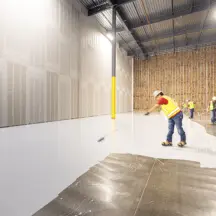
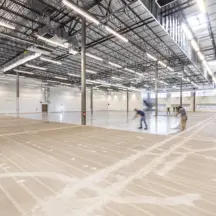
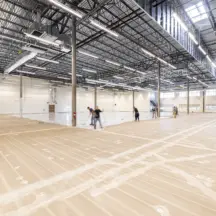
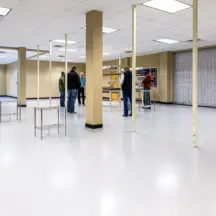

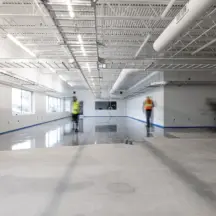
Request a Proposal
Submit project parameters for preliminary analysis. Commercial estimates typically returned within 24 hours.
Why Installed ESD Floors Drift Out of Spec
Cleaning Film Buildup
The most common failure we find is chemical. General-purpose floor cleaners leave a residue film that insulates the surface, and STM7.1 readings climb a decade or more above installed values without any visible change in the floor. Stripping the residue and moving to an ESD-rated cleaner usually returns readings to the installed band, which the retest confirms. Cleaning protocols and approved chemistries live on our ESD flooring maintenance page.
Grounding Faults
A floor can hold its material resistance perfectly and still fail verification because the path to ground is broken. Strap corrosion or a tie-in severed during another trade’s work reads the same way in the data. Points near the fault spike while the rest of the floor passes. Because grounding is the most common ESD installation failure point, we trace faults to the physical strap or tie-in rather than reporting a bare number, and the repair usually costs a fraction of what a recoat would.
Traffic-Lane Wear
Forklift lanes and cart paths thin the conductive topcoat years before the field of the floor shows wear. Resistance in the lanes drifts upward while everything else passes, and a whole-floor average hides it. Mapped readings catch lane drift early enough that a lane recoat, rather than full replacement, is still on the table. Once wear reaches the ground plane, the conversation changes — and we will tell you which side of that line your floor is on.
Recertification and Audit Support
Recertification turns test data into a program deliverable. ESD flooring recertification runs on the cadence your program document sets, while audit support compresses to whatever date a customer review puts on the calendar. When a point fails, the finding routes into a corrective scope the same company executes, so nothing is lost translating between a testing vendor and a flooring contractor. The services below share one documentation spine.
ESD Floor Testing Services on Floors We Did Not Install
Qualifying ESD flooring against S20.20 does not require the original installer, and most of the floors we test were put down by someone else. Testing ESD flooring with no baseline data starts by establishing the test-point map and a baseline set of readings; every visit after that measures drift against it. If your ESD flooring certification lapsed or was never formalized, the same visit produces the documentation set an S20.20 program requires, current as of the date on the sign-off.
Audit-Binder Documentation
When ESD flooring auditors or a customer’s quality team schedule a program review, the floor section of the binder either exists or it does not. Our closeout package is built to be that section. Mapped STM7.1 readings referenced to floor-plan locations, STM97.1 and STM97.2 results with the footwear pairing recorded, meter calibration certificates, and technician sign-off arrive assembled, not as raw data your team has to format the week before the audit.
When a Floor Fails Testing
A failed reading is the start of a diagnosis, and most failures never reach replacement. Cleaning-film failures resolve with a strip and a protocol change, and grounding faults resolve at the strap or tie-in. Wear failures scale from a lane recoat up to full replacement, and replacement work runs $3.34-13.55/sqft installed depending on system type, thickness, and substrate condition, derived from real bid data on 250+ commercial ESD projects. Because our in-house ESD flooring installation crews perform the corrective work themselves, the test data feeds the repair scope directly. Replacement options and system selection live on our ESD flooring hub.
Frequently Asked Questions
One visit measures floor resistance to ground per ANSI/ESD STM7.1 at mapped floor-plan points, then verifies the floor-footwear-person system per STM97.1 for resistance and STM97.2 for body voltage against the 100V S20.20 threshold. Results ship with meter calibration records and technician sign-off in a closeout package assembled for the audit binder.
Your S20.20 program document sets the cadence, and annual verification or testing per customer-audit cycle are the most common choices. The obligation itself is not optional. S20.20 requires periodic verification to maintain program conformance, so a floor with no recent data is a finding waiting to be written.
Testing is quoted per facility from square footage and test-point count, so ask for a scoped number rather than a rate card. When testing turns up a floor past corrective coating, replacement runs $3.34-13.55/sqft installed depending on system type, thickness, and substrate condition, derived from real bid data on 250+ commercial ESD projects. Most failures cost far less to fix, because cleaning-film and grounding faults resolve without touching the coating.
Yes. Qualifying ESD flooring against S20.20 does not depend on who installed it, and most floors we test were put down by someone else. The first visit establishes the test-point map and baseline, and later visits measure drift against it, which is what turns readings into a defensible trend for an auditor.
The floor usually changed less than its conditions did. Cleaning residue is the most common culprit, building an insulating film that pushes STM7.1 readings above the dissipative band, while grounding faults and traffic-lane wear account for most of the rest. Mapped readings show which mechanism is at work, and each carries a different fix, from a cleaner change to a lane recoat.
Resistance testing runs 24 to 72 hours after the final coat, because the resin has to cure before STM7.1 readings stabilize. Testing inside that window produces numbers that will not repeat, which is worse than no data in an audit file. For phased corrective work, each zone tests on its own cure clock, so live areas keep their current certification while repairs proceed.
ANSI/ESD S20.20 is the program standard, with STM7.1 covering floor-material resistance and the STM97.1 and STM97.2 pair covering system resistance and body-voltage generation with a person in the loop. ASTM F150 and IEC 61340-5-1 appear in many program documents as well. Definitions and edition history for each live on our ESD compliance standards page; this page is the service of testing floors to them.
In-house W-2 crews provide national service coverage, and we have installed industrial floors since 1999, so verification visits schedule the same way in any region. Multi-site programs can run on one test-point mapping convention, which keeps the binders consistent across facilities.
ESD Flooring Knowledge Center
Resource links
Test Selection & Qualification
Test Methods & Procedures
Routine Verification & Retesting
Measurement Accuracy & Troubleshooting
Reports & Data-Sheet Claims
Project Delivery & Capabilities
Case Studies
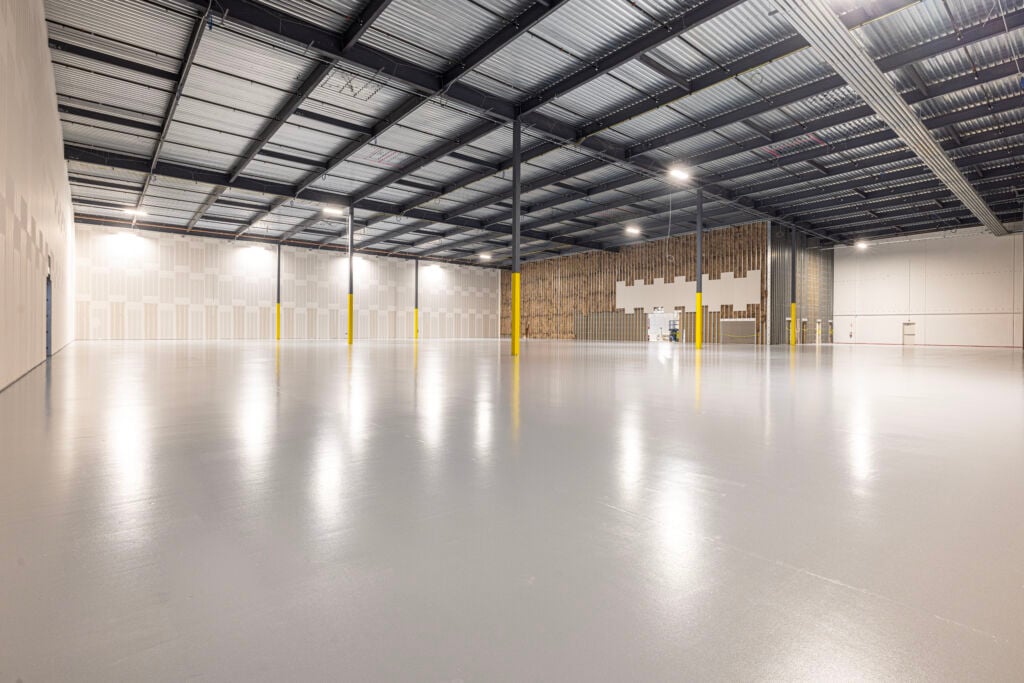
ESD Epoxy Flooring Case Study: 34,000 SF Dallas, TX
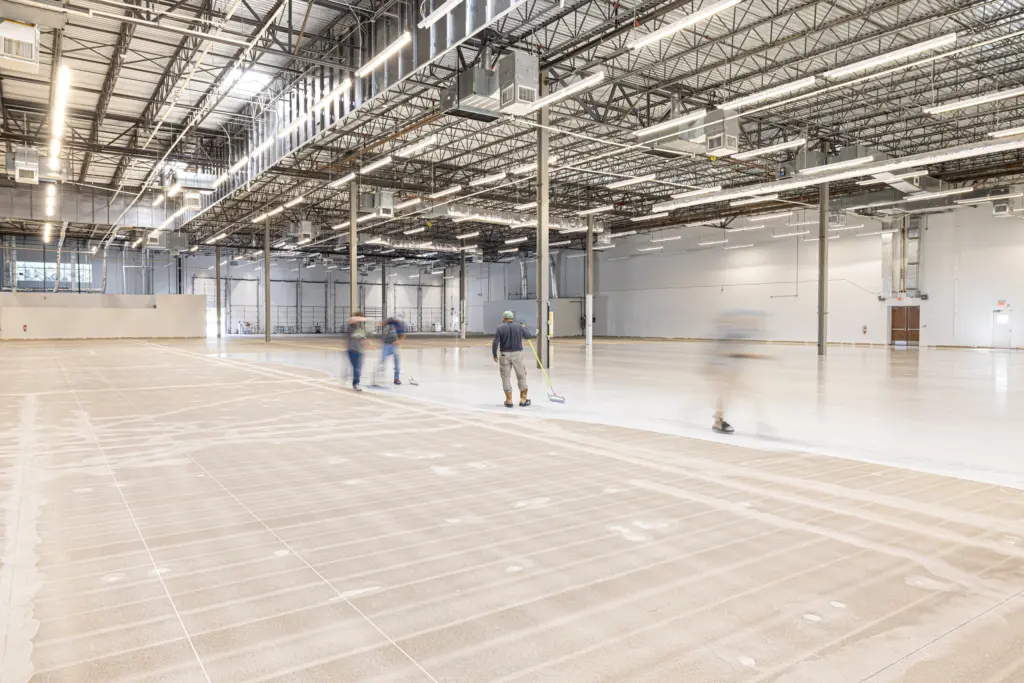
ESD Epoxy Flooring Case Study: 67,000 SF | Houston, TX