- Founded in 1999 • National commercial & industrial specialty flooring contractor
- Systems: Sika Ucrete & Sherwin-Williams High Performance Flooring Poly-Crete and Hybri-Flex urethane cement systems
- In-house W-2 crews provide national service coverage
- Single-contract multi-site programs under a Master Service Agreement
- Phased installation in occupied facilities — night and weekend shutdown-window execution
- Experience Modification Rate (EMR) below the industry average
- Authorized Sherwin-Williams High Performance Flooring installer; Sika installer; Westcoat certified
- Pre-install moisture and substrate testing & audit-ready closeout documentation
- Facility assessments, compliance inspections & lifecycle maintenance programs
- Licensed • Insured • Bonded • Enterprise vendor prequalification package available (COI, W-9, capabilities statement & supporting documentation)
- Surface profile: ICRI 310.2 CSP 4-6 — shot blast preferred per manufacturer application instructions
- Moisture acceptance: system ratings to 99% RH (ASTM F2170) & 20 lbs/1,000 sq ft/24 hr MVER (ASTM F1869)
- Substrate repair: crack routing, spall patching & keyway terminations scoped from slab condition
Phone: +1 (844) 687-1961
Urethane cement surface preparation determines whether the system reaches its 15-20+ year service life or fails at the bond line. Urethane cement bonds chemically to concrete, and the bond is only as good as the surface it forms on. That means a mechanical profile per ICRI 310.2, verified moisture per ASTM F2170, and a substrate free of laitance, curing compounds, and contamination. Most coating failures are prep failures. When epoxy delaminates in 12-24 months under hot-washdown thermal cycling, the failure runs along the bond plane, and prep is exactly what governs the bond plane. Concrete surface prep for urethane cement is therefore its own scope with its own acceptance criteria, not the sweeping that happens before the pour.
Three variables control the bond: profile, moisture, and contamination. Profile is cut mechanically, by shot blast, diamond grinder, or scarifier, and verified against the manufacturer’s specified ICRI 310.2 range, while moisture is measured inside the slab with ASTM F2170 in-situ probes. Contamination is removed and the removal verified, because urethane cement will not bond through a silicate densifier any better than epoxy will. Craftsman self-performs all of it with in-house W-2 crews and delivers the readings in an audit-ready closeout package.
Our Clients




















Concrete Surface Profile to ICRI 310.2
ICRI Technical Guideline 310.2R grades concrete surface profile from CSP 1, nearly flat, to CSP 10, roughness with an amplitude above 1/4 inch. It is the vocabulary every urethane cement manufacturer writes its prep spec in, and the molded replica chips that accompany it are how a profile gets verified on the slab. Urethane cement systems specify the middle of that scale.
Urethane Cement Surface Preparation Targets CSP 4-6
Sherwin-Williams’ surface preparation guide specifies CSP 4, 5, or 6 for self-leveling urethane cement systems in the 50-mil to 1/8 inch class, and each product’s application instructions state the governing number. Below the specified profile, the mortar sits on the slab instead of locking into it, and the bond releases under thermal cycling. Above it, a thin-build slurry spends its thickness filling profile instead of carrying traffic. Sika’s guide sets a 218 psi minimum substrate pull-off.
Shot Blasting — CSP 3-7 on the Open Floor
Shot blasting is the preferred preparation method in Sherwin-Williams’ Poly-Crete application instructions, and Sika’s surface preparation guide credits it with producing CSP 3 through 7. The machine throws steel shot at the slab, fractures the laitance layer, and recovers media and dust in a closed vacuum loop, so it runs inside occupied plants without tenting the room. One pass strips curing compound and cuts profile together. Edges, doorways, and the strip against every wall are finished by hand.
Grinding and Scarifying — the Ends of the Scale
Grinding and scarifying bracket the blast. Diamond grinding produces CSP 1-3 per Sika’s guide, too smooth to carry the field spec for a urethane cement pour, so its place is the perimeter. It handles edge work the blast machine cannot reach, keyway cuts at doorways and drains, and equipment-sensitive zones where shot containment is impractical. Scarifying cuts CSP 6-9 and is for slabs that need material removed rather than simply profiled. Sika pairs it with a follow-up shot blast pass, because carbide cutters leave fractured ridges that must come back to sound concrete before priming.
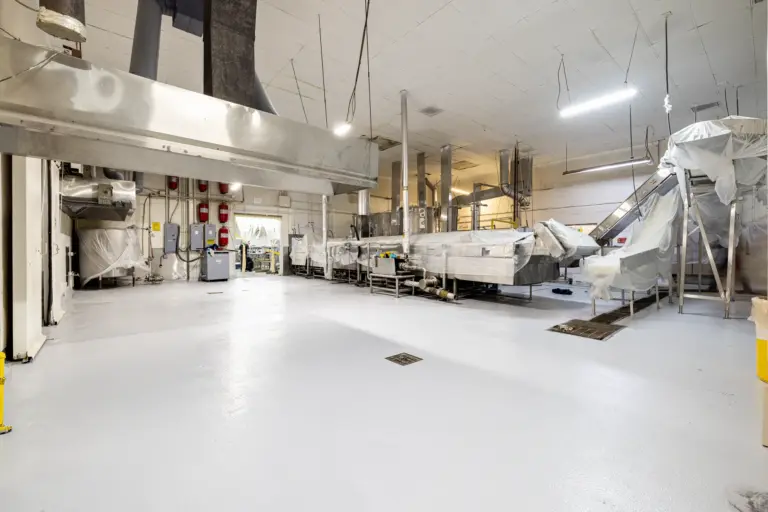
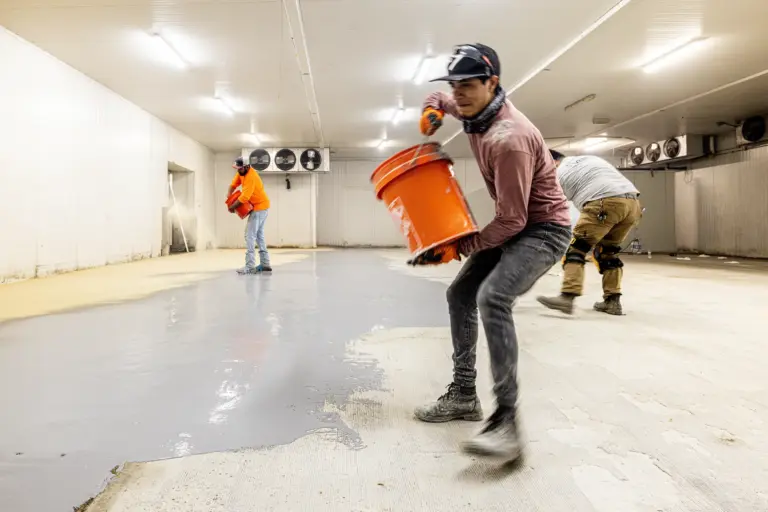
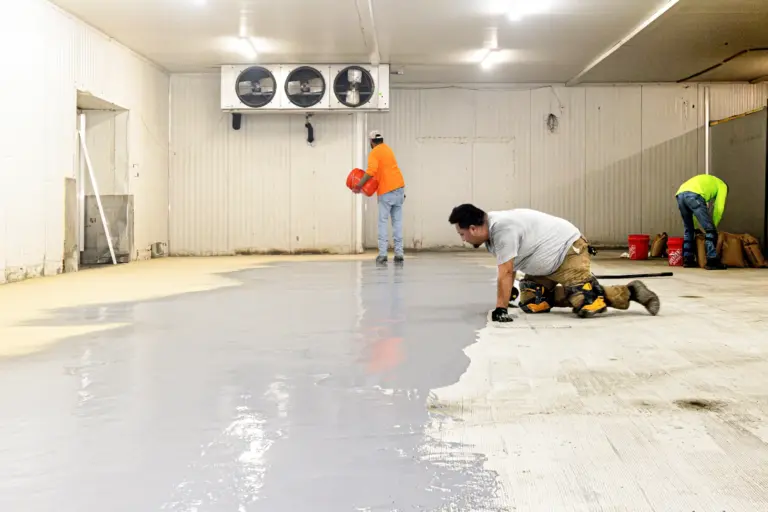
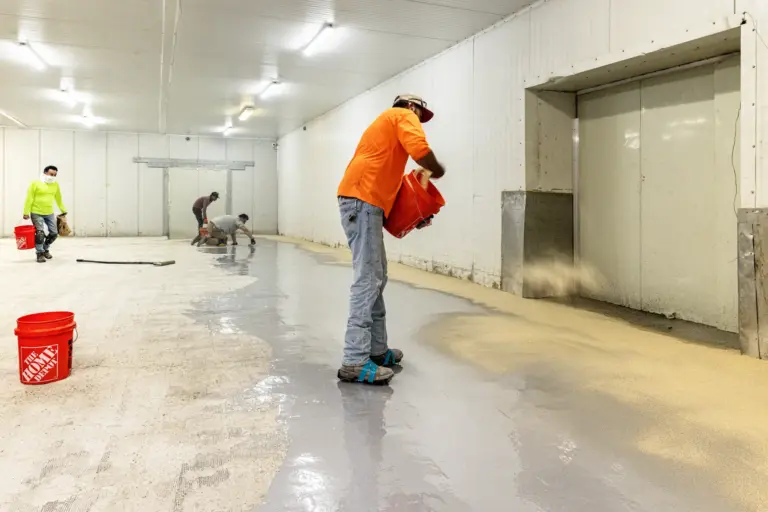
urethane Cement Installation Gallery
Request a Proposal
Submit project parameters for preliminary analysis. Commercial estimates typically returned within 24 hours.
ASTM F2170 Moisture Verification
ASTM F2170 — RH Read at 40 Percent of Slab Depth
ASTM F2170 reads relative humidity inside the slab, not at the surface, because the surface is what the building’s HVAC has been drying for weeks. Probe holes go to 40 percent of slab depth on a slab drying from one side and 20 percent when it dries from both, with three probes in the first 1,000 square feet and one more per additional 1,000. The current revision reads probes 24 hours after placement. Older revisions required 72, and some specs still carry that number. Readings log before primer, no exceptions.
Urethane Cement Tolerates Moisture That Stops Epoxy
Sherwin-Williams rates Poly-Crete systems to 99 percent relative humidity per ASTM F2170 and 20 pounds per 1,000 square feet per 24 hours per ASTM F1869. Sika publishes the same posture for Ucrete, with HS24 NA applied to green concrete at 7-10 days and to substrates reading under 100 percent RH. The cement fraction of the matrix is at home in a damp slab — the same chemistry as the concrete below it — where epoxy’s impermeable film gives vapor pressure something to push against. Moisture testing concrete before installation turns that tolerance into documented acceptance.
F1869 Is the Secondary Method, and the Spec Sets the Gate
ASTM F1869 calcium chloride testing measures vapor emission at the slab surface in pounds per 1,000 square feet per 24 hours. Poly-Crete’s F1869 limit is 20. F2170 reads moisture deeper in the slab and is the method both Sika and Sherwin-Williams publish RH limits against, and either way the acceptance number belongs to the installed system. A slab reading 90 percent RH passes for one system and can fail another.
Contamination, Repair, and Documentation
Densifiers and Curing Compounds Block the Bond
A slab that was densified, sealed, or cured with membrane compound will not bond a urethane cement system until the treatment is mechanically removed. Sherwin-Williams’ evaluation guidelines warn that curing compounds, hardeners, and densifiers can leave soluble salt deposits near the surface that set up osmotic blistering under a bonded floor. Removal is mechanical. Shot blast or scarifier takes the treated layer off, and the exposed concrete is re-inspected before primer. Oils get degreased first, because blasting an oily slab spreads contamination instead of removing it.
Repair Scope, Joints, and Keyway Terminations
Repair precedes profile verification. Cracks are routed and filled, spalls are cut back to sound concrete and patched, and moving joints are honored through the finished system rather than buried under it. Terminations never feather out: Sherwin-Williams’ application instructions read “always terminate in keyway groove at doorways and exposed edges,” and the same detail holds at drains and trench lips, where a feathered edge becomes the first chip under a pallet jack. Flatness and substrate tolerances check against ACI 302.1R.
The Substrate File That Leaves the Site
Every acceptance value leaves the site in writing. The closeout package carries the ASTM F2170 log, profile verification against ICRI replica chips, and primer coverage with batch numbers for every material layer, because a warranty conversation ten years out starts with day-one records. On phased installations the same records run zone by zone, so a facility that never fully shuts down still ends up with one continuous substrate file.
urethane Cement Flooring Knowledge Center
Resource links
Technical Performance
Selection & Standards
Industries Served
Sherwin-Williams Poly-Crete Systems
Sika Ucrete Systems
Cost, Comparisons & Legacy Names
Frequently Asked Questions
CSP 4-6 on the ICRI 310.2 scale is the specified range for self-leveling urethane cement systems in Sherwin-Williams’ surface preparation guide, and each product’s application instructions state the governing number. Shot blasting is the preferred method and produces CSP 3-7. Verification happens on the slab, against ICRI replica chips, before any primer goes down.
ASTM F2170 in-situ relative humidity testing, with probes at 40 percent of slab depth, three for the first 1,000 square feet plus one per additional 1,000, read after equilibration and logged before primer. ASTM F1869 calcium chloride testing measures surface vapor emission and runs where the spec calls for it. Both results go in the closeout file, because the manufacturer’s warranty rides on documented acceptance.
Shot blasting handles the open floor. It is the preferred method in manufacturer application instructions and cuts CSP 3-7 with contained dust recovery, so it runs in occupied plants. Diamond grinding produces CSP 1-3, below the urethane cement field spec, so it works edges, keyway terminations, and areas the blast machine cannot reach. Scarifying at CSP 6-9 is for deteriorated slabs that need material removed, and it takes a follow-up blast pass.
No, not until the sealer or densifier is mechanically removed and the removal verified. Sherwin-Williams’ evaluation guidelines warn that curing compounds, hardeners, and densifiers can leave soluble salt deposits near the surface that set up osmotic blistering under a bonded system. Shot blasting strips the treated layer, and the exposed concrete is re-inspected before primer.
The floor fails at the bond line, the same failure plane that takes out epoxy in 12-24 months under thermal cycling. Profile below spec delaminates because the mortar never got its mechanical key; moisture above the manufacturer’s limit blisters; contamination left in place lets the system release in sheets. Diagnosing an existing failure is its own subject, covered under replacing failed epoxy and common installation mistakes in the knowledge center.
Standard mechanical prep is included in installed urethane cement pricing, which runs $4-17/sqft installed depending on project size, system thickness, and substrate condition. Substrate repair is what moves a bid. Crack routing, spall patching, and contamination removal are scoped at walkthrough and priced from slab condition, and size-band pricing detail lives on the cost page.
The same crews that install the system. Craftsman is a Sika Certified + Authorized Sherwin-Williams High Performance Flooring installer, and prep runs to the installing manufacturer’s application instructions rather than a generic spec. In-house W-2 crews provide national service coverage, and on phased installs the prep, testing, and documentation run zone by zone around production.
Blog
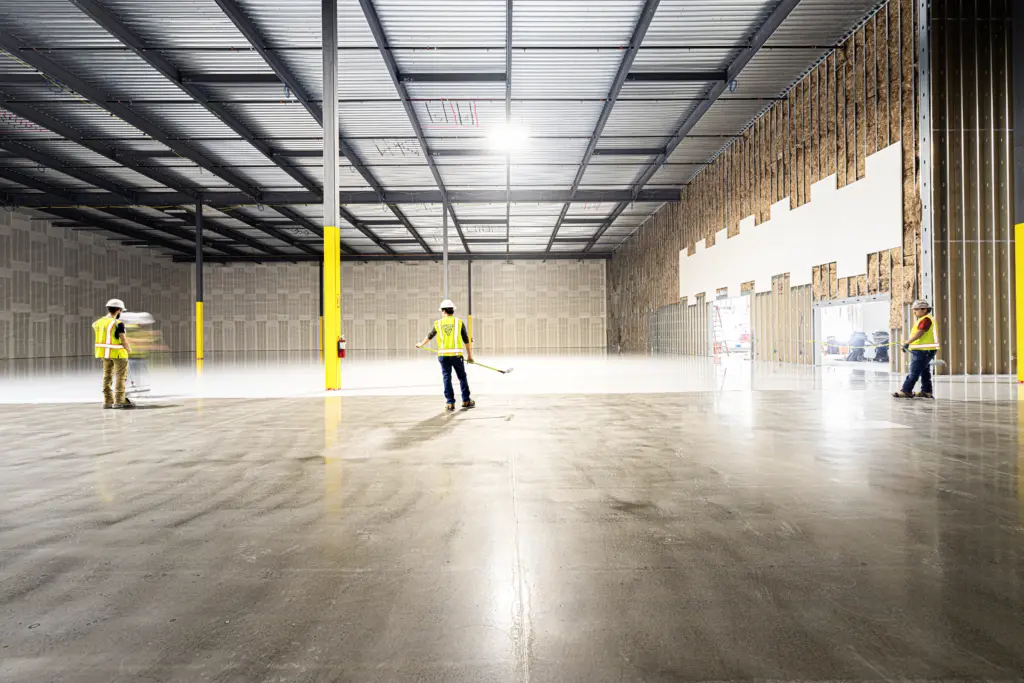
Craftsman Publishes 2026–2027 ESD Flooring Technical Guide
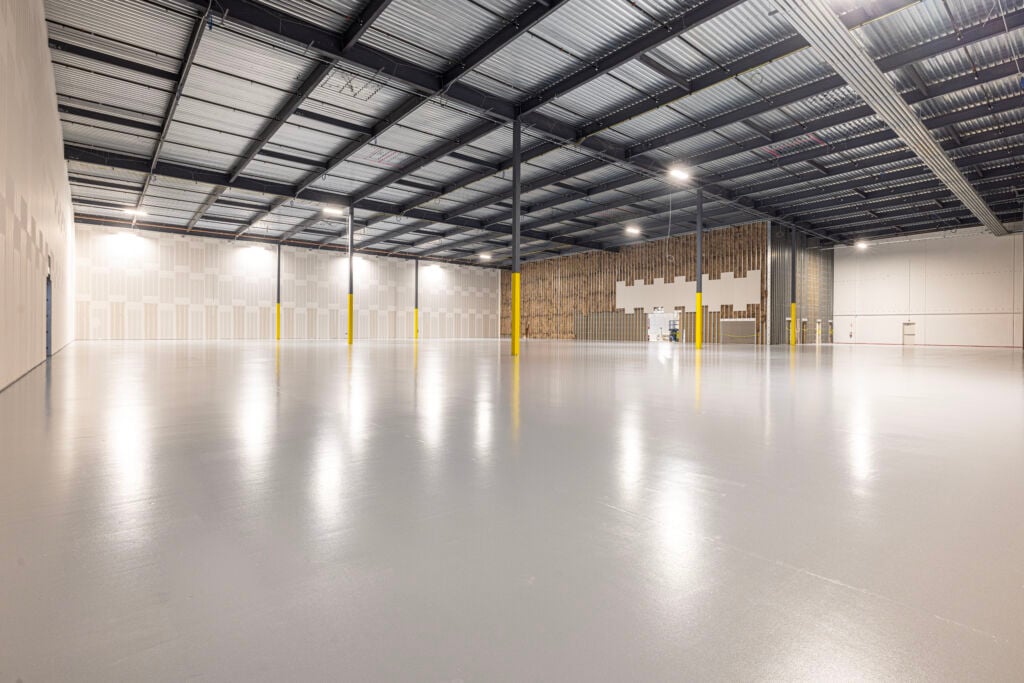
ESD Epoxy Flooring Case Study: 34,000 SF Dallas, TX