- System: cementitious urethane mortar flooring engineered for commercial kitchen and food service environments — seamless monolithic surface bonded chemically to concrete, with broadcast aggregate texture for slip resistance
- System Thickness: 3/16″ to 3/8″ standard; 9-12mm decorative terrazzo (Ucrete TZ) available for front-of-house transitions
- Service Life: 25+ years under heavy commercial kitchen conditions
- Thermal Shock Tolerance: 150°F+ temperature differential at the resin-to-concrete bond — the failure mode that delaminates standard epoxy within 12-24 months at fryer stations and walk-in cooler entries
- Operating Temperature Range: -40°F to 250°F continuous service
- Chemical Resistance:
- – Hot cooking oils, animal fats, grease, organic acids from food residue
- – Sugar acids from dessert and pastry prep, dairy, citrus and tomato acids
- – Caustic CIP detergents at 3-5% institutional concentration, sanitizers, commercial dish detergents
- Slip Resistance: DCOF .42 wet-surface threshold per ANSI A137.1 (ADA wet-surface compliance); zone-by-zone broadcast aggregate finish, coarser mesh (20/40 grit) at dishwash and cooler entries, finer mesh (40/60 grit) at prep counters
- Integral Cove Base: monolithic mortar cove base poured as part of the floor system, eliminating wall-floor seams that generate health inspection citations in quarry tile installations
- Health Code Compliance:
- – USDA and FDA guidelines for food-contact and food-adjacent environments
- – NSF/ANSI 51 documentation for food-equipment zones
- – HACCP, SQF, GFSI compliance documentation in closeout package
- Phased Installation:
- – Zone-by-zone install across overnight and weekend windows; service continues in non-paved zones
- – 24-hour cure-and-return-to-service for self-leveling systems
- – Weekend shutdown option for kitchens under approximately 2,500 sqft
- Installation Timeline: 1-3 weeks lead time from contract execution, driven by material availability
- Closeout Documentation:
- – DCOF test results per ANSI A137.1 for insurance and OSHA records
- – ICRI 310.2 concrete surface profile records
- – ASTM F2170 in-situ moisture readings
- – Manufacturer batch numbers, primer coverage rates, cure temperature logs
- Crew Structure: in-house W-2 crews mobilize nationwide; night and weekend installation at fixed project pricing without overtime markup
- Project History: commercial kitchen flooring installations since 1999 across restaurant, hotel banquet, hospital, school, prison, and military mess kitchen verticals
- Pricing: $8-15/sqft installed depending on system thickness, vertical, and substrate condition
Phone: +1 (844) 687-1961
Best Commercial Kitchen Flooring Choice
Five flooring materials show up in commercial kitchen specifications: epoxy, quarry tile, polished concrete, sheet vinyl, and urethane cement. Four of the five fail under hot CIP washdown chemistry, organic acid exposure from food prep, and continuous wet conditions — within 5-10 years for epoxy, 3-7 years for quarry tile grout, 3-5 years for densified polished concrete. Urethane cement is the fifth. The comparison below names each material, the specific failure mode that ends its service life in a commercial kitchen, and the operational consequence the facility owner inherits when the floor goes.
Epoxy — Thermal Shock Delamination Within 5-10 Years
Standard epoxy fails commercial kitchens at the resin-to-concrete interface. Hot CIP washdown at 180°F hits a cool slab and creates a temperature differential exceeding 150°F across the bond line. Epoxy is rigid and bonds adhesively. Concrete expands and contracts; epoxy does not. Within 12-24 months in a heavy commercial kitchen, delamination begins at floor drains and equipment edges where thermal cycling is most aggressive. By year 5-10 the failure is general and full replacement is the only repair. Operators replacing epoxy for the second or third time are the most common buyers of urethane cement.
Quarry Tile — Grout Joint Failure and Bacterial Harborage
Quarry tile bodies hold up. The grout between them does not. Steam cleaning and organic acid exposure from food residue degrade cementitious grout within 3-7 years, opening joints that become bacterial harborage no cleaning protocol fully reaches. Health inspectors cite grout failure routinely — open joints at wall-floor transitions and around floor drains are the common citation. Repair forces a choice: regrout (temporary, fails again on the same timeline) or tear out and replace the floor system. Tile demolition adds cost on top of the replacement system pricing — operators replacing failed quarry tile typically price the demo and the new floor as a combined line item.
Polished Concrete — Porosity After Densifier Wear
Polished concrete in a commercial kitchen wears through its densifier hardener in 3-5 years under cart traffic and continuous wet cleaning. Once the densifier is gone, the exposed concrete is porous and absorbs hot grease, organic acids from food prep, and bacterial residue. Re-densification is possible but requires removing the floor from service for grinding and re-application — a process that repeats on a 3-5 year cycle. Polished concrete works in retail and warehouse environments where chemistry exposure is low. It does not survive commercial kitchen operational conditions.
Paragraph placeholder 3B. Replace with the second paragraph for this subhead (optional).
Urethane Cement — Chemical Bond, 25+ Year Service Life
Urethane cement bonds chemically to concrete rather than adhesively. The cementitious matrix flexes with the substrate through thermal cycling instead of resisting it, which is why thermal shock does not delaminate the system the way it does epoxy. Service life is 25+ years in heavy commercial kitchen conditions. Installed pricing is $8-15/sqft depending on system thickness, vertical, and substrate condition. Lifecycle cost weighs the $8-15/sqft installed UC pricing against the recurring replacement and repair cycles of the alternative systems. Operators replacing epoxy for the second or third time, or facing the second regrout cycle on quarry tile, are the two most common buyer profiles for UC.
Restaurant Kitchen Flooring Considerations
Restaurant kitchen flooring projects run on a different operational calendar than institutional builds. Sunday close to Tuesday open is the standard window. Hot oil splatter at fryer stations and grills, sugar acids from dessert and pastry prep, and continuous wet conditions at dishwash all push the material specification past what epoxy or polished concrete can handle. Health department compliance is the gate the floor either passes or fails. The considerations below cover the operational chemistry, the inspection points health departments cite, and the install scheduling pattern restaurant operators need from a flooring contractor.
Operational Chemistry — Hot Oil, Sugar Acids, Wet Conditions
Restaurant kitchen chemistry exposure runs heavier than retail or warehouse environments at every station. Fryer station hot oil at 350°F splatters onto the floor and oxidizes into a degrading acid film. Grease accumulates at grills and flat-tops and migrates into any porous surface. Sugar acids from dessert and pastry prep concentrate during cleaning. Dishwash zones run continuously wet from prep through close. Urethane cement resists each of these exposures because the urethane resin matrix is chemically stable against organic acids and the cementitious base does not absorb fats. Epoxy and polished concrete fail under these specific exposures.
Health Department Compliance — Integral Cove Base, Monolithic Surface
Health inspectors cite restaurant kitchen flooring at three points: grout joints, wall-floor seams, and floor drain transitions. All three are bacterial harborage points where cleaning protocols cannot reach standing residue. Integral cove base eliminates the wall-floor seam by pouring the floor and the cove as one monolithic mortar element. Urethane cement installs as a single continuous surface with no grout joints. Floor drain transitions are sealed in the same pour. The result is a surface that passes health inspection where quarry tile and sheet vinyl typically generate citations. DCOF .42 wet-surface threshold per ANSI A137.1 is the slip-resistance standard the floor must meet.
Weekend Shutdown Windows — Sunday Close to Tuesday Open
Most restaurants cannot close for five consecutive days. Sunday close to Tuesday open is the realistic shutdown window. Self-leveling urethane cement returns to foot traffic within 24 hours of installation completion, which fits the weekend window for kitchens under roughly 1,500 sqft installed in a single overnight session. Larger kitchens phase by zone across consecutive weekends. In-house W-2 crews handle night and weekend installation at the same fixed project pricing — no overtime markup applied for off-hours work. The schedule builds against the actual operational calendar, not the contractor’s calendar.
Our Clients




















Request a Proposal
Industrial Kitchen Flooring Requirements
Industrial kitchen flooring covers hospitals, prisons, schools, military mess, hotel banquet kitchens, and large-volume commissary operations. These facilities run on a different operational tempo than restaurants — 18-hour days, seven days a week, with production volumes and CIP chemistry that exceed restaurant grade. Procurement runs through institutional channels with QA documentation requirements that restaurant projects rarely encounter. The requirements below cover the operational intensity, the chemistry exposure, and the documentation procurement officers expect at project closeout.
Production Volume — 18-Hour Operations, Seven Days a Week
A 500-bed hospital kitchen produces roughly 2,000 meals per day across patient meals, cafeteria service, and overnight refrigerated holds. Operations run from 4:00 AM prep through 10:00 PM service with overnight cleaning and prep cycling continuously. Mechanical traffic includes 600 lb production carts, motorized tilt skillets on casters, and pallet jacks moving incoming receivables from loading dock to cooler. Cart and equipment traffic on an institutional kitchen floor is roughly an order of magnitude heavier than a comparable restaurant kitchen footprint. Zero acceptable downtime for flooring failure means the floor system selection cannot tolerate the 5-10 year epoxy replacement cycle.
CIP Chemistry and Thermal Cycling — Beyond Restaurant Grade
Institutional CIP runs caustic detergents at 3-5% concentration, where restaurant kitchens typically operate at 1-2%. Wash temperatures hit 180°F+ at production wash stations. Walk-in freezer load-in at -10°F sits across the same kitchen footprint as steam table service at 180°F, with personnel and carts moving between the two zones continuously. The locked operating range -40°F to 250°F with 150°F+ thermal shock tolerance is the published performance envelope UC carries into institutional kitchen specifications, where standard epoxy systems are rated below this temperature differential.
Procurement Documentation — QA Records for Institutional Sign-Off
Institutional procurement requires documentation that residential and small commercial projects rarely produce. ICRI 310.2 CSP records confirm concrete surface profile before mortar placement. ASTM F2170 in-situ moisture readings document substrate condition. Manufacturer batch numbers, primer coverage rates, and cure temperature logs go in the closeout package. USDA, FDA, HACCP, SQF, and GFSI compliance documentation is referenced where the kitchen serves regulated food production. Closeout package delivery times to facility QA before the next inspection cycle so the documentation is in the facility binder when inspectors arrive, not requested after the fact.
Anti-Slip and Non-Slip Commercial Kitchen Flooring
Slip resistance in a commercial kitchen is not a single rating applied across the floor. Zones with different exposure get different texture specifications. Dishwash zones and walk-in cooler entries need aggressive texture; prep counters and service lines need finer aggregate that still cleans easily. DCOF .42 wet-surface threshold per ANSI A137.1 is the documented compliance reference for ADA wet-surface conditions. The specification approach below covers the standard, the broadcast aggregate method, and the documentation insurance carriers and OSHA expect.
DCOF .42 Wet-Surface Threshold — ADA Compliance Standard
DCOF .42 wet-surface is the dynamic coefficient of friction threshold referenced for ADA wet-surface compliance in commercial settings. ANSI A137.1 defines the test method. Commercial kitchen flooring meeting this threshold passes the wet-surface slip-resistance condition. Test results are produced on installed floor samples and delivered as part of the closeout package, not estimated from manufacturer technical data. Specifications written by health departments and insurance carriers for anti-slip and non-slip commercial kitchen flooring reference either the DCOF .42 threshold directly or ANSI A137.1 by name.
Broadcast Aggregate Finish — Zone-by-Zone Texture Specification
Slip resistance in urethane cement comes from aggregate broadcast into the surface during installation. Sand or angular quartz at controlled mesh size determines the texture and the resulting friction value. Coarser mesh (20/40 grit) goes at dishwash zones, walk-in cooler entries, and floor drain approaches where wet conditions are constant. Finer mesh (40/60 grit) goes at prep counters and service lines where cleaning frequency is high and aggressive texture trades against cleaning protocol time. The mesh selection per zone is documented in the floor plan submittal so the specification matches the as-built condition.
Insurance and OSHA Documentation — Verification Letters on Request
Workers’ compensation carriers renewing restaurant and institutional policies routinely request slip-resistance documentation. OSHA investigations after a kitchen slip-fall incident reference the same records. The closeout package includes DCOF test results per ANSI A137.1, manufacturer product data sheets covering slip-resistance specifications, and dated installation records identifying the aggregate mesh used per zone. Verification letters confirming installed slip-resistance values are provided on request for carrier renewals and incident response without additional fee.
Phased Installation for Commercial Kitchens
Phased installation is the default operating model on commercial kitchen projects, not a special accommodation. Most operators cannot shut down for five consecutive days. The project schedule builds against the actual service calendar — Sunday close for restaurants, holiday and summer reduced-service weeks at school cafeterias, scheduled deep-clean shutdowns at hospitals. Phased installation divides the kitchen into operational zones and installs each zone in the window the operator can provide. The methodology below covers the zone breakdown, the cure-and-return timing, and the crew structure that makes night and weekend work pricing-neutral.
Zone-by-Zone Methodology — 4-6 Operational Zones
A commercial kitchen breaks into 4-6 operational zones for phased installation: prep, hot line, dishwash, walk-in approach and cold storage, service pass and front-of-house transition, and floor drain trenches that cut across zones. Each zone installs in a separate overnight or weekend window. Service continues in the non-paved zones throughout the project — the kitchen does not close. Zone boundaries are defined at saw-cut transitions or expansion joints so the mortar pours meet cleanly at planned construction joints rather than mid-zone.
24-Hour Cure-and-Return-to-Service — Self-Leveling UC Systems
Self-leveling urethane cement systems return to foot traffic within 24 hours of installation completion. Heavy equipment and full operations resume after 72 hours, though many operators bring service back at 24 hours with carts and personnel only. Surface preparation and mortar placement can split across two windows when zone size or operational constraints require — diamond grinding completes in one overnight window and mortar pours in the next. Zones under approximately 1,500 sqft complete prep and pour in a single overnight session.
Weekend Shutdown Option — Full Kitchen Install Friday to Monday
Restaurants closed Sunday through Monday can install the entire kitchen between Friday close and Monday open when total footprint is approximately 2,500 sqft or smaller. Friday night runs surface prep; Saturday runs the mortar pour; Sunday is cure day; Monday operations resume. Larger institutional kitchens phase by zone across consecutive weekends, with a 4,000 sqft hospital kitchen typically completing across two weekend windows. The schedule confirms during pre-construction with operations leadership so service planning runs against confirmed dates.
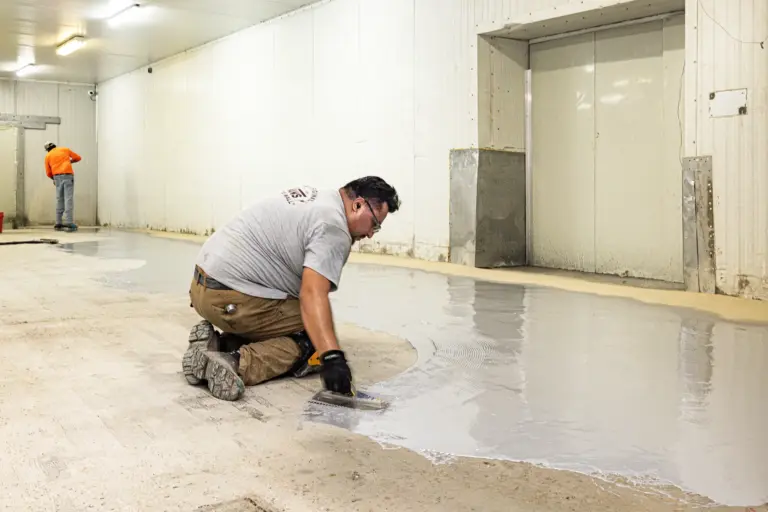
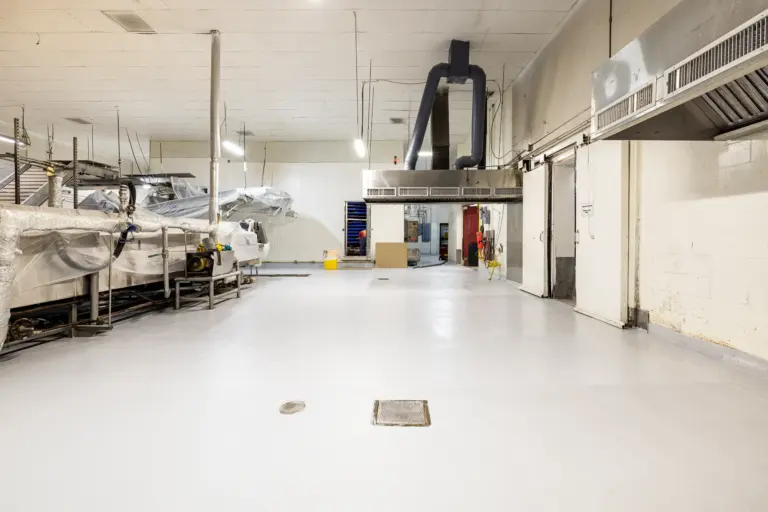
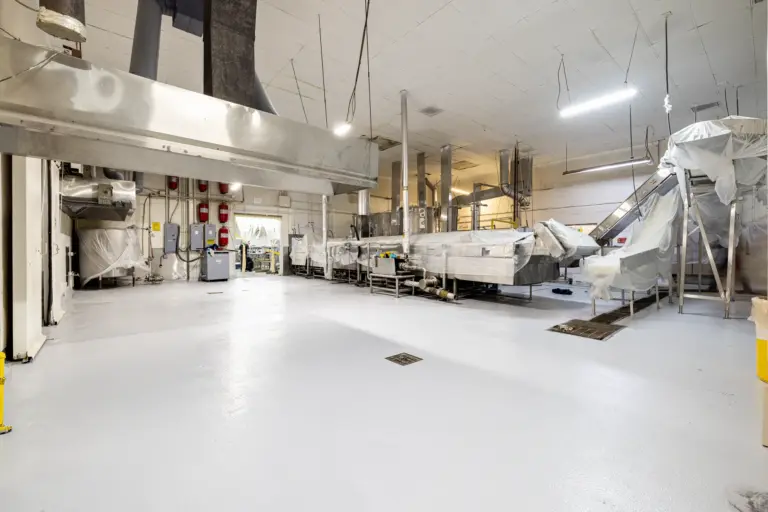
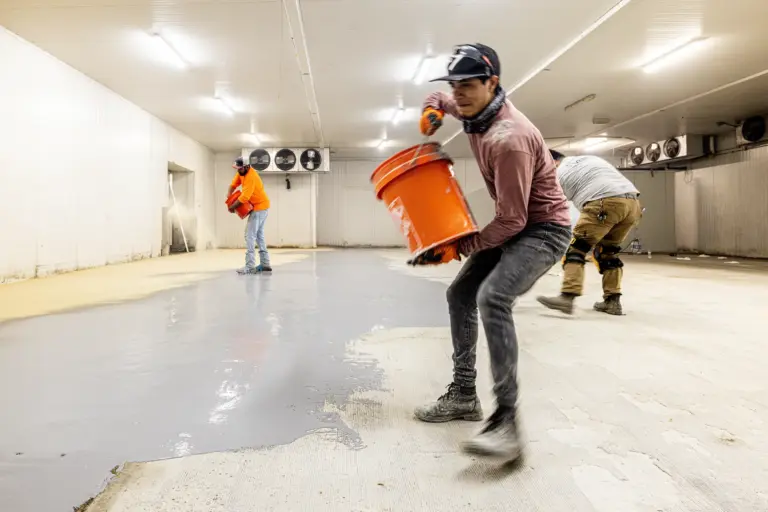
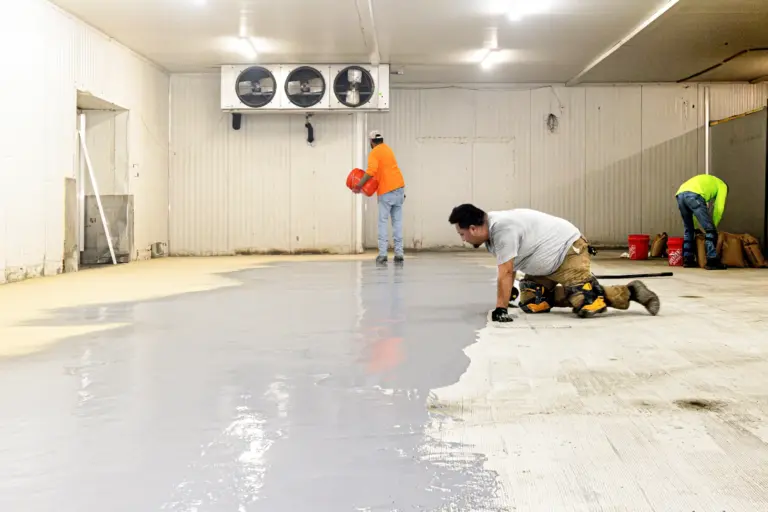
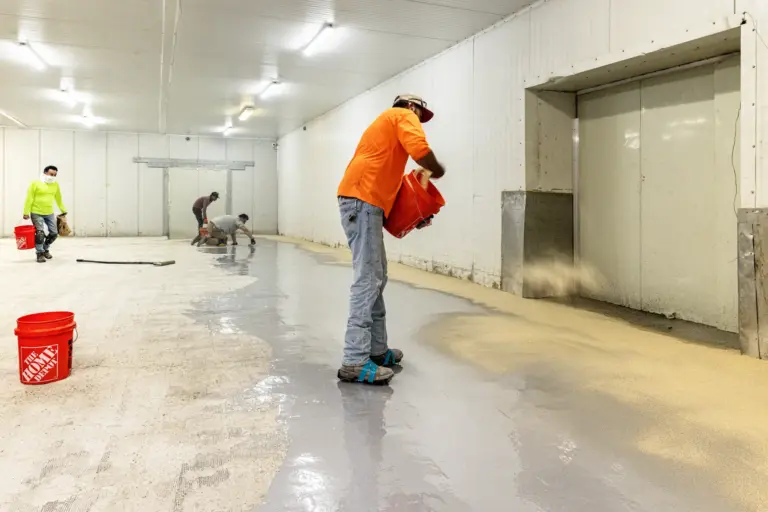
urethane Cement Installation Gallery
urethane Cement Flooring Knowledge Center
Resource links
Sherwin-Williams Poly-Crete Systems
Sika Ucrete Systems
Industries Served
Technical Performance
Selection & Standards
Costs, Comparisons & Legacy Names
Frequently Asked Questions
Urethane cement is the flooring system commercial kitchen operators select when the floor needs to outlast 5-10 year epoxy replacement cycles and pass health inspection without grout joints. Service life is 25+ years against $8-15/sqft installed pricing. Cementitious chemistry bonds chemically to concrete and the mortar matrix flexes with the substrate through thermal cycling — the mechanism epoxy lacks and the reason epoxy fails commercial kitchens within a decade.
Urethane cement commercial kitchen flooring runs $8-15/sqft installed depending on system thickness, vertical, and substrate condition. Standard self-leveling systems at 3/16″ thickness fall toward the lower end; heavy-duty trowel-applied systems at 3/8″ with broadcast aggregate and integral cove base fall toward the upper end. Substrate condition drives a meaningful portion of the variance — failed epoxy that requires full removal adds prep cost, while sound concrete with a clean profile installs at base pricing.
Phased installation divides the kitchen into 4-6 operational zones and installs each zone in a separate overnight or weekend window. Service continues in non-paved zones throughout the project, so the kitchen does not close. Self-leveling urethane cement returns to foot traffic within 24 hours of installation completion. Lead time is 1-3 weeks from contract execution.
Yes. Urethane cement systems installed by Craftsman meet USDA and FDA guidelines for food-contact and food-adjacent environments, with NSF/ANSI 51 documentation available for food-equipment zones. HACCP, SQF, and GFSI compliance documentation is referenced in the closeout package for facilities operating under those food safety frameworks. The closeout package includes ICRI 310.2 CSP records, ASTM F2170 in-situ moisture readings, manufacturer batch numbers, and primer coverage rates — the records facility QA needs at the next inspection cycle.
Nationwide. Estimating and scheduling are coordinated through Craftsman’s Dallas headquarters. In-house W-2 crews mobilize to project sites for restaurant, institutional, and industrial kitchen installations. Pre-bid walkthroughs are available within regional drive radius; remote spec review is standard for multi-region rollouts. Craftsman Concrete Floors has been installing industrial and commercial flooring systems since 1999.
Blog
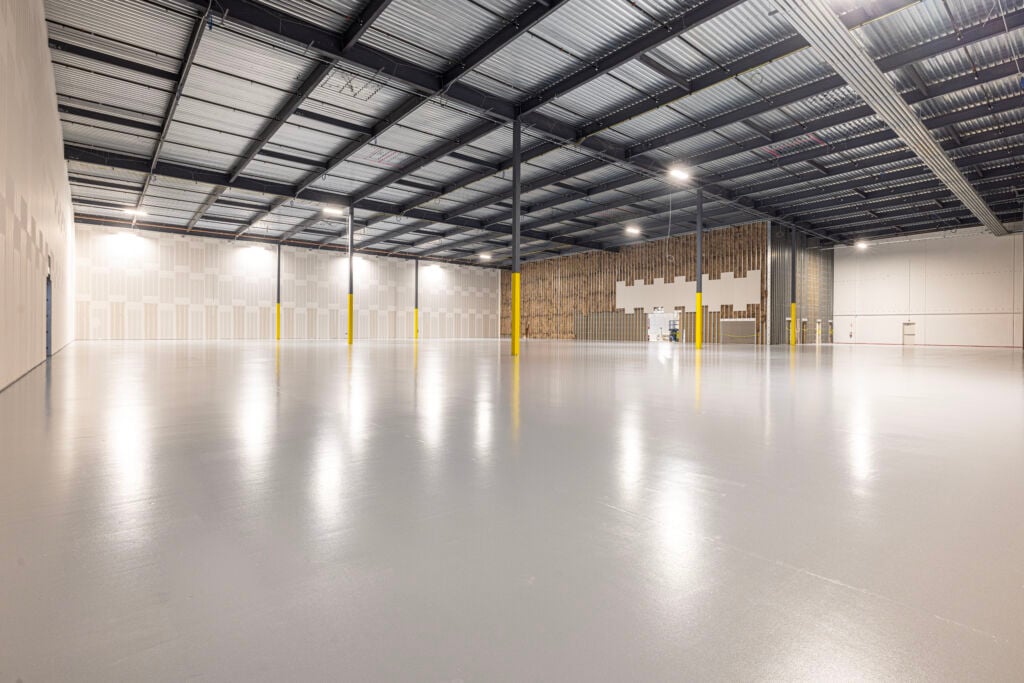
ESD Epoxy Flooring Case Study: 34,000 SF Dallas, TX
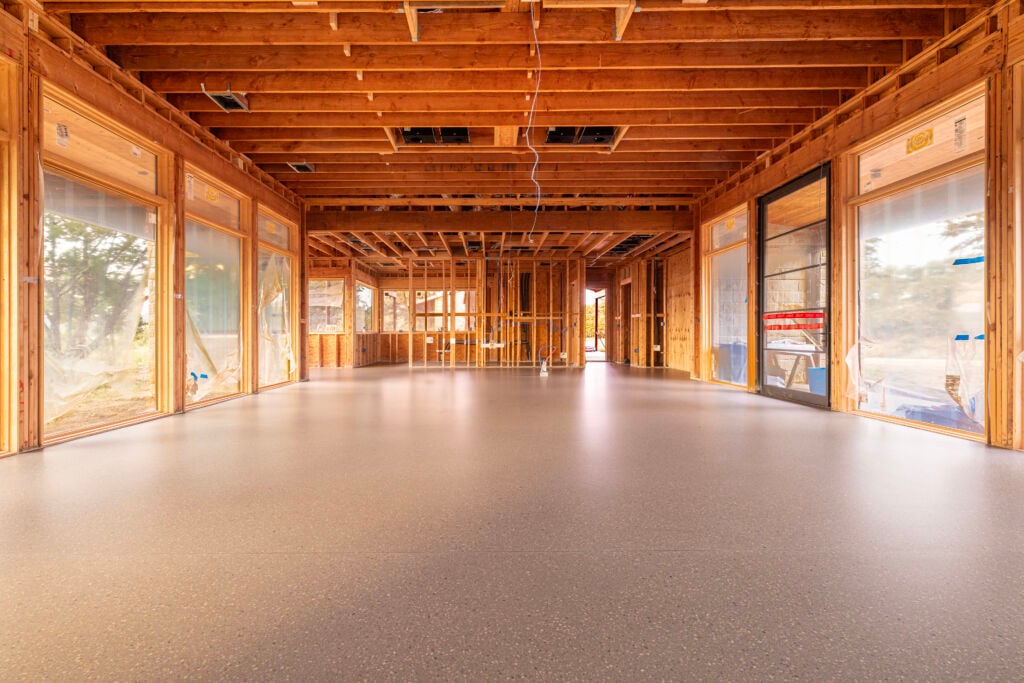
Residential Terrazzo Floors in Fort Worth, Texas