- Founded in 1999 • National commercial & industrial specialty flooring contractor
- Systems: Sika Ucrete & Sherwin-Williams High Performance Flooring Poly-Crete and Hybri-Flex urethane cement systems
- In-house W-2 crews provide national service coverage
- Single-contract multi-site programs under a Master Service Agreement
- Phased installation in occupied facilities — night and weekend shutdown-window execution
- Experience Modification Rate (EMR) below the industry average
- Authorized Sherwin-Williams High Performance Flooring installer; Sika installer; Westcoat certified
- Pre-install moisture and substrate testing & audit-ready closeout documentation
- Facility assessments, compliance inspections & lifecycle maintenance programs
- Licensed • Insured • Bonded • Enterprise vendor prequalification package available (COI, W-9, capabilities statement & supporting documentation)
- Service life: 15-20+ years
- Repair return-to-service: 24 hours self-leveling • 48-72 hours trowel-applied
- Cleaning compatibility: hot CIP washdown, caustic cleaners, organic acids (lactic, acetic, citric) & sanitizers
Phone: +1 (844) 687-1961
Urethane cement floor maintenance exists to protect two physical conditions. The 15-20+ year service life of a urethane cement floor assumes broadcast texture that still carries wet-area traction and an integral cove base that still seals the wall-floor joint. The mortar matrix itself asks little. Hot CIP washdown and caustic wash chemistry sit inside its daily duty, because the cementitious-urethane chemistry was specified against exactly that exposure. What shortens the life of a urethane cement floor is mechanical wear that goes unwatched. Texture polishes smooth in traffic lanes. Cove radii crack under cart and pallet impact. Drain perimeters erode, and gouges get left open to substrate. A maintenance program that watches those four points preserves the floor; a program that only schedules mopping does not.
This page covers the working parts of urethane cement floor care. It names the cleaning chemistry the matrix tolerates daily, the scrub methods that preserve texture instead of polishing it away, the inspection points that catch damage while it is still zone-repairable, and the repair windows that close damage without a production shutdown. Slip measurement and texture specification carry their own depth pages, and this one stays with the maintenance decisions a facility team owns.
Our Clients




















What Maintenance Actually Preserves
Traffic Lanes Polish Smooth Before Anything Else Fails
Broadcast aggregate in a urethane cement wear surface is sacrificial by design, and it wears fastest where forklifts turn and wash crews concentrate. A floor can be structurally sound for another decade and still miss a wet-traction expectation because its lanes went glossy. ANSI A326.3 sets a wet DCOF of 0.42 as the acceptance threshold for level interior floors walked on when wet, and that figure is the standard’s pass line rather than a tested value for any particular floor. Metric definitions live on the SCOF and DCOF page; texture selection lives on the slip resistance page.
A Cracked Cove Radius Reopens the Joint the System Was Specified to Remove
The integral cove base is formed in place during installation from the same mortar as the floor, monolithic with it; that continuity removes the wall-floor joint as a harborage line. Impact is what breaks it. Pallet corners and cart hubs crack the radius out of the main traffic path, where damage sits unnoticed until a sanitation audit finds it. A hairline crack at the cove returns the exact seam the specification paid to eliminate. Cove construction and termination detail lives on the integral cove base page.
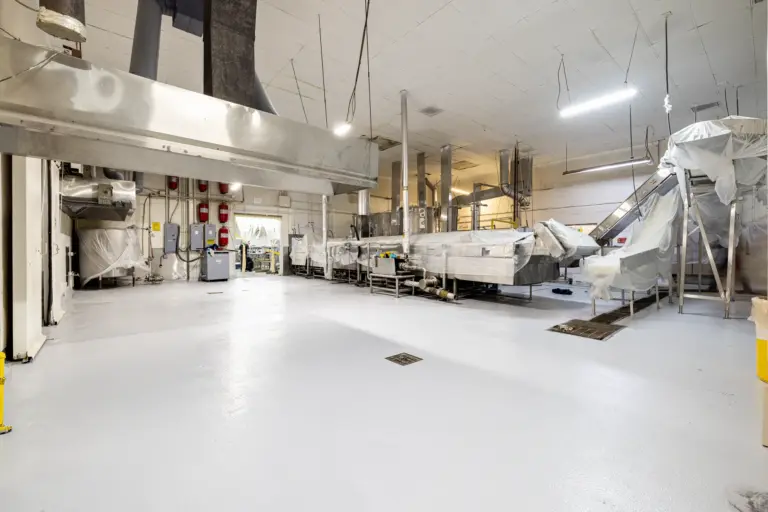
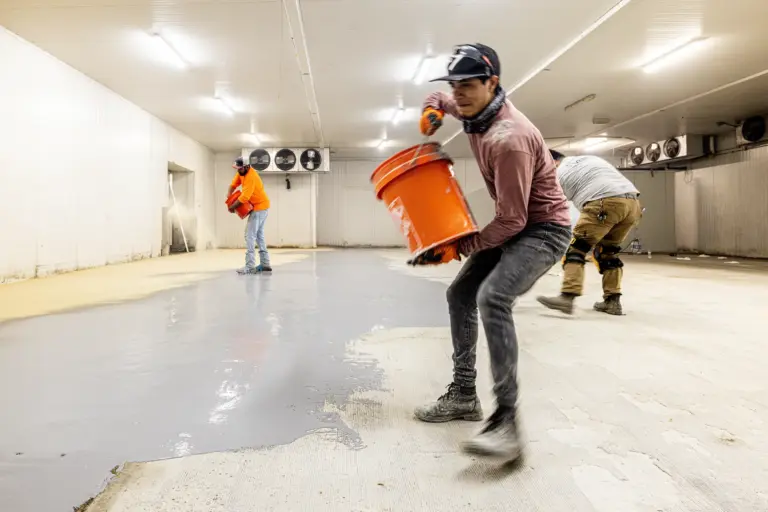
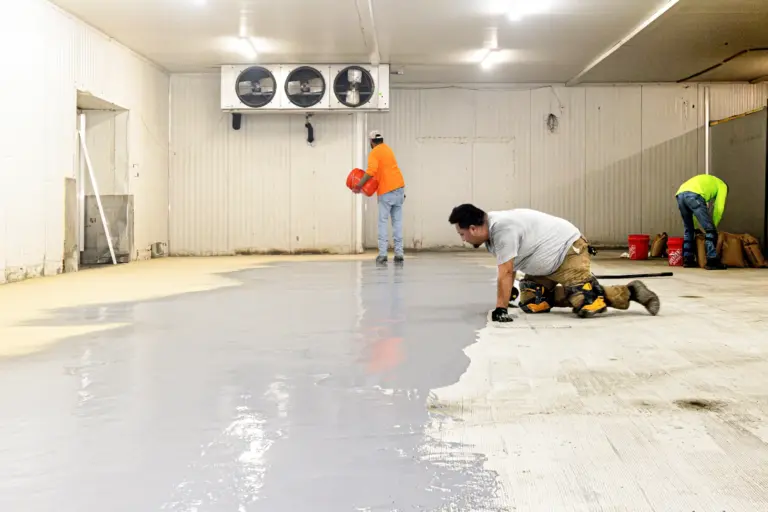
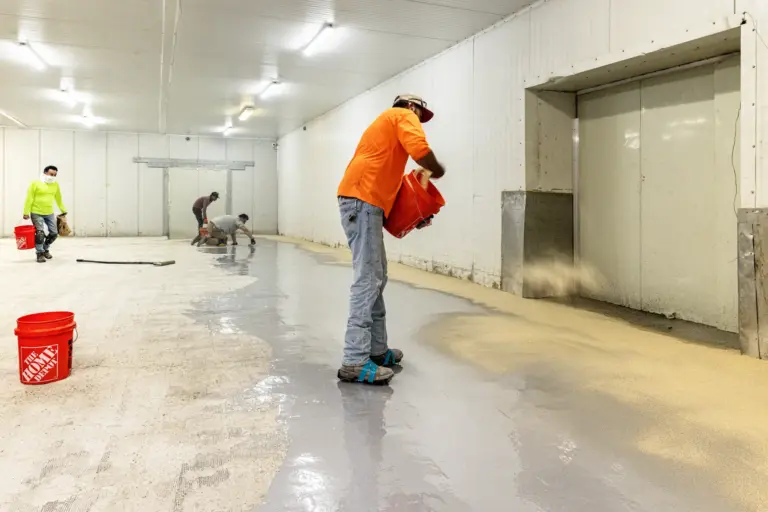
urethane Cement Installation Gallery
Request a Proposal
Submit project parameters for preliminary analysis. Commercial estimates typically returned within 24 hours.
Cleaning Chemistry and Method
Daily Chemistry Sits Inside the Matrix’s Specified Duty
Caustic CIP solutions and sanitizers at temperature are routine exposure for a urethane cement floor. So are the organic acids food processing leaves on a slab — lactic, acetic, citric. The matrix is non-porous and bonds chemically to the concrete below it, so cleaning solutions find no pore structure to penetrate and no film interface to attack. Standard epoxy fails at that film interface, delaminating within 12-24 months where 150°F+ washdown differentials work on the resin-concrete bond line. Chemical selection can therefore follow the sanitation protocol; anything outside it gets checked against the installed system’s manufacturer documentation first.
Scrub Media Can Do What the Chemistry Cannot
Grinding-class abrasive pads and steel-bristle heads cut broadcast aggregate the same way heavy traffic does, only faster and across the whole floor instead of just the lanes. A cleaning program built around aggressive media will flatten a slip profile the process chemistry could never touch. Match scrub media to the installed texture profile, and reserve aggressive cutting for actual buildup problems, not daily passes. Cleaning urethane cement floors day to day rarely needs more than the facility’s standard rotary brushes and squeegees.
HACCP SSOPs and the Floor’s Contribution to Cleaning Validation
Microbial control in regulated facilities is achieved through cleaning validation rather than floor surface chemistry. What a urethane cement floor contributes is geometry that does not defeat the protocol. A monolithic pour with an integral cove base gives the sanitation crew no grout lines, no welded seams, no wall-floor joint to validate around, which is what makes the system compatible with HACCP SSOPs. Maintenance protects that contribution: an open gouge or a cracked cove reintroduces harborage geometry, and the validated protocol starts passing over a defect it was never written to handle.
Inspection Cadence and Repair
Fold Urethane Cement Floor Maintenance Into Audits the Facility Already Runs
A separate floor-inspection calendar rarely survives contact with a production schedule. HACCP verification walkthroughs, customer audits, GMP audits, and scheduled shutdown windows already put trained eyes on the floor at a workable cadence, and a resinous floor maintenance program can ride them by adding four checks per pass — traffic-lane texture, cove radii, drain perimeters, and terminations where urethane cement meets adjacent systems. The audit-ready closeout package from the original installation, with its ASTM F2170 moisture logs, ICRI 310.2 surface profile records, and cove completion photos, is the baseline each pass compares against.
Four Early-Warning Signs, and Which Page Owns the Diagnosis
Glossy or smooth texture in traffic lanes, hairline cracking at the cove radius, an erosion ring at drain perimeters, and gouges deep enough to show substrate are the signs worth a service call, and caught early each stays a zone repair. Symptoms that trace to the original installation are a different diagnosis. Pinholes and bond failure at pour edges point to prep or application defects, and the installation mistakes page covers how each one happens. When the floor showing failure is an adjacent epoxy system rather than the urethane cement, the repair-or-replace decision is the replacing failed epoxy page’s subject.
Repairs Run Zone-by-Zone in Shutdown Windows
Zone repair follows the same discipline as phased installation in occupied facilities. The damaged zone comes out of service on a night or weekend window, gets mechanical prep to an ICRI 310.2 surface profile and moisture verification per ASTM F2170 exactly as the original pour did, and returns to service in 24 hours for self-leveling systems or 48-72 hours for trowel-applied repairs. Fresh urethane cement bonds chemically to prepared substrate, which is why a properly prepped patch performs as part of the floor rather than as a coating over it. Completed repairs are documented into the same audit-ready closeout record the installation produced, keeping the floor’s file current.
urethane Cement Flooring Knowledge Center
Resource links
Technical Performance
Selection & Standards
Industries Served
Sherwin-Williams Poly-Crete Systems
Sika Ucrete Systems
Cost, Comparisons & Legacy Names
Frequently Asked Questions
Clean urethane cement floors with the facility’s standard sanitation chemistry, applied with rotary brushes or squeegees rather than grinding-class abrasive pads. The matrix tolerates hot CIP washdown and caustic cleaners as daily duty, so chemical selection follows the sanitation protocol. Method matters more than chemistry, because media aggressive enough to cut broadcast texture will flatten the slip profile over time.
Caustic CIP solutions, sanitizers at temperature, and the organic acids common to food processing (lactic, acetic, citric) are routine chemical duty for a urethane cement floor. Its non-porous cementitious-urethane matrix gives cleaning solutions no pore structure to penetrate and no film interface to attack. Anything outside the facility’s normal sanitation protocol should be checked against the installed system’s manufacturer documentation before it goes on the floor.
The 15-20+ year service life of urethane cement flooring assumes maintained texture and an intact integral cove base, and maintenance is what keeps both true. A floor can stay structurally sound while its traffic lanes polish smooth or its cove radius cracks, and at that point it has failed the traction and sanitation expectations it was installed to meet. Watching traffic lanes, cove radii, drain perimeters, and terminations preserves the service life the system is rated for.
Yes. Grinding-class pads and steel-bristle heads cut broadcast aggregate the way heavy traffic does, and texture that polishes smooth loses the wet traction it was specified to provide. ANSI A326.3 sets a wet DCOF of 0.42 as its acceptance threshold for level interior floors walked on when wet; the SCOF and DCOF page defines the metrics, and the slip resistance page covers texture selection.
Smooth or glossy traffic lanes, hairline cracks at the cove radius, erosion rings at drain perimeters, and gouges deep enough to show substrate are the four signs worth a service call. Each is zone-repairable when caught early. Defects that trace to the original installation, such as pinholes or bond failure at pour edges, are covered on the installation mistakes page.
In most cases, yes. The damaged zone comes out of service in a night or weekend shutdown window, gets ICRI 310.2 surface prep and ASTM F2170 moisture verification like the original pour, and returns to service in 24 hours for self-leveling systems or 48-72 hours trowel-applied. Replacement becomes the question when the failing floor is an adjacent epoxy system rather than the urethane cement itself, and that decision is covered on the replacing failed epoxy page.
A lifecycle maintenance program pairs facility assessments and compliance inspections with zone-repair capability, from traffic-lane texture evaluation to cove and drain-perimeter repair, with every completed repair documented into the floor’s audit-ready closeout record. Craftsman has installed urethane cement flooring since 1999, and in-house W-2 crews provide national service coverage for assessment and repair work alike.
Blog
Craftsman Publishes 2026–2027 ESD Flooring Technical Guide
ESD Epoxy Flooring Case Study: 34,000 SF Dallas, TX