What can we help you with?
Technical flooring, delivered directly
- ESD flooring, urethane cement, terrazzo, and polished concrete
- In-house W-2 installation crews and experienced field leadership
- National service coverage with project-specific staffing plans
- Testing, documentation, and defined project closeout
- Dedicated support for corporate procurement and multi-site contracting
Phone: +1 (844) 687-1961
Our Clients




















Pros and cons at a glance
Seven factors decide most polished concrete projects: slab condition, durability expectations, appearance tolerance, maintenance appetite, comfort, chemical and moisture exposure, and the weight given to first cost against lifecycle value. None of the advantages is unconditional, and none of the limitations automatically disqualifies a building, so the useful question is which conditions apply to the specific slab and the specific operation.
| Decision factor | In polished concrete’s favor | The condition to weigh |
|---|---|---|
| Durability and renewal | The slab is the wear surface, with no coating to scratch through, peel, or delaminate | Longevity depends on slab quality, traffic, use, and maintenance, with no fixed service life |
| Appearance | Exposure options from cream to full aggregate, with sheen set separately by refinement | Gray-dominant color, natural variation, and visible cracks, joints, and repairs |
| Cleaning and upkeep | No wax and no film to recoat; routine cleaning is simple | Maintainable rather than maintenance-free, with condition-driven upkeep and stain-guard refresh |
| Comfort | Compatible with coordinated radiant heat | Hard underfoot, sometimes cool, and fatiguing at standing workstations without mats |
| Chemicals and moisture | No absorbent covering to tear out after a wetting event | Not a containment system; aggressive chemical zones and flooded slabs need evaluation |
| Cost | Lifecycle value through renewal in place instead of replacement | Not automatically the lowest first cost; pricing is project-specific |
| Slab condition | Sound existing slabs qualify after evaluation | The slab controls feasibility, appearance, schedule, and cost |
Polished concrete is a strong choice for most commercial buildings when the structural slab is sound and the owner accepts a floor that shows the slab’s real character. Its main advantages are durability with no coating to peel or delaminate, simple cleaning, repair and renewal in place, and a bright, light-reflective surface. Its main disadvantages are dependence on slab condition, visible variation and repairs, a hard and sometimes cool surface, and limited tolerance for aggressive chemicals and standing moisture. Where those limits control the environment, a purpose-selected coating, a sealed floor, or a softer finish is the better decision.
Most of the pros and cons of polished concrete floors can be established before any equipment arrives. The slab’s condition, the chemicals and moisture the floor will see, the appearance the owner will accept, and the maintenance program the building can sustain decide the outcome more reliably than any brochure. The same system carries the same trade-offs into houses at smaller scale.
What Polished Concrete Is and How to Weigh It
Mechanically polished concrete, defined
- Wear surface
- The refined slab
- Finish
- Penetrating stain guard
Mechanically polished concrete uses the structural slab itself as the finished wear surface. The slab is refined with bonded abrasives and treated with a liquid densifier, which soaks into the concrete and reacts within its pores to harden the surface. Craftsman then applies a penetrating stain guard. The stain guard soaks into the surface instead of forming a film, so there is no separate wear layer to maintain or replace. Because the finish is the slab, polished concrete behaves differently from every covering laid on top of a slab, and its condition is renewed by working the concrete itself.
How grind-and-seal and sealed floors differ
- Wear surface
- Film-forming sealer
- Renewed by
- Recoating
Grind-and-seal takes a different approach, because its film-forming sealer becomes the wear surface instead of the concrete. The film takes the traffic, so it can scratch and collect grime as it wears, and it is renewed by recoating instead of by re-refining the slab. The choice between the two is a maintenance commitment as much as a first-cost decision. Craftsman considers polishing the stronger system where the actual structural slab can appropriately be polished, and the sealed versus polished concrete comparison works through the decision in detail.
The Advantages of Polished Concrete Floors
Durability without a coating to fail
- No coating to
- Scratch through, peel, or delaminate
- Restored by
- Repair and mechanical re-refinement
The durability advantage is structural rather than applied. Traffic rides on the refined slab, so there is no film-forming coating to scratch through, peel, or delaminate, and the failure modes that end a coated floor’s life have nowhere to start. Wear, dulling, and damage are addressed by repair and mechanical re-refinement, which restores the floor in place instead of stripping and replacing it. With a suitable slab, appropriate use, and maintenance matched to traffic, service measured in decades is possible as a function of those conditions rather than as a warranty.
Lifecycle value instead of replacement cycles
- Model
- Renewal instead of replacement
The economic case for polished concrete rests on renewal instead of replacement. A polished floor is cleaned, repaired, and re-refined in place over its service life, while a covering that reaches the end of its wear layer is torn out and installed again. Using the slab as the wear surface also removes the separate floor covering entirely, which reduces added finish materials and the waste generated by replacement cycles. The sustainability of polished concrete covers that material picture in more depth.
A brighter interior through reflectance
- Savings
- Depend on lighting design and controls
A properly specified polished floor increases reflectance and can contribute to a brighter, more evenly illuminated interior. The floor supplies the reflectance; whether that becomes lower lighting-energy cost depends on lighting design and controls that capitalize on it. Where the lighting design does that work, the brighter environment can also support visual comfort and alertness in work areas. Reflectance is a design input to hand the lighting engineer, and any savings claim belongs to the lighting design.
Zero-VOC products as the standard system
- Standard
- Zero-VOC products
- Other products
- VOC content disclosed before installation
Craftsman’s standard and most common polished concrete system is installed with zero-VOC products. VOCs (volatile organic compounds) are chemicals that can be released into the air as gases. When a customer specifies a different product, any VOC content is disclosed before installation instead of being discovered during it. Low-emitting installation matters most in occupied buildings and phased work, where new flooring and working people share the same air from the first shift onward.
The Disadvantages of Polished Concrete Floors
The slab controls the outcome
- Controls
- Feasibility, appearance, exposure, schedule, cost
- Evaluation
- Accessible conditions; not a structural assessment
The defining limitation of polished concrete is dependence on the existing slab, because slab condition controls feasibility, appearance, exposure, schedule, and cost. Craftsman evaluates accessible slab conditions and documents visible issues that may affect the result, and that evaluation is not a structural assessment and cannot reveal every concealed condition. When a slab cannot appropriately be polished, the right response is a different floor rather than a forced finish. Whether an aging slab still qualifies is the subject of can old concrete be polished.
Hardness and standing fatigue
- Mitigation
- Anti-fatigue mats at workstations
Concrete has no give, and employees who stand at fixed workstations for long periods will feel that by the end of a shift. Anti-fatigue mats at those stations are the practical mitigation, and they belong in the plan from the start instead of arriving after complaints. Where standing comfort is a controlling requirement across large areas, a softer resilient floor deserves the comparison.
Surface temperature and radiant heat
- Option
- Coordinated radiant heat
Polished concrete can feel cool underfoot, the way stone and tile do, because hard mineral surfaces move heat away from skin faster than soft coverings. Radiant heat can be coordinated where a project justifies it, with the heating specialist controlling the design and its performance. No automatic heating or cooling savings should be assumed from the floor itself.
Appearance, Variation, and Acceptance
Aggregate exposure and sheen are separate selections
- Exposure
- Cream, salt-and-pepper, rock-cut
- Sheen
- Set by refinement
Two separate choices set the look of a polished floor. Aggregate exposure determines the pattern grinding reveals, running from cream, through salt-and-pepper, to rock-cut floors that show the full coarse aggregate, and the level of refinement then determines the sheen. Choosing the two independently produces the range shown in styles of polished concrete floors, and the aggregate exposure guide covers what each grinding depth reveals.
Color expectations and confirmation
- Confirm with
- A physical sample or onsite mockup
Most slabs polish to some shade of gray, and integral color or dye is how a project moves beyond gray where the specification calls for it. Appearance should be confirmed against a physical sample or a representative onsite mockup, never against a photograph of someone else’s floor, because mix, placement, finishing, and field conditions make every slab different.
Cracks and joints are managed, not erased
- Evaluated for
- Serviceability, safety, edge protection, degradation risk
Cracking is normal in concrete and is not automatically a flooring failure. Joints and existing cracks are evaluated for serviceability, safety, edge protection, and degradation risk, and the treatment follows that evaluation. A polished floor keeps its joints visible and keeps its history legible, which is part of what buyers accept when they choose a finish that reveals the slab.
Repairs stay visible
- Repair materials
- Approved by color family
Repairs remain visible parts of the slab’s history after polishing. Standard repair materials are approved by color family, and they are not expected to disappear into the surrounding floor. The same holds for uniformity in general, because aggregate exposure depends on mix, aggregate distribution, placement, finishing, flatness, repairs, and field conditions that no contractor fully controls. A buyer who needs repairs to vanish, or the floor to read as one uniform sheet, is describing a different flooring system.
Cleaning, Maintenance, and Service Conditions
The routine cleaning baseline
- Scales with
- Traffic and program consistency
Polished concrete is maintainable, not maintenance-free. Routine cleaning is simple, and the effort involved scales with traffic and the consistency of the cleaning program more than with the floor’s age. A building that keeps that program consistent protects both the finish and the stain guard between deeper services. The working routine is laid out in how to clean a polished concrete floor.
Upkeep that follows condition, not a calendar
- Actions
- Inspection, burnishing, re-refinement, repairs, stain-guard refresh
Longer-term upkeep responds to the floor’s condition. Inspection, burnishing, mechanical re-refinement, repairs, and stain-guard refresh are separate actions with separate triggers, and a well-run building applies whichever one the floor actually needs. Traffic, use, and housekeeping set how often each becomes necessary, and how to maintain polished concrete floors treats each action in detail.
Stains and chemical exposure
- Most urgent
- Acidic and alkaline spills
The penetrating stain guard reduces staining risk, but it does not make concrete impervious. Spills should be cleaned promptly, with acidic and alkaline spills treated as the most urgent, because concentration, temperature, dwell time, and traffic all raise or lower the damage risk. Polished concrete is not a chemical-containment system and should not be asked to act like one. For everyday accidents, cleaning spills and stains on indoor polished concrete covers the response.
Moisture and flood events
- After wetting
- Assess before declaring the slab sound
A polished slab adds no separate absorbent covering, which is a real advantage after a wetting event, but the floor is not flood-proof. A flooded or moisture-affected slab still requires assessment before anyone declares it sound, because moisture in concrete has to be evaluated before the floor’s condition is known.
Slip performance under real conditions
- Evaluate against
- The facility’s defined standard
Slip performance depends on surface condition, contamination, water, cleaning practice, the finish selected, and the specification or test that applies to the facility. No universal slip claim holds for polished concrete or against it, because the same floor can test differently under different conditions. A facility that must meet a defined standard should evaluate against that standard, and slip resistance explains the variables that move the result.
Cost, Scheduling, and Commercial Fit
The drivers behind a project-specific price
- Drivers
- Size, slab condition, repairs, appearance level, schedule
Polished concrete pricing is project-specific, driven by project size, slab condition, required repairs, the appearance level selected, and the schedule the work must fit. Polishing is not automatically the lowest first-cost flooring option, and the cheapest bid and the cheapest floor over its service life are often different answers. The polished concrete cost guide explains how each driver moves a number up or down.
Working around an operating facility
- Phasing
- Nights, weekends, shutdown windows
Polished concrete work can often be phased around operations, using nights, weekends, and shutdown windows to keep a facility running while sections are completed. Every commitment of that kind is schedule-specific, set by the building, the slab, and the scope. Builders and specifiers sequencing the work inside new construction will find the planning detail in the builder installation guide.
Where it fits in commercial and industrial buildings
- Evaluated in
- Warehouses, retail, grocery, offices, schools, light industrial
Warehouses and distribution centers, retail and grocery stores, offices, schools, and light industrial facilities are the commercial environments where polished concrete is evaluated most often. Fit in each case depends on chemical exposure, standing workstations, appearance tolerance, slab condition, the cleaning program, and schedule. The same floor that reads as background under warehouse racking is a visible design decision in a grocery aisle or an office lobby, so appearance tolerance deserves the same scrutiny as performance.
Where Another Flooring System Wins
Aggressive chemical zones call for resinous coatings
- Better fit
- Chemical-resistant resinous coating
- Example
- Forklift-battery charging and storage
Predictable, concentrated chemical exposure is the clearest case against polished concrete, and forklift-battery charging and storage areas are the standard example. Zones like these may require a purpose-designed chemical-resistant resinous coating selected for the specific chemistry involved. The rest of the facility can still be polished, with the chemical zone drawn as its own flooring boundary, and mixed-system floors of that kind are routine in industrial buildings.
When a sealed floor is the right compromise
- Better fit
- Grind-and-seal or sealed floor
A grind-and-seal or other film-forming sealed floor can still be the better decision in specific situations. Lower first cost, faster installation, a short planned service horizon, or a slab unsuitable for polishing can each outweigh the film’s wear-and-recoat trade-off, and a buyer who accepts that trade knowingly is making a legitimate call. The mistake is treating the two systems as interchangeable and discovering the difference at the first recoat.
Terrazzo and tile for constructed surfaces
- Better fit
- Terrazzo or tile
Terrazzo is the better selection when a project needs a tightly controlled, constructed decorative surface instead of a finish that reveals the existing slab, and terrazzo versus polished concrete works through that decision. Tile earns its place where repeatable manufactured units and easy localized replacement matter more than a continuous slab-based surface. Both trade polished concrete’s renewal-in-place model for tighter control over the finished appearance.
Comfort-first and uniformity-first spaces
- Better fit
- A warm, soft, or uniform finish
A homeowner who wants a warm, soft, or perfectly uniform floor is better served by another finish, and any commercial space that leads with those qualities points the same direction. Warmth and softness can be layered onto polished concrete only at the edges, and its underlying character stays hard, cool, and naturally varied. Buyers who need the opposite qualities should select a floor that has them by nature.
Polished Concrete in Homes
Living areas and kitchens
- Add
- Rugs; mats where someone stands to work
In houses, polished concrete carries the same advantages and trade-offs at smaller scale, and living areas are where the balance most often favors it. The floor is durable, bright, and simple to keep clean, and rugs supply warmth and softness exactly where people want them. In kitchens the working questions are spills and standing time, and both are handled the way a busy commercial floor handles them, with prompt cleanup and a mat wherever someone stands to work.
Basements
- First
- Settle moisture behavior
A basement slab can be a strong polishing candidate, and candidacy is decided by condition evaluation, with moisture behavior settled first. Polishing does not correct a moisture problem, so a damp or water-affected basement needs that answer before any conversation about appearance. Once the slab qualifies, the floor’s cool, hard character is managed with rugs and mats, or with radiant heat planned alongside the flooring work.
Garages
- Hard-used bay
- Often a purpose-designed coating
In a garage, the right floor depends on the fluids and chemicals the bay will see, tire traffic, the appearance the owner wants, and the maintenance they will actually do. A lightly used bay can be a good polishing candidate, while a hard-used or chemically exposed bay is often better served by a purpose-designed coating. The polished concrete versus flake epoxy comparison walks through that decision for garages specifically.
Polished Concrete Gallery


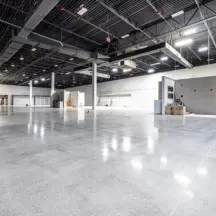


Frequently Asked Questions
Existing and older slabs are regular polishing candidates, because feasibility is decided by condition rather than age. An evaluation documents the visible issues that could affect appearance, exposure, performance, schedule, or cost, and what grinding will reveal depends on how the slab was placed and what it has carried since. An older slab in sound condition can be a better candidate than a newer slab with placement or finishing problems.
There is no universal waiting period to publish, because readiness is evaluated project by project. Cure state, surface condition, and moisture behavior all factor into when polishing can begin, and the start date is set during project evaluation rather than taken from a generic chart.
Yes. Mechanically polished concrete refines the structural slab itself into the finished floor, so there must be a suitable slab to refine. Framed wood floors and buildings without a qualifying slab cannot take this system, and a project in that position should evaluate a different finish.
Often, but the answer waits until the covering comes up. Once the old flooring and adhesive are removed, the exposed slab is evaluated like any other candidate, and what the covering left behind — patches, adhesive residue, or damage — becomes part of the appearance and feasibility picture.
No. Wax is not part of the mechanically polished system, and there is no film-forming coating to recoat. The penetrating stain guard is refreshed as condition requires, and gloss is recovered through burnishing or mechanical re-refinement rather than by adding a sacrificial layer on top of the floor.
Strongly acidic and strongly alkaline products carry the most risk, because concentration, temperature, and dwell time drive chemical damage in concrete. A cleaner left sitting wet on the floor behaves like a spill left to dwell, so prompt and complete removal matters more than the brand on the bottle.
No. Environmental credits tied to flooring are documented within each project and are never automatic. Claims about energy, waste, or certification points should be established inside the project’s own documentation, because the same floor can support credits on one project and none on another.
Usually not without careful boundaries. Areas with concentrated grease, aggressive cleaning chemistry, or frequent hot washdown behave like the chemical-exposure zones where a purpose-designed resinous system is the better tool. Dining rooms and front-of-house space are a different question and are evaluated like any other commercial floor.
Hot-tire peeling, the classic garage-coating failure, cannot happen on polished concrete because there is no film to peel. Tires still track grime and fluids, and automotive chemicals still call for prompt cleanup, so a polished garage still needs basic upkeep.
Duration depends on the project, and no universal production timing applies. Project size, slab condition, the amount of repair work, and the appearance level selected all move the schedule. A firm commitment is set during project evaluation, when those variables stop being estimates.
Polished Concrete Knowledge Center
Resource links
Performance & Safety
Design & Aesthetics
Installation Guidance
Economics & Sustainability
Maintenance & Aftercare
Comparative & Decision-Making
Blog
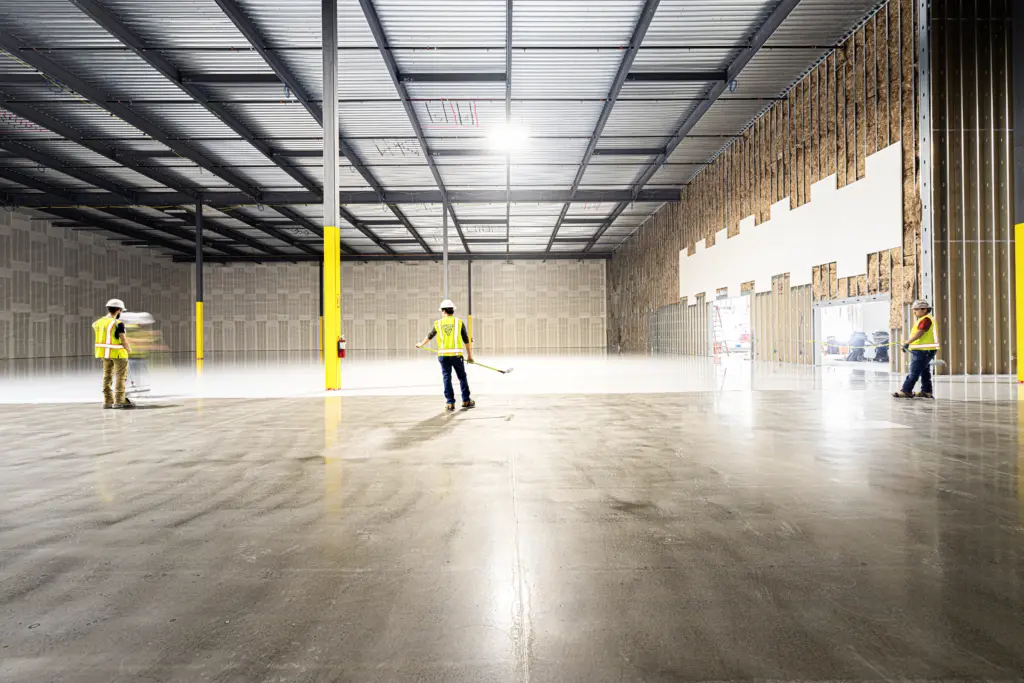
Craftsman Publishes 2026–2027 ESD Flooring Technical Guide
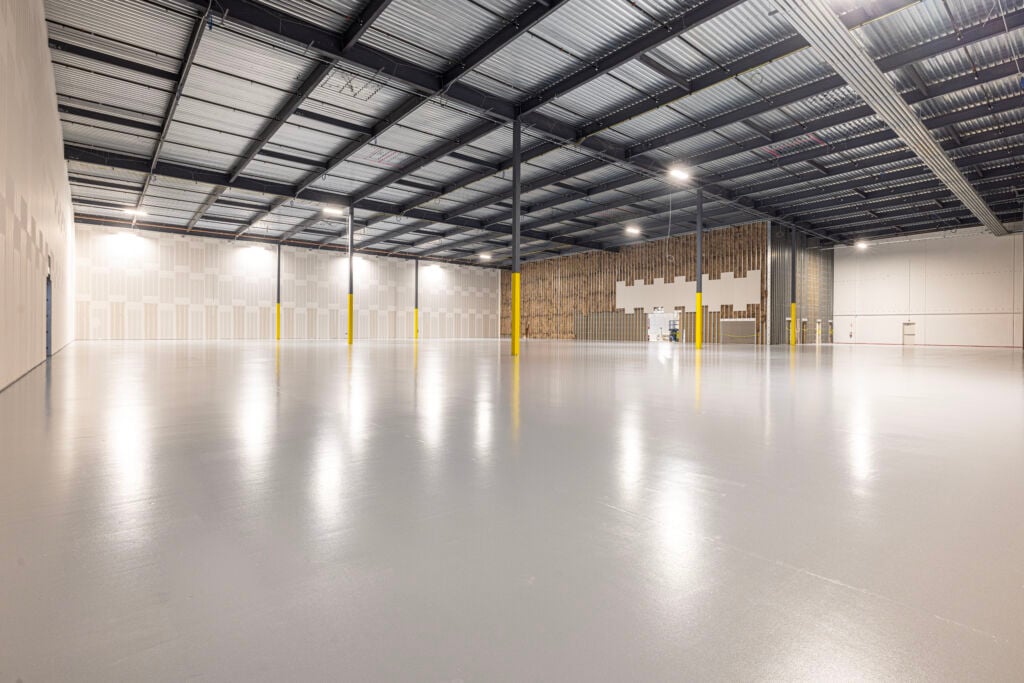
ESD Epoxy Flooring Case Study: 34,000 SF Dallas, TX