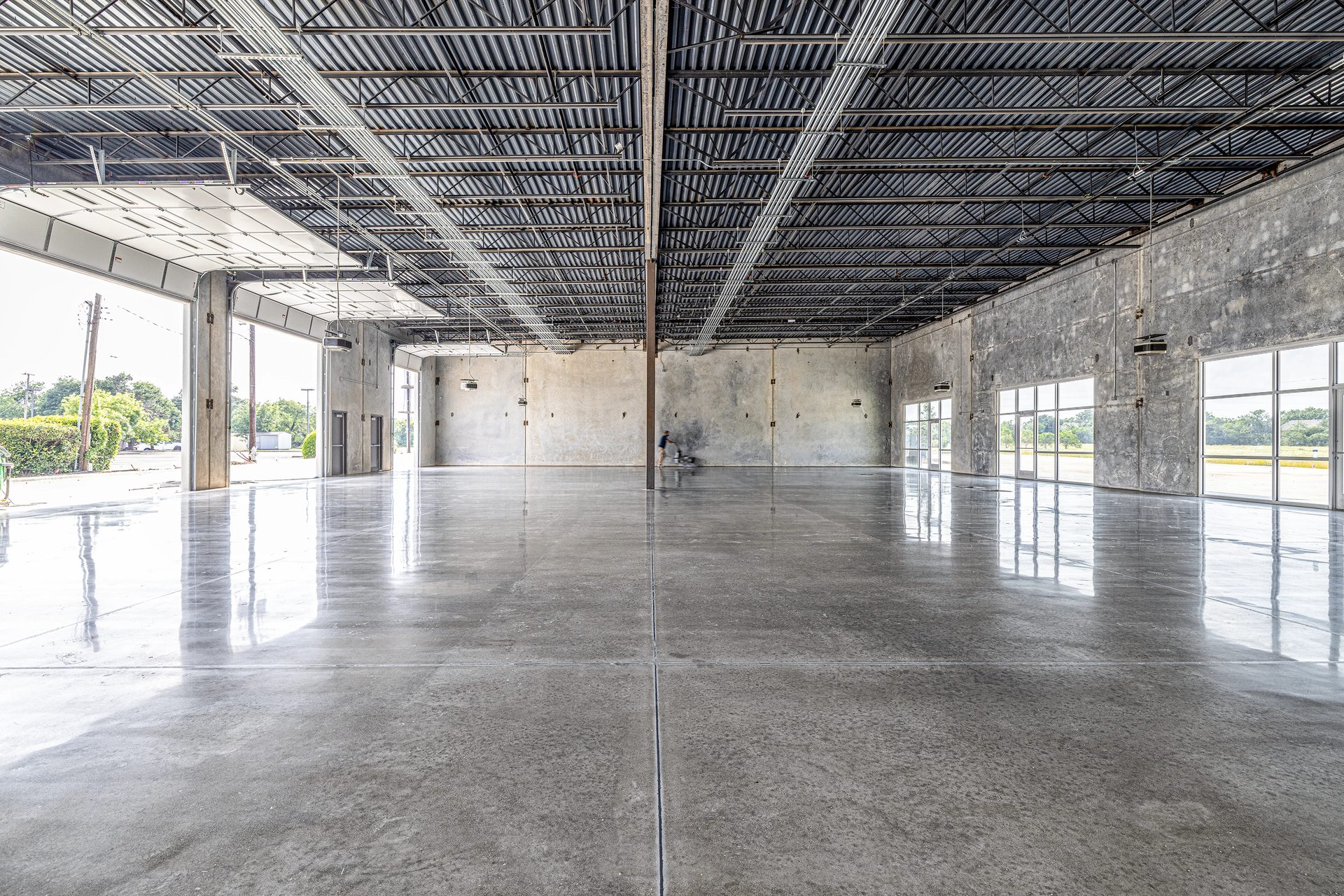
Maintaining polished concrete floors takes two layers of work: routine care the facility team runs, and professional maintenance selected by the floor’s condition. Polished concrete is maintainable, not maintenance-free, so routine cleaning is required. The facility team also cleans up spills promptly, acidic or alkaline ones especially. Between cleanings the same team watches the floor for conditions the routine does not correct, such as dulling, wear paths, staining, or physical damage.
Professional work is then matched to what the floor shows rather than to a calendar, and there is no universal maintenance interval. How much the program includes depends on the traffic, use, and environment the floor sees, the products and cleaning program in place, the condition actually observed, and the appearance standard the floor has to hold. When a condition persists after the routine has been checked, have a qualified concrete-flooring contractor evaluate the floor before any work is selected.
What It Takes to Maintain Polished Concrete Floors
Polished concrete is a durable, maintainable, and repairable flooring system. Because the concrete remains the wear surface rather than relying on a replaceable film-forming coating, the floor can often be cleaned, repaired, re-refined, and refreshed as conditions require. A maintenance program keeps those options open. How much service the floor delivers depends on the slab it was built on, the finish that was specified, the traffic, use, and contaminants it sees, the care it receives, and the standard it is expected to meet. The work itself divides into two layers, and keeping them straight is where planning starts.
Routine Care the Facility Team Runs
Routine cleaning is required, and the facility team carries it on its own schedule. Cleaning methods belong with the crew doing the work, and the guide to cleaning polished concrete floors covers the basic routine, compatible cleaners, tools, machine work, and troubleshooting. If the project’s closeout package records required care products or practices, the routine follows those requirements. Spill response belongs to this layer as well. Polished concrete is not a chemical-containment system. Acidic or alkaline spills should be cleaned promptly because concentrated material or extended dwell time can damage the floor. For an active spill or a stain that has already set, identification and treatment are covered in the guide to cleaning spills and stains on indoor polished concrete floors.
Professional Maintenance Selected by Condition
Professional maintenance is the second layer, and it covers several distinct actions rather than one recurring service. Inspection, burnishing, mechanical re-refinement, repairs, and guard or stain-protector refresh are each selected by the condition the floor presents. Assess the floor before scoping the work. Which action belongs in the scope is determined by the observed condition, the available documentation, and the appearance standard the area has to meet.
What Separates One Maintenance Action from Another
The six actions differ in where they sit in the decision and how far they reach. Reading them side by side is what keeps a facility from buying a broad mechanical scope when a localized repair, or an evaluation, is what the floor’s condition actually supports.
| Maintenance action | Decision position | Scope boundary | What selects the work |
|---|---|---|---|
| Inspection or evaluation | Comes first whenever the cause of a condition, or the scope of the work it needs, is unclear | Produces the decision, not the correction | An unclear cause, or an unclear scope of work |
| Burnishing | A maintenance action in its own right | Not another name for routine cleaning, and not an automatic calendar service | The condition the floor presents at the time |
| Mechanical re-refinement | A separate mechanical scope | Not routine cleaning, not ordinary burnishing, and not a repolishing every floor eventually needs | The observed condition, assessed before the scope is set |
| Localized repair | Localized work on physical defects that have been identified | Repairing a damaged area does not automatically mean treating the entire floor | Identified physical defects |
| Guard or stain-protector refresh | On the list only where the installed system actually includes a renewable guard or sealer | Not collapsed into a universal resealing interval | A renewable guard or sealer in the installed system, and an observed condition that supports the work |
| Broader restoration | Selected once the floor’s condition and the affected areas have been established | Not scoped from a fixed restoration interval | The floor’s condition, the areas affected, the documentation available, and the appearance standard the owner applies |
No universal chart pairs a symptom with one of these actions. The same appearance can come from different causes on different floors, so the pairing is made floor by floor, through evaluation.
Why There Is No Universal Maintenance Schedule
No universal maintenance interval fits every polished concrete floor. Two facilities with the same floor finish can end up with different programs, and the same facility can need different cadences in different areas. What moves the answer is the traffic and use the floor carries, the cleaning program already in place, the condition actually observed, and the standard each area has to hold. Scheduling is its own decision. The guide to how often polished concrete floor maintenance should take place treats it in condition terms rather than fixed intervals.
Reading the Floor Before Selecting Work
Maintenance decisions start with the floor itself. Condition assessment is the step that keeps an owner from buying work the floor does not need, and from postponing work it does. It also produces the record a contractor reads later, which is why the assessment and the record are built together.
Establish a Baseline Before the First Decision
Record what the program is starting with. That means the installed system and its guard product where known, the closeout or maintenance documentation from the project, the floor’s current appearance area by area, and any existing wear, staining, or damage, with photographs and locations. A floor entering a program after years of service is a different starting point than a floor at turnover, and the plan should say which one it is. From there the work is observation. Walk the floor on a regular rhythm, note where and when conditions appear, and keep the record current so changes stand out against the baseline instead of against memory.
Conditions That Look Alike but Call for Different Work
A floor that reads dull, marked, or dirty can have more than one cause. Cleaning-program conditions, product residue, the state of the guard, physical wear, and outright damage can present in similar ways, and appearance alone does not reliably separate them. Verify the cleaning side first, so mechanical work is not purchased for a condition the routine can correct. Treating every dull floor as a repolishing candidate skips that step. Where lost shine is the specific complaint, start with the guide to restoring shine on polished concrete floors, which walks through diagnosis and corrective paths.
Signs That Point to a Professional Evaluation
A condition that persists after the cleaning routine has been verified should trigger a professional evaluation. So should wear paths that keep widening in traffic lanes, staining that has set and no longer responds to spill treatment, and physical damage such as spalled edges, popouts, or failed joint filler. Each of these calls for scheduling a professional look rather than buying a specific service. Document where the condition is, when it appeared, and what has already been tried, because that record is what lets an evaluation separate a care adjustment from a condition that needs mechanical work.
Planning the Program Around the Facility
A maintenance plan is shaped by how the facility actually runs. Where the floor works hardest, what the operation puts on it, and what each area has to look like all change the workload.
Traffic, Soils, and Use Set the Workload
Plan around where the floor works hardest. Entrances, transitions, and the lanes where carts and lifts run take the heaviest load, and any area that soils or wears faster than the rest earns its own place in the plan, separate from the average across the whole floor. The soils the facility generates matter as much as traffic volume, so the program should record which contaminants the operation produces and where they show up.
Appearance Standards Belong in the Plan
Decide, in writing, what standard each area has to hold. A customer-facing showroom and a back-of-house corridor can carry the same floor to different expectations, and the standard the owner sets is part of what determines when professional intervention is warranted. Setting it by area, at the start, gives every later maintenance decision something written to measure against. A slow decline then shows up as a deviation from the record, before it settles in as the floor’s accepted state.
Zones Where Exposed Polished Concrete May Be the Wrong System
Areas with predictable chemical exposure—such as forklift battery charging or storage—may require a purpose-designed chemical-resistant coating system instead of exposed polished concrete. Which system fits such a zone depends on the specific chemical, its concentration and temperature, how long it dwells, the traffic and slip requirements of the area, and the containment and operations involved. A zone that keeps consuming spill response and restoration work, no matter how disciplined the team is, should be raised with a flooring contractor as a system question for that area rather than absorbed as a permanent maintenance burden.
Running the Program With a Qualified Contractor
The owner’s side of the program is observation, records, and standards. The contractor’s side is evaluation and condition-selected work. Planning the handoff between them is what keeps the program moving.
What to Have Ready Before an Evaluation
A clear condition record makes the evaluation more useful. The contractor should have the installed system and guard product where known, the project’s closeout or maintenance documentation, and the cleaning products and program currently in use. The condition record itself should carry locations, dates, and photographs, what has already been tried, and the appearance standard the area is expected to meet. With that in hand, a qualified concrete-flooring contractor can distinguish a care-program adjustment from a floor that needs mechanical work, and can scope that work to the areas and conditions that justify it.
Scoping, Acceptance, and Records
Scope is defined by condition rather than by square footage alone. A scope should name which areas receive which actions, what result defines completion, and how that result will be judged against the stated standard. Agreeing that judgment before the work starts is what makes acceptance straightforward at the end. The paperwork matters after the work as well. Records of what was performed, which products were used, and how the floor was left become part of the maintenance documentation the next decision relies on, and updating the baseline at the same time lets the program measure future change from the floor as it now stands.
Where Facility Responsibility Ends and Contract Work Begins
A workable division of responsibility keeps the program from stalling. In practice, the facility team manages routine cleaning, prompt spill response, observation, and the condition record, because that work follows the operation’s schedule and depends on being close to the floor. A qualified concrete-flooring contractor is brought in to evaluate persistent or unclear conditions and to scope specialized mechanical or repair work, because selecting that work depends on reading the floor’s condition correctly. How much a facility handles in-house is the owner’s decision. This split is a working default, not a rule. Writing the chosen split into the program, with named responsibilities on each side, settles in advance who acts when a walk-through finds something.
A maintenance program works best when it is built before a condition forces the decision, while the floor’s starting point is still on record. To have a floor’s condition evaluated, or to put a program on paper for a facility or a portfolio, share the floor’s condition record and documentation with Craftsman’s commercial polished concrete team and start from what the floor shows.
- Founded in 1999 • National commercial & industrial technical flooring contractor
- High-spec systems: ESD/static-control flooring, urethane cement, terrazzo, polished concrete, resinous flooring & coatings, and concrete overlays
- National service coverage • Installation performed by Craftsman-employed W-2 crews
- W-2 installers, not 1099 day-labor • Trained, insured, and accountable to you
- The same core workforce model, installation leadership, training system, documentation path & safety accountability can carry across phased and multi-site programs
- Since current ownership began in 2018, zero OSHA-reportable incidents and no workplace injury requiring medical treatment beyond first aid
- Current prequalification documents available through controlled review, including COI, W-9, safety information & other current qualification records
- Commercial estimates are typically returned within 24 hours; complex bids may take longer
Company: Craftsman Concrete Floors
Phone: +1 (844) 687-1961
Our Clients




















Request a Proposal
Submit project parameters for preliminary analysis. Commercial estimates typically returned within 24 hours.
Frequently Asked Questions
Yes. Polished concrete is maintainable, not maintenance-free, so routine cleaning is required. The facility team runs that routine on its own schedule and watches the floor for conditions the routine does not correct, such as dulling, wear paths, staining, or physical damage. Professional maintenance is a separate layer, and the work is selected by the condition the floor shows rather than by a calendar. Where a condition persists after the routine has been checked, a qualified concrete-flooring contractor evaluates the floor before any work is selected.
There is no universal maintenance interval for polished concrete floors. Professional work is matched to the condition the floor actually shows, so two facilities with the same floor finish can end up with different programs, and one facility can need different cadences in different areas. What moves the answer is the traffic, use, and environment the floor sees, the products and cleaning program in place, the condition observed, and the standard each area has to hold. Scheduling depth belongs to the guide to how often polished concrete floor maintenance should take place.
No. Burnishing is a maintenance action in its own right, it is not another name for routine cleaning, and it is not an automatic calendar service. Routine cleaning is the everyday work the facility team carries on its own schedule. Burnishing is selected by the condition the polished concrete floor presents, and where the cause of that condition or the scope of the work it needs is unclear, inspection or evaluation comes before the work is scoped.
No. Guard or stain-protector refresh belongs on the list only when the installed system actually includes a renewable guard or sealer and the observed condition supports that work, and it is not collapsed into a universal resealing interval. Some polished concrete floors have no renewable guard or sealer to refresh. Where the installed system and its products are not known, the project’s closeout or maintenance documentation is the record that identifies them.
A dull appearance on polished concrete can have more than one cause. Cleaning-program conditions, product residue, the state of the guard, physical wear, and outright damage can present in similar ways, and appearance alone does not reliably separate them. Verifying the cleaning side first keeps mechanical work from being purchased for a condition the routine can correct. Where lost shine is the specific complaint, the guide to restoring shine on polished concrete floors carries the diagnosis and the corrective paths.
A facility team normally handles routine cleaning, prompt spill response, observation, and the condition record, because that work follows the operation’s schedule and depends on being close to the floor. How much a facility handles in-house is the owner’s decision, and this split is a working default, not a rule. Cleaning methods, compatible cleaners, tools, and machine work belong to the guide to cleaning polished concrete floors rather than to the maintenance program itself.
A polished concrete floor should receive a professional evaluation when a condition persists after the cleaning routine has been verified. Wear paths that keep widening in traffic lanes, staining that has set and no longer responds to spill treatment, and physical damage such as spalled edges, popouts, or failed joint filler all call for the same step. Each of these means scheduling an evaluation by a qualified concrete-flooring contractor rather than buying a specific service, because the same appearance can come from different causes on different floors and evaluation is what separates them.
A qualified concrete-flooring contractor needs the installed system and guard product where known, the project’s closeout or maintenance documentation, and the cleaning products and program currently in use. The condition record should carry locations, dates, and photographs, what has already been tried, and the appearance standard the area is expected to meet. With that in hand, the contractor can distinguish a care-program adjustment from a floor that needs mechanical work, and can scope that work to the areas and conditions that justify it.
Areas with predictable chemical exposure, such as forklift battery charging or storage, may require a purpose-designed chemical-resistant coating system instead of exposed polished concrete. Which system fits such a zone depends on the specific chemical, its concentration and temperature, how long it dwells, the traffic and slip requirements of the area, and the containment and operations involved. A zone that keeps consuming spill response and restoration work, no matter how disciplined the facility team is, should be raised with a flooring contractor as a system question for that area rather than absorbed as a permanent maintenance burden.
Burnishing, mechanical re-refinement, and broader restoration differ in decision position and in how far they reach. Burnishing is a maintenance action in its own right, distinct from routine cleaning, and it is not an automatic calendar service. Mechanical re-refinement is a separate mechanical scope, and it is not routine cleaning, ordinary burnishing, or a repolishing every floor eventually needs. Broader restoration is scoped from the floor’s condition, the areas affected, the documentation available, and the appearance standard the owner applies, not from a fixed restoration interval. No universal chart pairs a symptom with one of these actions, so the pairing is made floor by floor, through evaluation.
Blog
How to Maintain Polished Concrete Floors
ESD Epoxy Flooring Case Study: 34,000 SF Dallas, TX