What can we help you with?
Technical flooring, delivered directly
- ESD flooring, urethane cement, terrazzo, and polished concrete
- In-house W-2 installation crews and experienced field leadership
- National service coverage with project-specific staffing plans
- Testing, documentation, and defined project closeout
- Dedicated support for corporate procurement and multi-site contracting
Phone: +1 (844) 687-1961
Our Clients




















Resistance, Floors, and Footwear
Craftsman Concrete Floors specializes in conductive floors for explosives operations. These floors require careful coordination of floor materials, grounding connections, personnel footwear, and testing to meet the facility’s technical requirements.
DoD Manual 4145.26 requires conductive floors, tabletops, and shoes to ground personnel at operations involving exposed explosives with electrostatic sensitivity of 0.1 joule or less. The resistance of the person’s body, conductive shoes, and floor to the ground system must not exceed 1,000,000 ohms in total. Separate provisions govern minimum resistance, daily footwear checks, and floor and tabletop testing.
These requirements come from the DoD Contractor’s Safety Manual for Ammunition and Explosives, dated 13 March 2008 and incorporating Change 2 of 31 August 2018. For guides covering other authorities and applications, use the hazardous-area flooring and static-control guide.
Resistance limits for the person, shoes, floor, and tabletop
- Clause
- C6.4.7.5.1
- Combined max
- 1,000,000 ohms
DoD Manual 4145.26 distinguishes the combined personnel-grounding path from the resistance of a tabletop alone. It also sets minimum floor-to-ground and tabletop-to-ground resistance to protect against electrocution.
| Resistance path | Requirement in DoD Manual 4145.26 |
|---|---|
| Person’s body + conductive shoes + floor to the ground system | Must not exceed 1,000,000 ohms total (C6.4.7.5.1) |
| Conductive tabletop to the ground system | Must not exceed 1,000,000 ohms (C6.4.7.5.3) |
| Floor to ground and tabletop to ground in areas with 110-volt service | Each must exceed 40,000 ohms, subject to the ground fault interrupt alternative below (C6.4.7.5.2) |
| Floor to ground and tabletop to ground in areas with 220-volt service | Each must exceed 75,000 ohms, subject to the ground fault interrupt alternative below (C6.4.7.5.2) |
The floor and the person’s body plus shoes share a single 1,000,000-ohm resistance limit. Their individual maximums can differ, but the combined resistance must stay within that total. The DoD person-shoe-floor resistance budget explains the allocation and the manual’s example.
A ground fault interrupt circuit also meets the minimum-resistance requirement in C6.4.7.5.2.
Floor construction and connection to ground
- Clauses
- C6.4.7, C6.4.7.3
Under C6.4.7 and C6.4.7.3, conductive floors and tabletops must connect to the static ground system through bonding wires or straps. Surfaces made of or covered with non-sparking materials, such as conductive rubber or conductive compositions, must:
- Provide a continuous electrical path to the static ground system within the resistance limits referenced in C6.4.7.5.1.
- Be reasonably smooth and free from cracks.
- Use materials compatible with the energetic materials present.
These connections do not remove the separate equipment-bonding requirement. Under C6.4.5, contact with a conductive floor or tabletop does not establish permanent-equipment bonding.
Conductive footwear and daily checks
- Clauses
- C6.4.7.4, C6.4.7.5.4
- Testing
- Daily before use
Operators must wear conductive shoes in areas requiring conductive mats, floors, or runners. Visitors must wear conductive shoes, ankle straps, or similar devices, one on each leg (C6.4.7.4).
All personnel must test conductive footwear daily before use. The body-plus-shoes result must satisfy C6.4.7.5.1, accounting for the floor’s share of the combined 1,000,000-ohm limit. Supervisors must retain documentation of all test results, including calibration of the test equipment (C6.4.7.5.4).
Personnel must not test shoes in rooms or areas containing exposed explosives or flammable gas mixtures.
Testing conductive floors and tabletops
Installation tests and annual checks
- Clause
- C6.4.7.5.5
- Frequency
- Installation, then annually
Under C6.4.7.5.5, trained personnel must test conductive floors and tabletops upon installation and at least annually thereafter, using equipment specifically designed for this purpose. All test results must be retained for at least five years.
Testing may proceed only when the room or area is free from exposed explosives and flammable gas mixtures.
Measurements and electrode placement
- Spacing
- 3 ft [1 m]
The DoD test procedure requires both measurements:
- Resistance between an electrode attached to the ground system and an electrode on the floor or tabletop.
- Resistance between two electrodes placed 3 ft [1 m] apart on the floor or tabletop.
Both measurements must be made at five or more locations in each room, including at least two heavily trafficked locations. Electrodes for both measurements must remain at least 3 ft [1 m] from earth ground or other grounded items, such as door frames or grounded equipment. If resistance changes appreciably with time, record the resistance at the five-second interval.
The small-surface test-location exception applies when the floor or tabletop is too small for five measurements while maintaining that clearance. The exception does not reduce the clearance from grounded items.
Substitutions, Cleaning, and Electrical Work
Conductive mats and runners
- Clause
- C6.4.7.2
When a hazard remains localized, C6.4.7.2 permits conductive mats or runners instead of conductive floors throughout an entire building or room. The mats and runners must meet all specifications and test requirements that apply to conductive floors.
Wrist straps at small, isolated operations
- Clause
- C6.4.7.2
C6.4.7.2 permits wrist straps in place of conductive floors and shoes for personnel grounding at small scale and isolated operations when justified by hazard analysis.
Cleaning and electrical work
- Clauses
- C3.5.5, C3.8.5, C6.4.7.4
DoD Manual 4145.26 prohibits sweeping compounds containing wax on conductive floors if the wax can reduce conductivity (C3.5.5).
Conductive shoes must not be worn by electricians working on electrical equipment (C3.8.5), or by personnel working on electrical equipment in conductive-floor areas (C6.4.7.4). Before electrical work begins, exposed explosives and other static-sensitive hazardous material must be removed; in conductive-floor areas, operators must remove all ammunition and explosives sensitive to electrostatic discharge.
ESD Flooring Gallery











Frequently asked questions
DoD Manual 4145.26 C6.4.7 requires conductive floors, tabletops, and shoes for grounding personnel at operations involving exposed explosives with electrostatic sensitivity of 0.1 joule or less. The manual’s examples include primer, initiator, detonator, igniter, tracer, and incendiary mixtures.
DoD Manual 4145.26 states that the minimum resistance protects against electrocution. Under C6.4.7.5.2, both floor-to-ground and tabletop-to-ground resistance must exceed 40,000 ohms in areas with 110-volt service and 75,000 ohms in areas with 220-volt service. A ground fault interrupt circuit also meets this minimum-resistance requirement.
Under DoD Manual 4145.26 C6.4.7.5.4, all personnel must test conductive footwear daily before use, and supervisors must retain documentation of all results, including test-equipment calibration. The body-plus-shoes result must meet C6.4.7.5.1, accounting for the floor’s share of the combined 1,000,000-ohm limit. Shoe testing is prohibited in rooms or areas containing exposed explosives or flammable gas mixtures.
DoD Manual 4145.26 C6.4.7.5.5 requires testing upon installation and at least annually thereafter by trained personnel using equipment specifically designed for this purpose. All results must be retained for at least five years. Testing may proceed only when the room or area is free from exposed explosives and flammable gas mixtures.
DoD Manual 4145.26 C6.4.7.2 permits conductive mats or runners instead of conductive floors throughout an entire building or room when the hazard remains localized. The mats and runners must meet all specifications and test requirements that apply to conductive floors.
Blog

Craftsman Publishes 2026–2027 ESD Flooring Technical Guide
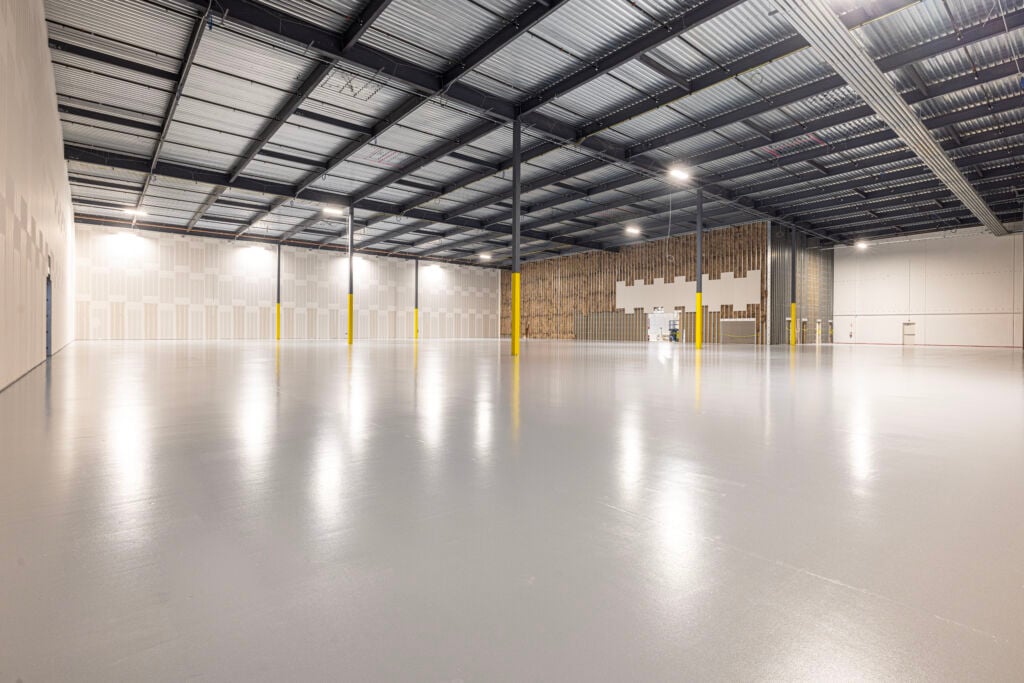
ESD Epoxy Flooring Case Study: 34,000 SF Dallas, TX