What can we help you with?
Technical flooring, delivered directly
- ESD flooring, urethane cement, terrazzo, and polished concrete
- In-house W-2 installation crews and experienced field leadership
- National service coverage with project-specific staffing plans
- Testing, documentation, and defined project closeout
- Dedicated support for corporate procurement and multi-site contracting
Phone: +1 (844) 687-1961
Cleaning and Maintenance
Terrazzo floor cleaning comes down to a short, repeatable routine: get abrasive dry soil off the floor, clean with a compatible pH-neutral cleaner, pick up the dirty solution before it dries, rinse only when the cleaner you chose calls for it, and let the surface dry. What changes from one floor to the next is not that routine but the details around it, because the right cleaner, pad, and pace depend on the terrazzo system and the finish it carries.
This guide is written to be followed two ways: a homeowner can use it to keep a small terrazzo floor looking its best, and a facility manager can operationalize it across a large commercial building. The rule that holds throughout is to match the method to the floor in front of you rather than to a universal recipe, and to move up to professional cleaning, refinishing, or restoration when routine care can no longer do the job. If you manage commercial terrazzo and simply want that work handled, Craftsman’s national crews can assess the floor and take it from there.
Start by identifying your terrazzo system and finish
Terrazzo is decorative aggregate, usually marble or other stone chips, set in a binder, poured over a prepared substrate, then ground and polished so the surface itself is the finished floor. Two things about that surface decide how you should clean it: the binder holding the chips, and the finish currently on top. Neither is identical across floors, so a minute spent identifying what you have prevents most cleaning mistakes.
Why one routine does not fit every terrazzo floor
Cleaning that is right for a polished epoxy floor in a lobby can be wrong for a waxed cementitious floor in an older building, and a product that is safe on one can dull or damage the other. Maintenance is not identical across epoxy (resin), cementitious, waxed or coated, and mechanically refined floors. The safe constant across all of them is the same short routine, remove dry grit, clean with a compatible neutral cleaner, recover the solution, and dry, but the cleaner, the pad or brush, and how often you do the work should follow the specific system and finish rather than a one-size rule.
The binder: resin (epoxy) versus cementitious
Poured terrazzo is made with either an epoxy (resin) binder or a cementitious binder, and the two behave differently. Resin binders are generally more resistant to staining and to many chemicals, which is why modern epoxy terrazzo is common in demanding commercial spaces; cementitious binders are generally more absorbent. What they share matters more for cleaning: the marble and other calcareous stone commonly used as terrazzo aggregate can be etched by acids, so acidic cleaners are a risk on either binder. That is why a pH-neutral cleaner is the safe default across systems, and why sweeping claims, such as one binder being completely nonporous or every cementitious floor needing wax, are too broad to rely on. When you are unsure about your specific floor, confirm the system with the installer or the material manufacturer.
The finish: mechanically polished versus waxed or coated
A terrazzo floor is finished in one of two broad ways, and it changes your whole program. A mechanically refined or polished floor relies on the mineral surface itself for its sheen and is maintained mainly by keeping it clean. Mechanically polished describes how that surface was finished, though, not what should be applied to it afterward. On compatible cementitious and other mineral-based terrazzo systems, the published sealer reference guide describes silicate-based penetrating densifiers as one post-polishing approach for reducing porosity and helping repel stains and soils. This is not equivalent to every penetrating stain guard or topical sealer. The approach applies only when the installed system and the product’s own requirements support it.
Epoxy terrazzo is a different case: its resin binder is a different chemistry, and its protection and maintenance follow the resin system’s requirements rather than a cement-floor treatment. Nor are the categories interchangeable, because a densifier, a penetrating stain guard, a film-forming sealer, and a wax do different jobs and are maintained differently. A waxed or coated floor carries a sacrificial topical layer that has to be maintained, and periodically stripped and reapplied on the coating manufacturer’s terms. If you are not sure what system or finish you have, identify it before stripping, coating, densifying, or applying any other treatment, because stripping a floor that was never coated, or waxing one that was designed to be bare, both create problems.
The everyday cleaning routine for homes and small areas
For a home or a small area, good terrazzo cleaning is mostly about doing simple things consistently and not improvising with the wrong product. The four steps below are the whole routine; the judgment is in the cleaner you choose and the residue you leave behind.
Remove dry, abrasive soil first
Grit is what actually wears terrazzo, because fine dry soil acts like sandpaper underfoot and grinds at the surface in traffic paths. Dust mop, sweep, or vacuum with a hard-floor setting before you introduce any water, and do it often in the spots that collect the most soil. This one habit does more to keep a floor looking new than any cleaner, and skipping it just turns loose grit into an abrasive slurry the moment you mop.
Damp-clean with a compatible neutral cleaner
Clean with a pH-neutral cleaner that is compatible with your floor, diluted per the label, applied with a clean mop or microfiber and enough solution to lift soil without flooding the floor. The best cleaner for terrazzo floors is not a particular brand but a set of properties: pH-neutral, residue-controlled, non-abrasive, and appropriate to your system and finish, plus any cleaner the installer or material manufacturer specifically recommends for your floor. A dedicated neutral floor cleaner is a reliable choice; a heavily fragranced, oily, or acidic household product is not, however well it works on other surfaces.
Recover the solution, control residue, and dry
Dirty mop water left on the floor just redeposits soil and dries into a film, so change your water before it turns gray and pick up the used solution rather than letting it evaporate in place. Rinse when the chemistry you chose calls for it, since many neutral cleaners are designed to need little or no rinsing while others leave a residue that must be rinsed off, and then let the floor dry. Residue is not only a cosmetic issue: a cleaner film can dull the surface, hold onto new soil, and change how the floor feels underfoot, which is one reason a clean, residue-free surface is part of safe footing rather than separate from it.
What not to improvise
A few shortcuts cause most avoidable damage. Acidic cleaners, including vinegar and many bathroom or lime-scale products, can etch the calcareous aggregate and a cementitious binder, while strong alkaline strippers and bleach can dull, discolor, or break down finishes and sealers over time, so neutral chemistry is the safe default and anything stronger should be matched to the floor and its finish. Oil- or soap-based cleaners tend to leave a residue that builds up and holds soil. Abrasive pads and powders scratch the polished surface. And sealing, stripping, waxing, or densifying are not routine cleaning steps to improvise from a how-to video, because a treatment matched to the wrong system, or an over-applied coating, can do more harm than good; if you do not know what system and finish you have, identify them first, and treat these as decisions made with your installer or the product manufacturer, or hand them to a professional.
Running a commercial terrazzo maintenance program
In a commercial building the routine is the same in principle but has to survive real traffic, tight schedules, and more than one person doing the work. A commercial terrazzo maintenance program is mostly a matter of controlling soil before it reaches the floor and then cleaning in a disciplined, repeatable way so the finish holds up between any deeper professional service.
Control soil before it reaches the floor
Most of what damages a commercial terrazzo floor arrives on shoes, so the cheapest maintenance happens at the entrance. Adequate walk-off matting at every exterior door captures grit and moisture before they reach the terrazzo, and dust mopping or vacuuming on a schedule that matches the traffic keeps abrasive soil from accumulating in lanes and doorways. Soil control is not a glamorous line item, but it is the single highest-leverage part of the program, because grit that never lands on the floor never has to be scrubbed off or ground out later.
Scrub with the right machine, pad, and metered solution
For anything beyond a small area, an automatic scrubber that lays down neutral cleaning solution, agitates with an appropriate non-abrasive pad or brush, and vacuums the dirty water back up in one pass is the workhorse of terrazzo floor maintenance. Match the pad or brush to the floor and the soil load, using a softer or white pad for routine cleaning and more aggressive options only where the finish and the manufacturer’s guidance allow, and meter the solution to the correct dilution rather than eyeballing it, since over-concentrated cleaner is a leading cause of streaking and residue. The goal is to clean the floor, not to coat it in product.
Recover dirty water, overlap passes, and finish the edges
The difference between a floor that looks maintained and one that looks tired is usually recovery discipline. Recover the solution before it dries, keep the recovery tank and squeegee working so you are picking water up rather than smearing it, and overlap each pass so you are not leaving dirty lanes between clean ones. Machines do not reach walls, corners, and column bases, so plan for edge and detail work by hand, and control the dirty water by dumping and refilling before it turns gray rather than pushing the same soil around. None of this is exotic; it is simply the part of the job that is easy to shortcut and expensive to skip.
Verify the result and keep it consistent
A program only works if someone checks it, so build in a simple way to verify the floor after cleaning, since a walk-through in raking light will show haze, streaks, and missed edges that look fine head-on, and correct the process rather than just the spot when something is off. Consistency is also part of why terrazzo is attractive to maintain at scale. In an LA Metro station comparison, the agency reported approximately 66% less cleaning labor for terrazzo than porcelain tile. That is a single high-traffic transit observation that was not normalized for area, traffic, or cleaning standard, so treat it as one agency’s experience rather than a production standard you can bank on LA Metro Station Surfaces and Materials White Paper. What travels from that example is the principle, not the number: a hard, monolithic, well-maintained terrazzo surface tends to be efficient to keep clean.
Match the symptom to the right action
When a terrazzo floor stops looking right, the useful question is whether it needs better cleaning or a different service entirely. Start with the least aggressive step that could reasonably work, escalate only if it does not, and route anything beyond cleaning to the service that owns it.
Cleaning is not polishing, honing, grinding, or restoration
These are different jobs, and many searches for terrazzo polishing land on cleaning pages by mistake, so it is worth drawing the line. Cleaning removes soil from the existing surface. Buffing or burnishing can lift the gloss of a floor that is otherwise sound. Polishing and honing mechanically refine the mineral surface itself to restore clarity and sheen and to take out fine scratches, which is finish work rather than cleaning and is covered on the terrazzo floor polishing page. Grinding, patching, crack repair, and aggregate and color matching are restoration, handled on the terrazzo restoration and repair page.
Sealing or densifying is a separate step layered onto a clean floor, one whose fit depends on the installed system, its binder, and its finish; it is not part of routine cleaning, and not a cure for a surface that actually needs refinishing. If cleaning is not getting the result you want, the fix is usually one of these services rather than a stronger chemical.
Read the symptom-to-action reference below before reaching for a product
The reference that follows pairs each common symptom with a likely cause, a first action you can take through cleaning, and where to route the problem when cleaning does not resolve it. Use it to decide quickly whether you are looking at a cleaning fix or a refinishing and restoration question, and remember that a residue film and a genuinely worn finish can look alike from standing height even though they need opposite responses.
Traction, safety, and planning your maintenance
Two questions come up once the routine is in place: is the floor safe underfoot, and how often should all of this happen. Both have real answers, but neither has a single universal number, because both depend on your floor and how it is used.
Traction and safety are outcomes you maintain, not a fixed rating
How slip-resistant a terrazzo floor is at any moment depends on the finish, how clean and dry it is, what has contaminated it, and how it is maintained, rather than on a permanent rating stamped on the material. The published sealer reference guide directs designers to the sealer supplier for the applicable coefficient-of-friction data and test method. That direction matters precisely because traction is a property of the installed and maintained surface rather than of terrazzo in the abstract. Practically, that means good footing is something your maintenance protects: keep the floor clean and free of residue films, deal with water and spills promptly, and choose finishes and any sealer with the wet and dry conditions of the space in mind. For exterior or wet areas, surface texture is chosen at design time, and LA Metro’s exposed-platform criteria, for example, favor rusticated terrazzo where wet-weather slip requirements apply, so changing traction after the fact is a finish and design question rather than a cleaning one. This page does not make slip-resistance or code-compliance promises; those belong to the tested finish and the authority having jurisdiction.
Plan maintenance around your floor, not a universal calendar
It is tempting to want a fixed schedule, mop this often and seal on this date, but a cadence that is right for a quiet residential floor is wrong for a hospital entrance, and publishing one universal calendar does more harm than good. Plan instead from a few variables: how much traffic the floor sees, how much soil it takes on, the system and finish it has, and the appearance standard you are holding it to. Set daily and periodic frequencies high enough that the floor never gets ahead of you, watch the floor rather than the calendar for signs that soil control or a finish needs attention, and confirm any sealing or refinishing intervals with your installer or the product manufacturer rather than a generic rule. For recurring commercial work, the right frequencies are best set with the crew that will actually perform and verify them.
When to bring in a professional, and how Craftsman can help
Routine cleaning has a ceiling. When a floor stays dull after correct cleaning, shows scratch patterns or worn lanes, has a failing coating, or is chipped or cracked, the next step is professional refinishing or restoration rather than a stronger cleaner or more wax. That is also the point at which a national contractor is worth a call. Craftsman Concrete Floors is a commercial and industrial technical flooring contractor whose in-house W-2 crews provide national service coverage, so a commercial owner with terrazzo in one building or many can have the floor assessed and the right work performed, whether that is machine refinishing and polishing or restoration and repair where the terrazzo is damaged, by the same company rather than a chain of subcontractors. If that is what you need, or you simply want commercial terrazzo cleaning and maintenance handled properly, a project specialist can talk through the floor and the next steps on the initial call. For questions that are really about price or system selection, the terrazzo floor cost guide and the main terrazzo hub go deeper.
SYMPTOM-TO-ACTION REFERENCE
| Symptom | Likely cause | First action through cleaning | If cleaning does not resolve it |
|---|---|---|---|
| Overall dullness | Cleaner film, residue, or fine surface wear | Re-clean with a correctly diluted neutral cleaner, rinse, and remove any film | A worn mineral surface is a polishing and refinement question, not a cleaning one |
| Haze | Sealer or cleaner residue, or a hard-water film | Rinse with clean water and a neutral cleaner; correct the dilution | A failing coating may need professional stripping and re-coating |
| Streaking | Over-concentrated or incompatible cleaner; dirty solution left to dry | Dilute correctly, recover the solution, and rinse | Reassess the product and process, and confirm cleaner compatibility |
| Embedded soil | Grit ground into traffic lanes or into a porous surface | Deep-scrub with an appropriate non-abrasive pad and neutral cleaner | Persistent soil in a porous floor calls for professional cleaning and a finish decision |
| Fine scratches | Abrasive grit or the wrong pad | Improve dry-soil control and switch to a non-abrasive pad | Scratch patterns are removed by polishing and refinement, not cleaning |
| Stains | A spill absorbed into aggregate or an unsealed surface | Blot promptly and clean with a neutral cleaner; address the source | Set or deep stains and acid-etch marks are a honing and restoration question |
| Localized wear | Concentrated traffic in a lane or entry | Confirm soil control and clean thoroughly | Worn zones are re-refined by polishing; matching is restoration work |
| Coating or wax failure | Peeling, yellowing, or uneven topical finish | Stop adding product and identify the coating | Strip and re-coat, or convert to a maintained mineral finish, with a professional |
| Physical damage | Chips, cracks, spalls, or impact damage | Keep the area clean and protected | Patching, crack repair, and aggregate and color matching are restoration work |
Terrazzo Floors Gallery

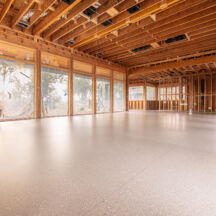
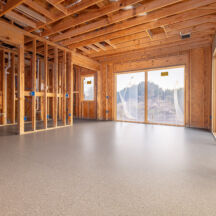



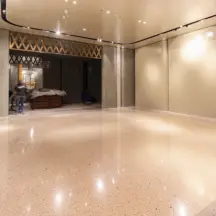
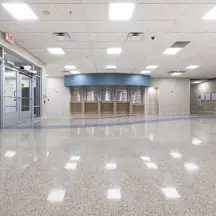
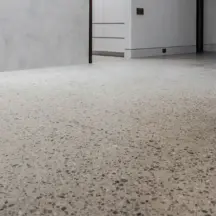
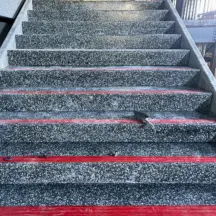
Terrazzo Samples
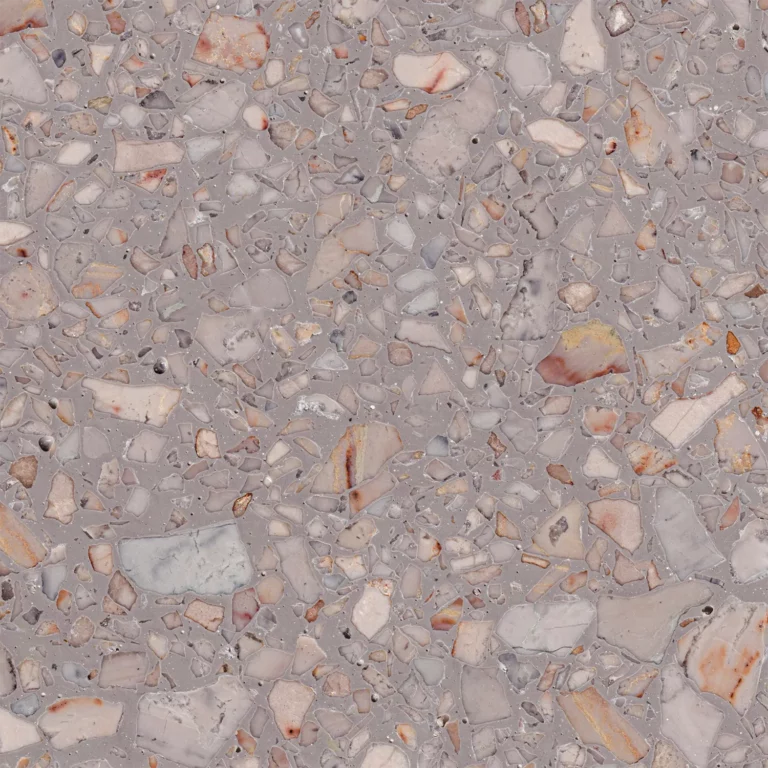
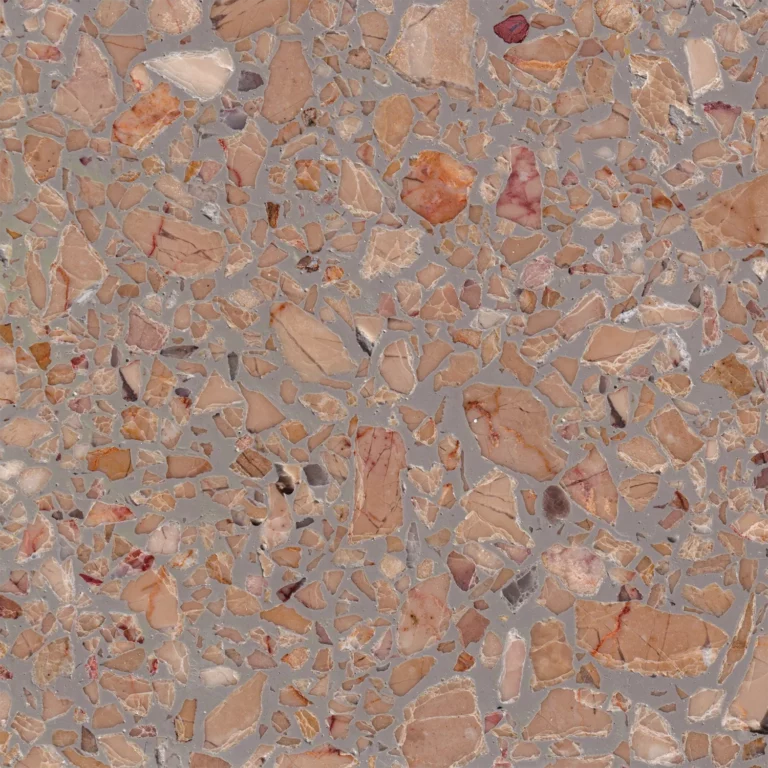
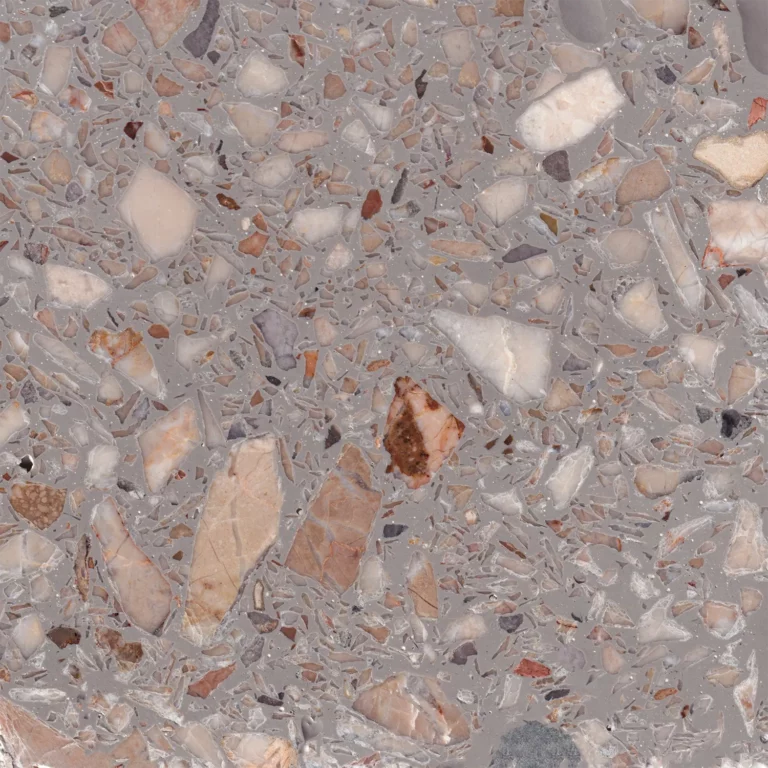
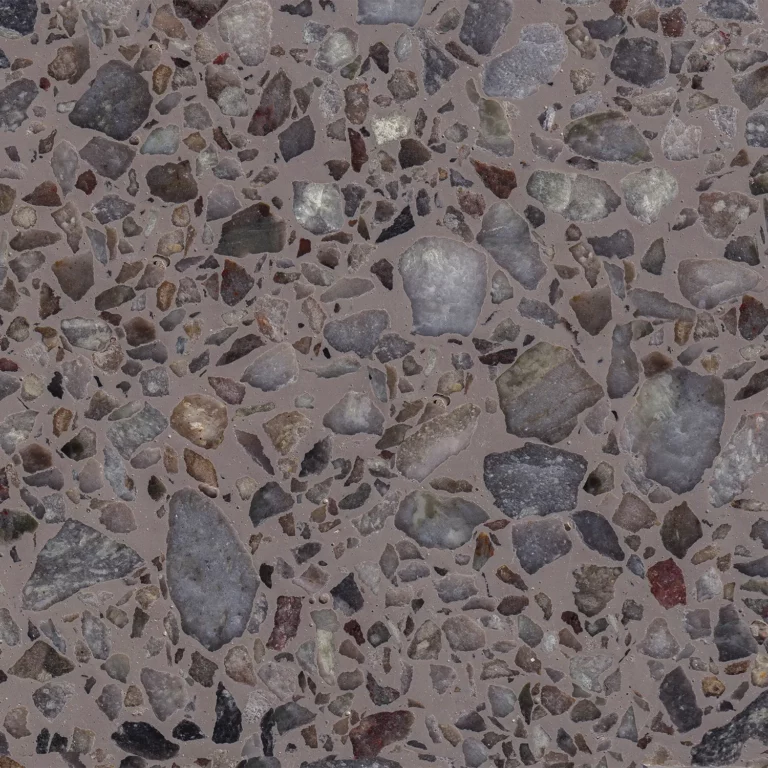
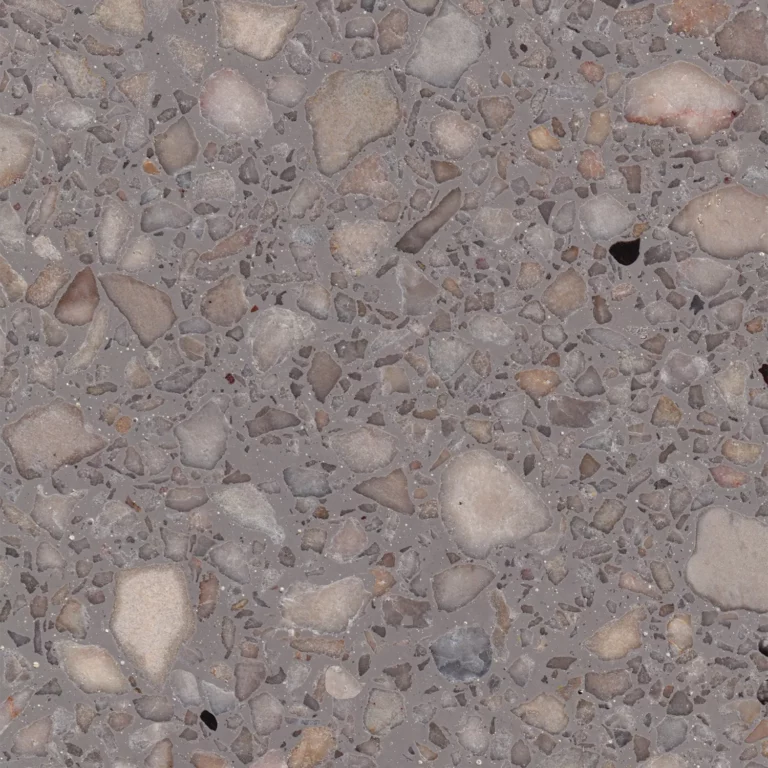
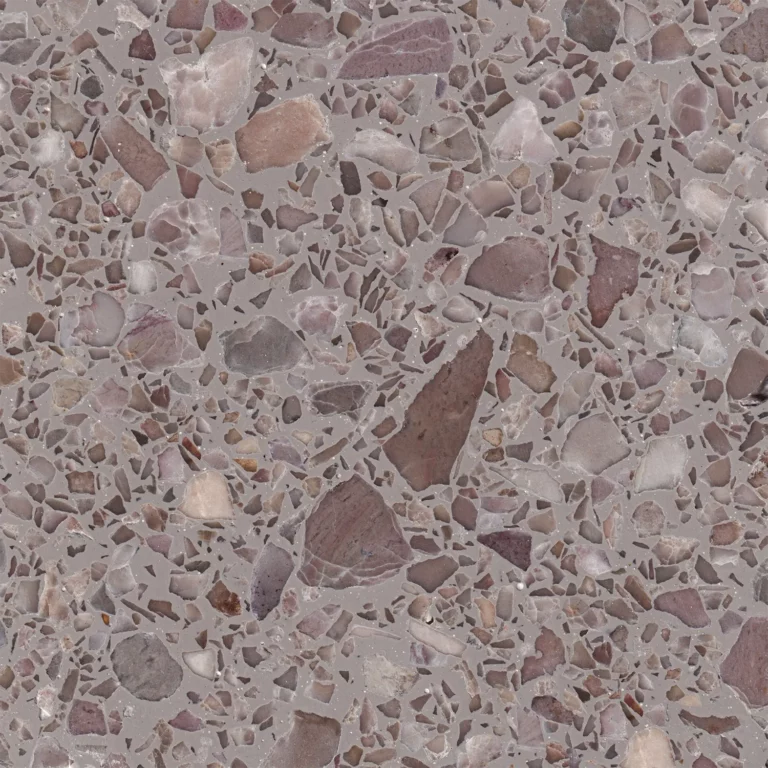
Frequently Asked Questions
The best cleaner for terrazzo floors is defined by its properties rather than a brand name: a pH-neutral, residue-controlled, non-abrasive floor cleaner that is compatible with your terrazzo system and finish, used at the dilution on the label. Where your floor came with a cleaner recommendation from the installer or material manufacturer, follow it. Avoid acidic products, strong alkaline strippers, bleach, and oily or heavily fragranced household soaps, which can etch the aggregate, dull the finish, or leave residue.
Remove dry, abrasive soil first by dust mopping, sweeping, or vacuuming; damp-clean with a compatible pH-neutral cleaner; pick up the dirty solution before it dries; rinse if the cleaner you chose requires it; and let the floor dry. Doing those steps consistently, and keeping grit off the floor, matters more than any single product.
Acidic cleaners such as vinegar are a risk on terrazzo, because the marble and other calcareous aggregate common in terrazzo can be etched by acids, and a cementitious binder can be affected as well. A pH-neutral cleaner is the safer default. If a specific stain seems to need something stronger, match the product to your system and finish, or ask a professional, rather than reaching for an acid.
There is no universal schedule. Dry-soil removal should be frequent, as often as the traffic demands, while wet cleaning and any sealing or refinishing should be set from how heavily the floor is used, its system and finish, and the appearance you are holding it to. Watch the floor for signs it needs attention rather than following a fixed calendar, and confirm sealing or refinishing intervals with your installer or the product manufacturer.
It depends on the system, its binder, and the finish, and blanket rules are unreliable. A mechanically polished floor is often maintained without a topical coating; on compatible cementitious and other mineral-based systems, a silicate penetrating densifier is one post-polishing option when the installed system and the product’s requirements support it, while epoxy terrazzo’s resin binder takes its own protection approach. A floor built around a topical sealer or wax needs that layer maintained and periodically renewed. A densifier, a penetrating stain guard, a film-forming sealer, and a wax are different treatments, not substitutes, so deciding what, if anything, to apply is a decision to make with your installer or the product manufacturer for your specific floor, and if the system is unknown, identify it before applying or removing anything.
The most common cause is residue, whether from cleaner left too concentrated, dirty solution allowed to dry, or a coating that is failing, so re-clean with a correctly diluted neutral cleaner, rinse, and recover the solution. If the surface is still dull once any film is gone, the mineral finish itself may be worn, which is a polishing question rather than a cleaning one.
Craftsman is a national commercial and industrial flooring contractor whose in-house W-2 crews mobilize across the country, so commercial terrazzo work is not limited to one region. For floors that need more than routine cleaning, such as refinishing, polishing, or restoration, a project specialist can review the floor and outline next steps, typically returning a commercial estimate within 24 hours for straightforward scopes.
Terrazzo Knowledge Center
Resource links
Restoration & Maintenance
Project Planning & Delivery
Systems & Selection
Where Terrazzo Is Used
Design & Specification
Performance, Safety & Sustainability
Blog
Craftsman Publishes 2026–2027 ESD Flooring Technical Guide
ESD Epoxy Flooring Case Study: 34,000 SF Dallas, TX