- Founded in 1999 • National commercial & industrial specialty flooring contractor
- Systems: Sika Ucrete & Sherwin-Williams High Performance Flooring Poly-Crete and Hybri-Flex urethane cement systems
- In-house W-2 crews provide national service coverage
- Single-contract multi-site programs under a Master Service Agreement
- Phased installation in occupied facilities — night and weekend shutdown-window execution
- Experience Modification Rate (EMR) below the industry average
- Authorized Sherwin-Williams High Performance Flooring installer; Sika installer; Westcoat certified
- Pre-install moisture and substrate testing & audit-ready closeout documentation
- Facility assessments, compliance inspections & lifecycle maintenance programs
- Licensed • Insured • Bonded • Enterprise vendor prequalification package available (COI, W-9, capabilities statement & supporting documentation)
- Typical walk-in boxes: 100 to 2,000 sq ft — single-box replacements to multi-site rollout programs
- Single night to single day on site for typical box sizes — 24-hour return to service on self-leveling systems
- Compliance:
- – USDA, FDA inspection ready
- – NSF/ANSI 51 food contact
- – Slip texture specified to ANSI A326.3 (wet DCOF 0.42+ threshold)
Phone: +1 (844) 687-1961
Walk-in cooler flooring fails in a predictable pattern: the slab under the box runs cold and damp year-round, and whatever was coated over it lets go at the door threshold first. Craftsman Concrete Floors installs urethane cement flooring in walk-in coolers and walk-in freezers nationwide — poured, monolithic floors at 3/16 to 3/8 inch that bond chemically to the slab and flex with it through every door cycle instead of shearing at the bond line. Most walk-in cooler floor replacements finish in a single night. The box is back in service 24 hours after a self-leveling pour.
Search results for walk-in cooler flooring mix installed floors with products that manage symptoms. A freezer floor mat covers a bad slab for a few hundred dollars; a poured urethane cement floor resolves the slab itself, with an integral cove base formed in the same pour where the floor meets the wall panels. Typical boxes run 100 to 2,000 square feet, from restaurant walk-ins to grocery backroom coolers and commissary freezers. Facility-scale cold rooms and freezer warehouses are a different scope with their own cold storage flooring page. This page covers the small box.
Our Clients




















Why Walk-In Cooler and Freezer Floors Fail
Epoxy Loses a Cold Slab From Both Sides
Epoxy in a walk-in cooler loses its bond from two directions at once. A refrigerated slab runs below the dew point of the surrounding room, so condensation forms at the surface while vapor drives upward through the concrete, and both arrive at the resin-to-concrete interface, where a rigid, vapor-impermeable film has nowhere to send them. The slab never fully dries. A freezer floor coating placed over concrete in that condition starts bubbling at the door and flaking outward along the cart paths before it shows surface wear.
The Door Threshold Is the Hardest Few Square Feet in the Building
Every door swing pulls 70°F kitchen air across a floor holding near 35°F in a cooler or -10°F in a freezer. Condensate forms on the cold surface, freezes in the freezer case, and cart wheels work that exact line all shift. Coatings fail at the threshold first. The structural answer is a monolithic pour carried through the transition, with an integral cove base where the floor turns up the wall, so no joint exists at the point where the box works hardest.
Tile Grout, Panel Seams, and Bare Slab Lose to Water
Quarry tile survives the cold but not its own joints. Grout lines absorb wash water and crack under cart impact, and once water reaches the setting bed the tiles debond one at a time. Vinyl and overlay panels fail at their seams instead. Water migrates underneath, freezes, and the expanding ice lifts the floor off the substrate. Bare slab is the quiet failure in a freezer, icing and dusting under traffic while it absorbs every spill, and bare boxes get written up on cleanability long before they get written up on damage.
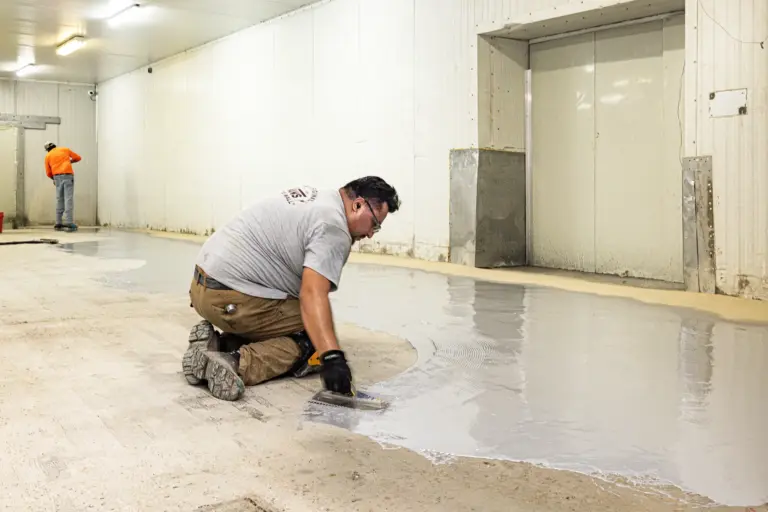
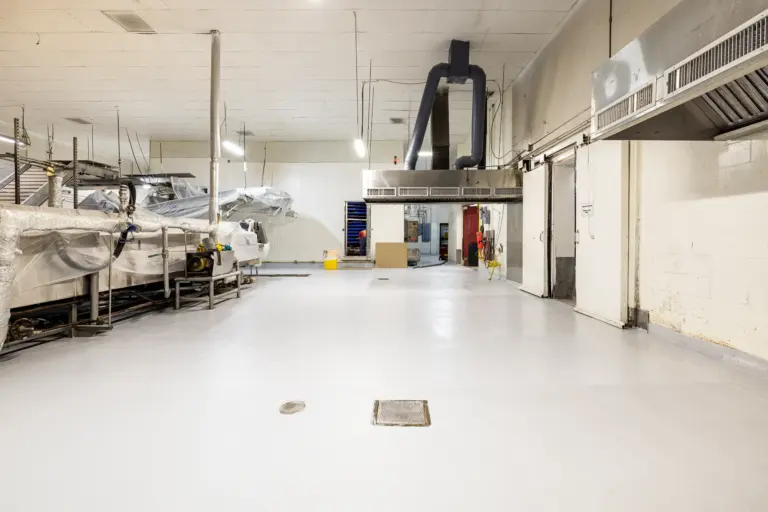
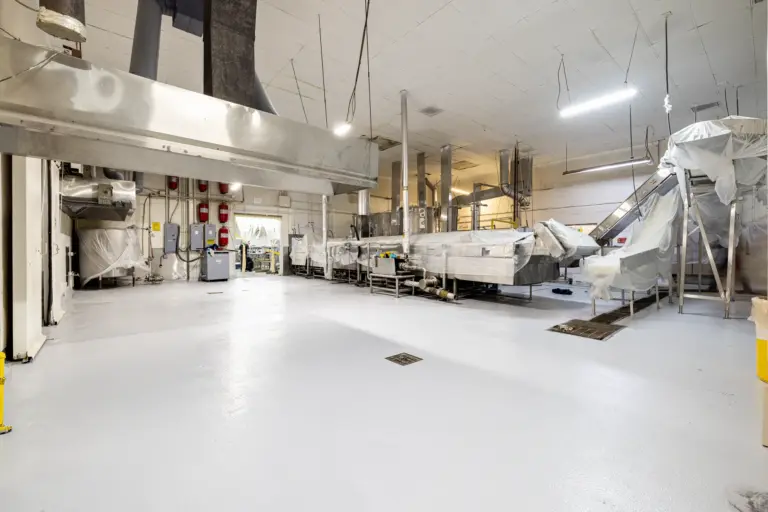
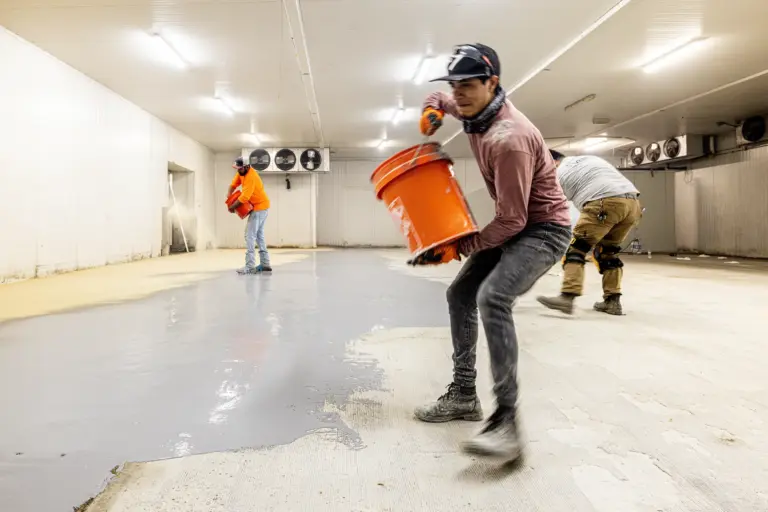
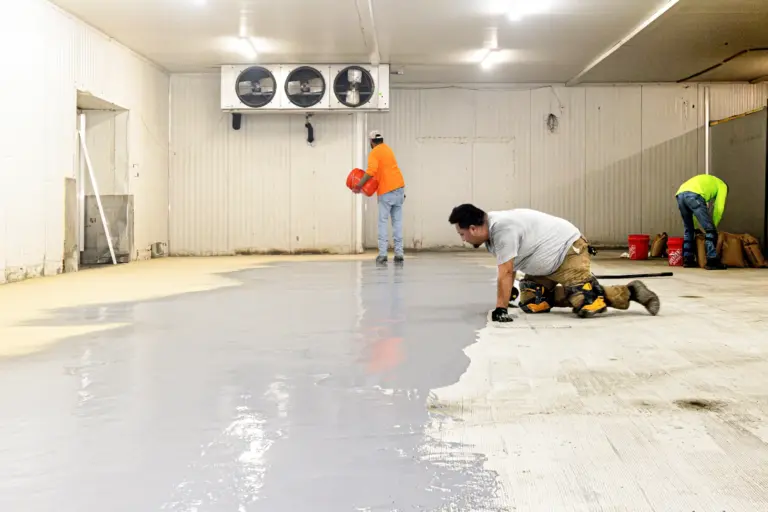
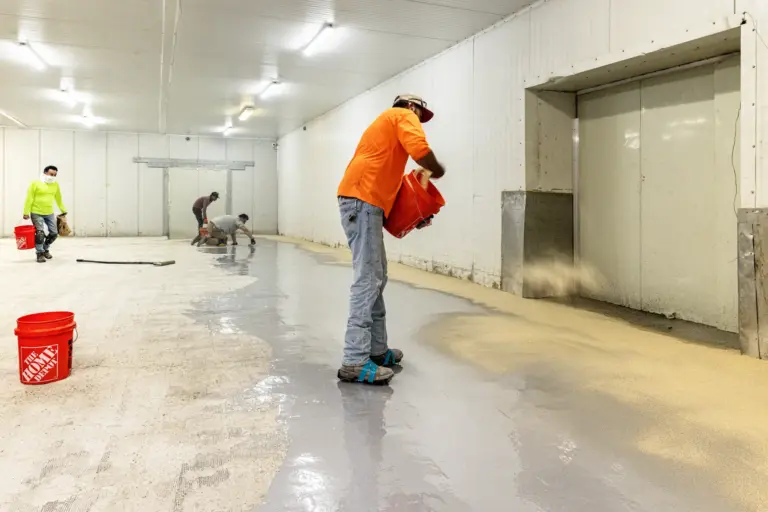
urethane Cement Installation Gallery
Request a Proposal
Submit project parameters for preliminary analysis. Commercial estimates typically returned within 24 hours.
Single-Night Replacement Around a Running Facility
A walk-in out of service is inventory at risk, which is why the replacement schedule is engineered backward from the 24-hour cure-and-return-to-service window of self-leveling urethane cement. On a production floor that window is a scheduling convenience; in a walk-in it is the difference between moving product once and losing it. Phased installation extends the logic across multi-box facilities.
Demo to Restock in 24 Hours
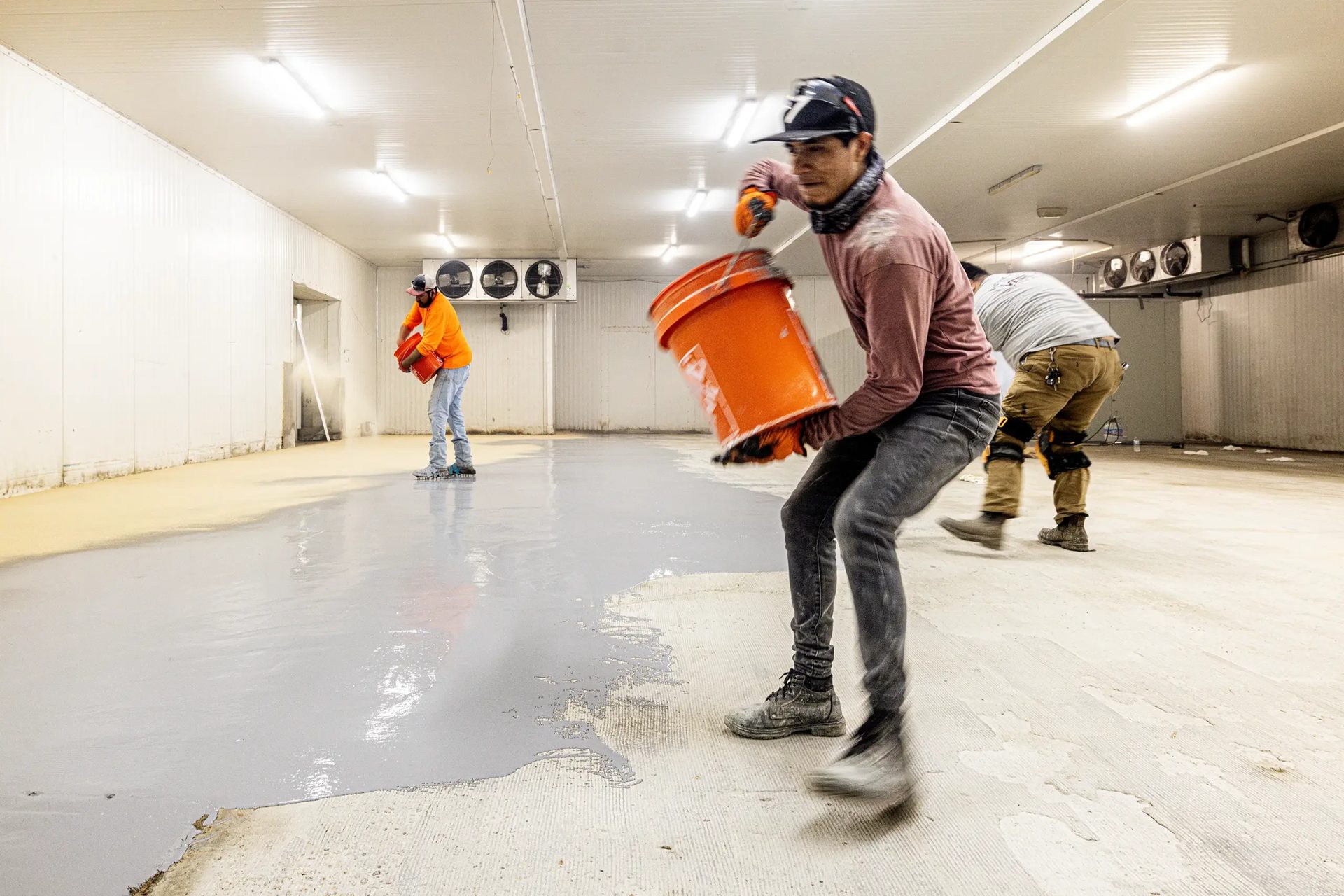
The overnight sequence runs product out to backup refrigeration, demo of the failed floor, profiling to ICRI 310.2, an ASTM F2170 moisture probe, and then the pour. Self-leveling systems take foot and cart traffic 24 hours after placement, so a box emptied Sunday night restocks Monday night. Multi-box facilities run one box per night, keeping the rest of the refrigeration footprint live while each floor cures. Most operators pick the lowest-volume night of the week.
Insulated Panel Floors Need a Wear Slab First
Urethane cement installs over concrete, which makes the substrate the first scoping question in any walk-in. Slab-built boxes are simple to scope. Demo the failed floor, profile the slab, pour. Prefab boxes on insulated tongue-and-groove panel floors need a concrete wear slab or a manufacturer-approved underlayment placed first, because the panel itself is not a substrate. We settle that at the pre-bid walkthrough instead of discovering it on install night, and new-box installs run the same sequence as replacements, minus the demo.
Where Walk-Ins Land in the $4-17/sqft Installed Range
Expect $4-17/sqft installed depending on project size, system thickness, and substrate condition. Project size dominates in a walk-in. A crew and its equipment cost roughly the same to mobilize for 300 square feet as for 3,000, so one night’s fixed costs concentrate on a single small box and push it toward the top of the range. The size-band breakdown lives on the urethane cement cost page.
What an Installed Urethane Cement Floor Does in a Cold Box
Thermal Movement — Why the Bond Survives Door Cycles
Urethane cement bonds chemically to prepared concrete and carries a thermal expansion coefficient close to the slab’s own, so when box temperature swings through door cycles and defrost, the mortar moves with the concrete instead of shearing against it. Door-cycle swings in a walk-in run 80 to 110°F between box and kitchen, well inside the category’s -40°F to 250°F operating range and 150°F+ thermal shock differential. Walk-in freezer flooring runs the same system on the service side of that range. A -40°F box sits within the category rating.
A Cooler Floor That Stays Walkable When It Sweats
A walk-in cooler floor sweats whenever humid kitchen air reaches it, and a wet, smooth floor is a slip claim on a schedule. Slip texture in urethane cement comes from the pour itself. Aggregate broadcast into the wet mortar sets the profile through the wear layer, so the texture survives scrubbing instead of wearing off like a grit additive in paint. Texture is specified to meet ANSI A326.3 (a wet DCOF of 0.42 or higher for level interior floors walked on when wet) and confirmed on a sample panel — 0.42 is the standard’s acceptance threshold, not a tested product number.
Food Storage Compliance — Cleanable by Construction
USDA and FDA inspection-ready comes down to a continuous, non-porous surface with no joint at the wall where residue can sit, and a monolithic pour with an integral cove base meets that by construction rather than by maintenance. There is no grout line to harbor anything. A box holding food answers to the production floor’s compliance logic at any square footage, so the system supports NSF/ANSI 51 food-contact requirements at the program level and slots into an existing HACCP sanitation SOP without a separate protocol.
W-2 Crews, One Contract, and the Closeout Package
Craftsman has installed industrial floors since 1999. The crews are in-house, manufacturer-certified installers, not labor assembled the week of the job. In-house W-2 crews provide national service coverage, which is what turns a 50-store rollout of walk-in floor replacements into one program under one contract instead of fifty separate subcontractor negotiations. We install as a Sika Certified + Authorized Sherwin-Williams High Performance Flooring installer. Every box closes with documentation: the ASTM F2170 moisture log, ICRI 310.2 profile verification, and cove completion photos in an audit-ready closeout package.
Knowledge Center
Resource links
Industries Served
Technical Performance
Selection & Standards
Sherwin-Williams Poly-Crete Systems
Sika Ucrete Systems
Cost, Comparisons & Legacy Names
Frequently Asked Questions
Expect $4-17/sqft installed depending on project size, system thickness, and substrate condition, with a single small box pricing toward the top of the range because one night’s mobilization concentrates on a few hundred square feet. Multi-box and multi-site scopes pull unit pricing back down. The full size-band breakdown lives on our urethane cement cost page.
A poured urethane cement floor, because freezers kill the alternatives at their seams. Water gets under mats, overlay panels, and tile grout, freezes, and lifts the floor, while a monolithic pour has no seam to let water in. Installed systems carry a 15-20+ year service life, with the manufacturer warranty preserved through documented installation. The one qualifier is substrate. The system needs concrete beneath it, so panel-floor boxes take a wear slab first.
Yes. The facility keeps running while the box comes offline overnight. Product moves to backup refrigeration, demo and pour run after close, and the box restocks 24 hours after the self-leveling pour goes down. Most operators schedule the work for the lowest-volume night of the week.
Only over concrete, so an insulated tongue-and-groove panel floor needs a concrete wear slab or a manufacturer-approved underlayment placed before the pour, because the panel itself is not a substrate. Slab-built boxes skip that step, with the existing floor demoed and profiled to ICRI 310.2. We settle the build-up question at the pre-bid walkthrough, available based on project requirements, timing, and resource availability, with remote spec review standard for multi-region rollouts.
Because a refrigerated slab never fully dries. It runs below the dew point of the room around it, so condensation forms on the surface while vapor drives up through the concrete, and both loads meet at the bond line of a rigid, vapor-impermeable film. The door threshold accelerates the failure, since every swing cycles the surface between kitchen air and box temperature. Urethane cement holds in the same conditions because its thermal expansion coefficient sits close to concrete’s, so the bond moves instead of shearing.
One night to one day on site for typical 100 to 2,000 square foot boxes, on a lead time of 1-3 weeks from contract execution, driven by material availability. Self-leveling systems take traffic again 24 hours after placement. Multi-box facilities phase the work one box per night so the rest of the refrigeration footprint keeps running.
A walk-in holding food is evaluated on the same cleanability logic as the production floor, which means a continuous, non-porous surface with no harborage joint at the wall. A monolithic urethane cement pour with an integral cove base removes the grout lines and the floor-to-wall seam where boxes usually fail, supports NSF/ANSI 51 food-contact requirements at the program level, and slots into an existing HACCP sanitation SOP without a separate protocol.
In-house W-2 crews provide national service coverage, and Craftsman has installed industrial flooring since 1999. Single-box replacements and multi-site rollout programs run on the same employee crews and close with the same audit-ready documentation package.
Blog
ESD Epoxy Flooring Case Study: 34,000 SF Dallas, TX
Residential Terrazzo Floors in Fort Worth, Texas